
If you read a lot of horror literature because you like to be scared, then you’re probably a normal, healthy person. If you read horror literature to fulfill some deeply personal predisposition, be assured there is probably something odd and unwholesome about you. Don’t ever let anyone tell you it’s not all right to be that way.
People interested in horror fiction and horror movies often encounter two common questions, or variations on them:
“What is there to enjoy in being horrified?” (often expressed as: “Why do you like that awful stuff!?”)
and, a bit less frequently,
“What is horror?”
The latter is ostensibly the subject of a recent episode of the Against Everyone with Conner Habib podcast, where the hosts of the Weird Studies podcast are guests. The conversation mostly ranges beyond the title question, “What Is Horror?”, to ideas closer to the more common question of what one likes (or finds interesting) in horror rather than exactly what is or (just as important for any definition) what is not horror. This is probably for the best. Certainly, it makes for a more interesting conversation than would have occurred if they had kept trying to nail down a definition. I tend toward Samuel Delany’s idea (see Starboard Wine) that an overdetermined phenomenon like science fiction (or, in this case, horror) can be described but not defined.
Perhaps more interesting than the question “What is horror?” is the question “Why horror?” — and that’s a question the podcast takes in some interesting directions, exploring not just the attractions of horror stories and movies, but the affordances: what can horror do.
While listening to and then afterwards thinking about this podcast episode, I realized that one of the key attractions for me of horror is also one of the key attractions for me of a Zen Buddhist worldview and philosophy. Both allow a grappling with significant questions of suffering and with the fact of change and impermanence in the universe.
However, as I listened, I also realized that I am deeply at odds with the podcasters because they disparage a materialist understanding of the universe and I do not. Again and again, their spiritualistic metaphysics causes them to assert limits to materialist ethics and aesthetics that I don’t believe exist — but seeing beyond those limits would require them to make some sympathetic thought experiments that they seem unwilling or unable to make.
In the end, though, while our perceptions of existence and reality are different, I don’t think we get to fundamentally different places regarding horror. And that is interesting.
Impermanence & Tragedy
In the midst of watching a really scary movie, we must ask ourselves at some point, “What would it feel like for this to stop?” And we may even speculate about the world of the story that gives us this horror, might begin to think: what would it take for this world to be less horrifying?
Horror can work in a way that Schopenhauer saw tragedy as working:
Our pleasure in the tragedy belongs not to the feeling of the beautiful, but to that of the sublime; it is, in fact, the highest degree of this feeling. For, just as at the sight of the sublime in nature we turn away from the interest of the will, in order to behave in a purely perceptive way, so in the tragic catastrophe we turn away from the will-to-live itself. Thus in the tragedy the terrible side of life is presented to us, the wailing and lamentation of mankind, the dominion of chance and error, the fall of the righteous, the triumph of the wicked; and so that aspect of the world is brought before our eyes which directly opposes our will. At this sight we feel ourselves urged to turn our will away from life, to give up willing and loving life. But precisely in this way we become aware that there is still left in us something different that we cannot possibly know positively, but only negatively, as that which does not will life. Just as the chord of the seventh demands the fundamental chord; just as a red color demands green, and even produces it in the eye; so every tragedy demands an existence of an entirely different kind, a different world, the knowledge of which can always be given to us only indirectly, as here by such a demand. At the moment of the tragic catastrophe, we become convinced more clearly than ever that life is a bad dream from which we have to awake.1World as Will and Representation volume 2, Ch. 37 (“On the Aesthetics of Poetry”), trans. E.F.J. Payne, 1958, Dover Publications, p. 433
Schopenhauer goes on to say that this tragic effect must inevitably lead us toward resignation, since our realization is that “the world and life can afford us no true satisfaction, and are therefore not worth our attachment to them“2World as Will and Representation volume 2, Ch. 37 (“On the Aesthetics of Poetry”), trans. E.F.J. Payne, 1958, Dover Publications, pp. 433-434, but it seems to me other choices are possible. Yes, one could respond to the revelations of horror or tragedy in the manner of Eeyore, but moping and moaning is hardly the only option.
Schopenhauer is right that the fierce, unblinkered eye of horror or tragedy gives us a vision of a world from which we want to awake, and that vision proposes its opposite (“an existence of an entirely different kind, a different world”) — but we do not have to be resigned to the impossibility of such a world. Instead, we can choose to think about what we may be able to do to bring such a world closer to reality.
It’s important to note here that Habib, Ford, and Martel are all people of some religious conviction — Habib and Martel with their own forms of Christianity (for Habib, via Rudolf Steiner and Anthroposophy), Ford with Zen Buddhism. Beyond their theological convictions, they are also critics of materialist conceptions of the universe.
While my own worldview is deeply influenced by Zen Buddhism, I am not a practicing Buddhist and generally describe myself as not a Buddhist but also not not a Buddhist. It’s the religion I’m most comfortable with, the religion whose texts and history I have studied most of any, though not in any particularly scholarly way. But I also don’t see much evidence for a spiritual dimension to the universe. I am attracted to the aesthetics and history of occultism, to the ways people have used the occult to steal philosophy, art, and even politics from the rich and powerful; I love tarot cards; but I can’t say I believe in any of it. My beliefs are something like a classical agnosticism, one with a whiff of Platonism: I expect (believe?) the universe is far beyond our ability to understand it, and I believe (expect?) that what we can know of the universe is not much better than what a mosquito can know of it.
Such beliefs, I suppose, put me in conflict with materialists who believe that we can figure out the clockwork of reality. I don’t believe that for a second (nor do I believe reality is like clockwork, or like a computer, or “like” anything we can conceive). I am quite comfortable with the idea that various concepts get at various elements of our experience of consciousness, nature, and what we perceive to be reality. Some of my best friends are witches.
But I am definitely not as open to spiritual ideas as Habib, Martel, and Ford. In fact, though I do listen to both the podcasts the three are responsible for, and am currently a subscriber to Weird Studies and a past subscriber to Habib’s podcast (it got too Christian and New Agey for me to want to keep sending money), I have to work hard not to groan sometimes at how credulous the three sometimes seem to me to be.
Knowing & Thinking
First, there is the (I think generally accurate) idea that Lovecraft’s fiction presents the intrusion of another world into our own, and that intruding world is radically unknowable.3Whether it’s actually another world intruding into ours or it’s simply other, previously unperceived aspects of our world becoming briefly apparent might be something to argue over, but it’s not a point important to this discussion. Phil Ford points to the overlap between scientific reasoning and theological propositions: both suggest a way of understanding and knowing reality. What that reality is, and what is knowable or unknowable about it, depends on the type of science and the type of theology, but it is a basic premise of both that we can know true things, that we can know how things work and why they work, and that there is cause and effect and there might even be intentions, motivations. The differences, of course, are about what things are true, what we know about how and why things work, and what sorts of causes and effects matter, and who or what (nature, deity) has intentions and motivations that can shape reality.
Lovecraft proposes a universe that, yes, has its own reasons, causes, effects, and laws … but he proposes that humans may be unable ever to know what those reasons, causes, effects, and laws actually are because it is so alien from us, so indifferent to us. Speaking of Lovecraft, Ford says, “But what if there were an order of being that on a fundamental molecular level we have nothing in common with? A kind of cosmic tissue rejection, and if we tried to lodge ourselves in that realm, we could find no place in it. We couldn’t understand anything that we found there.” This is the idea behind a lot of Lovecraft’s fiction, although in the development of that fiction we also see that Lovecraft can’t escape his desire to explain and understand (which is why, I must admit, most of what Lovecraft wrote in the 1930s I find less compelling than his earlier, more mystical writing; his turn to science fiction seems to me unfortunate. I’m with Ligotti: “The Music of Erich Zann” is the perfect template; I would also add “The Festival” and “The Outsider”). A radically unknowable universe is among the sublime frights Lovecraft offers.
So far so good. But then comes the idea of The Absolute.
J.F. Martel links Lovecraft with Immanuel Kant’s idea of the-thing-in-itself (as opposed to the thing as appearance). The Stanford Encyclopedia of Philosophy has a good definition: things in themselves “are absolutely real in the sense that they would exist and have whatever properties they have even if no human beings were around to perceive them.” Martel asserts that, according to the ideas of Henri Bergson, the thing-in-itself is knowable … but not thinkable. (This may be similar to Timothy Morton’s idea of the hyperobject, which we can know parts of, but which is too large for us really to hold in our minds.) Martel says that this is the opposite of Kant and Lovecraft, for whom such an absolute thing is thinkable (we can conceive of it) but not knowable. He brings in animals here: “When you look at animals interacting with the world, you’re seeing creatures interacting with the absolute. They don’t have a representation in their minds of the world. They’re simply interacting with it in a kind of direct way.”
This seems to be what Martel himself believes, and Ford and Habib seem to agree. The rest of their conversation is often premised on this idea of the absolute being knowable — we interact not with representations of things, but with things in themselves. Even if we can’t grasp (think) everything about them, we are still nonetheless about to know that there is something with which to interact and how to interact with it. We can know them but not fully conceive of them, maybe not fully understand them.
Myself, I don’t agree that there needs to be a strict separation between knowing and thinking, but if forced to choose I would say I believe the opposite of Martel, Ford, and Habib about it: I have no trouble thinking about the absolute and no ability to believe I, you, or anybody else has access to it, if it even exists. (In that way, I guess I’m just a Kantian, though I’ve mostly found reading Kant to be a good cure for insomnia. Actually, I’m probably more a Humean, but that’s a topic for another time.) However, I recognize that the idea of the absolute being knowable but not thinkable is a perfectly legitimate philosophical position, one going back centuries and maybe millennia. What’s interesting to me is how it affects one’s perception of horror.
In 2022, I wrote a long post about horror and belief, which gets at some of the ways our beliefs affect our understanding of what is and is not horrifying.4That post is very much a companion to this one, as it also draws from podcasts by Conner Habib, Phil Ford, and J.F. Martel. Obviously, while I come at things from a different perspective than they do, and have some disagreements with a few of their conclusions, their approach to horror and weirdness is one I find useful, productive, and stimulating. For example, to be scared by a ghost requires some beliefs about what ghosts are or might be. Very few things are universally horrifying, even death. (I, for instance, have no fear of death. I have much fear of pain, and so I fear a violent death or a long disease or something like that, but death itself seems like something to look forward to as a relief from the suffering that is existence.) The range of people’s beliefs is especially challenging for any horror that is about more than jump-scares and jolts to the old reptile brain.
Let’s return to Martel’s statement about animals. “They don’t have a representation in their minds of the world,” he says. But how would he know this? (Studies of crows suggest they have something like a theory of mind…) Beyond the vexing question of how we can know anything about an animal’s consciousness, how could Martel know that animals’ interactions with the world are direct ones, not mediated by mental representation? This question returns me to my inveterate agnosticism, my tendency to think we can’t actually know much of anything for certain, certainly not about the minds of nonhuman animals. (I suppose I write fiction because I think it’s almost impossible to know much about the minds of human animals. I write fiction to keep trying to find some of that imaginary knowledge.) What we can know is behavior.
Immediately, Martel brings in theology: “You can know the divine, but you can’t think it,” he asserts forcefully. This, from a believing Christian, is an argument for faith. He says: “If you are attached to the way you know things, to the concepts by which you know the world, then the absolute will be the most horrific of horrors. But if you were to let go of your conceptual grasping, then you could live in the knowledge you have, which exceeds your own intellection of the absolute.” On one hand, I agree — there is more to heaven and Earth than is dreamt of in our philosophies, etc. etc. But does the vastness of the universe require an absolute?
Martel’s statement is premised on the idea of the absolute as knowable — the way you know things may be proved wrong by knowledge of the absolute. But does he mean knowledge? And what does he mean by it? I am comfortable, perhaps because of my fundamental agnosticism, saying I can know basically nothing about the universe. This, of course, is itself a knowledge claim, a claim to know that nothing can really, fundamentally be known, because we are trapped in our very limited sensorium. But Martel is not going in that direction. He says: “That’s the path that, that’s where I choose to go for myself as a Christian, but also just as someone who at some point in their life decided that trust in the real was the way I would go.”
I’m not sure I fully understand what he’s saying here, and even less am I sure his following claim about finding Thomas Ligotti’s nihilism comforting and attractive, but if I get the point, it is that he has chosen to believe that knowledge of the absolute is possible and real, even if the absolute itself exceeds our understanding or perception. Against Ligotti, Martel chooses God and Christianity. That’s fine — religion of some sort is what most people choose as a path away from the horror that is existence — but it’s not knowledge. It’s choice and faith.
Later, Martel, Ford, and Habib recoil from the pessimism and materialism of thinkers like Ligotti because, in their perception, it renders both morality and the sublime impossible. This is a common critique of anything that gets labeled nihilism (a label which itself is pretty much void of meaning at this point), but I think the critique is flawed and generally leads to unsupportable, deeply prejudiced conclusions.
This turning away from the implications of pessimistic materialism is understandable, maybe even virtuous. Even Schopenhauer, that pessimist of pessimists, at times seemed horrified at his conclusions and desired to escape them. In Dark Matters: Pessimism and the Problem of Suffering, Mara van der Lugt spends a lot of time with Schopenhauer and points out that in the Parerga and Paralipomena especially he has “theodician instincts” and “ends up following precisely the argumentative structure of traditional theodicy”.5van der Lugt p. 370 Van der Lugt herself ends her long study of pessimism by turning away from it, toward something she calls “hopeful pessimism”, a topic she has explored in a more recent book. That’s fine, as far as it goes, but such thinking skirts the question of its necessity. There must be something beyond despair, van der Lugt and others say, but the only reason they can give for why there must be something is that they desire it to be so. Like J.F. Martel’s turn away from Ligottian pessimism, this is not logic, it is chosen belief.
And so we stand paralyzed with horror at the meaningless, unconscious, indifferent, despair-filled universe.
But must we? Is the only choice between a.) utter despair or b.) a universe of inherent meaning?
On the Virtues of Meaningless Matters
The conversation between Habib, Ford, and Martel shows the limits of a discussion between people of such similar worldviews, because they end up reinforcing each others’ assumptions. (Taking notes as I listened, I wrote at one point: “Like college dormmates drinking each other’s bong water.”) This is clear in their assumption that a materialist metaphysics or a denial of a meaningful absolute in the universe leads always to misery and terror, and it becomes most clear in their contempt for the idea that love (or any other emotion) is a bodily response without spiritual content.
Toward the end of the episode, Ford, Habib, and Martel raise the spectre of the people I think of as the Very Insistent Public Atheists (VIPAs) of the earlier part of this century — people like Richard Dawkins, Christopher Hitchens, Sam Harris — who were, indeed, mostly contemptible louts better at shouting than thinking. The podcasters identify that brand of fundamentalist atheism as a kind of nihilism, one to be horrified by. Phil Ford points to the
reduction of everything that makes life not just sweet, but tolerable at all. For example, love. The idea that love could be reduced to chemicals in your brain. The idea that beauty is merely a projection of values onto a universe that is as indifferent to us as Lovecraft imagines. (Lovecraft pioneered something of this form of horror.) The idea that music is just an idle noise, a kind of a wet fart that we make within this indifferent universe. That is very productive of horror when you see, for example, in a film, when you see those values reduce, just human beings reduce to meat, right? The reduction of the human body to just meat is analogous to the reduction of love to shit happening in your brain.
Martel says, a little later on, “Your love for your mom or for your spouse or for your friends might be biochemical, but your need for love can’t be interpreted as biochemical. It can be, but you can’t experience it. You can’t even intellectually reduce your need for love to biochemistry.”
Speak for yourself, dude.
The idea of love as a spiritual force is the basis of many ideas in multiple religions, and it makes sense that Christians like Habib and Martel believe it (they’d hardly be Christians if they didn’t!). But there’s no reason for us to accept that if love is nothing more (or less) than a phenomenon within a body (and often between a couple bodies), therefore it is not able to produce feelings of wonder, awe, and even something like transcendence.
Contra Martel, I can intellectually understand the human need for love as basically biochemical … but that doesn’t mean it is somehow minor or ineffective or even unnecessary. I see zero reason to view love or any other emotion as anything more mystical than a phenomenon of the nervous system and brain, one that often leads us to recognize and to some extent harmonize with phenomena in the nervous systems and brains of other people.6All sorts of things our brains and bodies do together can be both amazing and material — see, for instance, Annie Murphy Paul’s book The Extended Mind. Embodied love still produces an experience of powerful sensations, ones that often do feel mystical and transcendent, but just because something feels mystical doesn’t mean that it is mystical. As any magician, illusionist, or pickpocket can tell you, the human sensorium is limited enough to be easy to fool if you know the right tricks. Love knows those tricks well.
I’m not by any means insisting that people ought to throw away their spiritual beliefs; I am simply suggesting that we do not need to see the lack of spiritual beliefs as horrifying or contemptible, as Habib, Ford, and Martel seem to. Certainly, it produces no horror in me to think that everything I feel is my body’s response to some sort of stimulus, some elements of the environment that my body lives in and moves through. That actually seems pretty wondrous to me. Bodies are astonishing! (Also vexing.)
Extremes
Horror, in order to be real, for me, has to include this dimension of wonder. There needs to be a more than this feeling of the horror. The horror is not just the experience of a kind of finitude, but rather the finitude of a particular way of seeing that opens onto another, that opens onto something deeper or higher or whatever — but other. And I think that that’s the difference. If I were to try to pinpoint it philosophically, that’s where I kind of swerve between horror is my favorite thing and horror is my least favorite thing. It’s whether that the place of wonder is acknowledged, whether that one little corner of the field is left unplowed for the fairies. There needs to still be, and I think part of the art of horror is getting me as close to that moment of nihilistic finitude as possible, while also recognizing the opening onto wonder. If that can’t exist in the depths of true horror, then it can’t exist anywhere.
The conversation soon, briefly, moves to a discussion of the Marquis de Sade as the prototype or maybe king of this type of horror, which makes a lot of sense if you see these sorts of stories as based in cruelty and, well, sadism. As Martel says, his use of de Sade here is simplistic, but it’s also, and I expect intentionally, a quiet attack on atheists — since de Sade was famously a committed atheist, Martel can imply that atheists are closer to de Sade than to himself.7If you want a less reductive approach, see John Phillips’s Very Short Introduction to the Marquis de Sade for an overview; for more fun, seek out Angela Carter’s The Sadeian Woman.
Most of what Habib, Ford, and Martel talk about as horror is supernatural horror — the sort of horror that most easily and obviously lends itself to transcendence, since it is premised on there being something beyond what we understand of natural laws. We might be tempted to make a distinction, then, between transcendent/supernatural horror and mundane/nonsupernatural horror. This would fit with the idea that transcendence must always be a spiritual experience. But once we start thinking about examples, edges begin to blur.
Consider, for instance, The Texas Chainsaw Massacre.
Last year, writing about the film for its 50th anniversary, I said: “The Texas Chain Saw Massacre ends with the sublime. The greatest horror always does. Not just escape. If there is escape, it is not escape into the same world of the beginning of the story. Horror is about extreme emotion, about apex experiences. It is about ecstacy. About transcendence.”
Not too different from what Martel, Ford, and Habib say. Yet The Texas Chainsaw Massacre is not a supernatural movie. Grotesque and absurd and more mythic than realistic, certainly, but it is not supernatural.
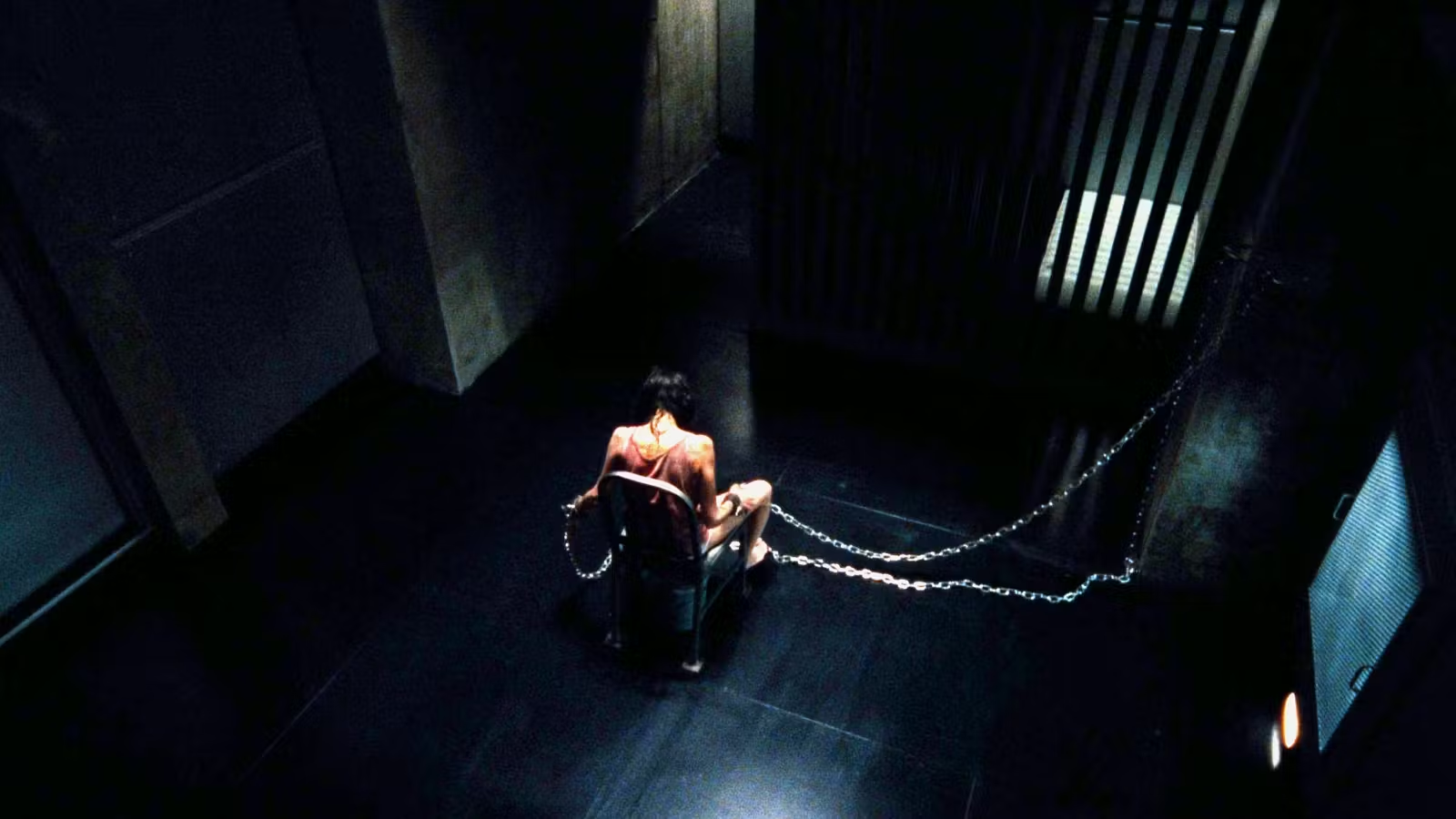
Though he hates the Saw and Hostel movies, J.F. Martel appreciates Texas Chainsaw Massacre, calling it during the episode “one of the great horror films in my opinion”. He is not put off by it in the way he is by Saw, Hostel, and other “torture porn” movies. He seems to have access to Texas Chainsaw Massacre’s transcendent power. I’m glad of this, but I don’t understand where he is drawing the line between these films, which, while artistically different, are functionally very similar. For Martel, what Texas Chainsaw Massacre does with sunlight is transcendent, but for some reason what Saw does with yellow and green lighting is not.
(Side note: I would honestly love to know what J.F. Martel, Phil Ford, and Conner Habib make of Pascal Laugier’s 2008 film Martyrs. I think the film is astonishing and also almost unendurable. It’s deliberately subversive and challenging, an attack on the church and on European history, but also in many ways an anti-transcendent film, a film that suggests that, under certain [capitalistic] circumstances, the desire for transcendence is conservative and irresponsible.)
If Texas Chainsaw Massacre can be seen as transcendent, then why not Saw, Hostel, etc.? In many ways, the question is too big for the moment, because it would require a close look at various films and a delving into the highs and lows of the “torture porn” category. (For that, see Steve Jones’s impressive, thoughtful academic study Torture Porn: Popular Horror After Saw.) However, while I’m not here to try to convince anybody to watch any sort of violent or disturbing movie if they don’t want to, I want to describe at least one way of finding transcendence and (dare I say it?) an artistic sensibility in films that seem otherwise mundane and even clumsy.
The early Saw and Hostel films are not as cheap and empty as their reputations might make them out to be — and certainly not in comparison to many of the films that tried to copy their popular success. They were made by filmmakers with particular points of view who continue to have solid, even distinctive careers: James Wan, Leigh Whannell, Eli Roth.8I don’t think the director of a lot of the Saw films, including III, Darren Lynn Bousman, has similarly distinguished himself, but I’m sure he has some fans. By saying that, I don’t mean to say I’m a fan, exactly (Eli Roth’s films are hit or miss for me; I do not like any James Wan-directed movies after Saw; Leigh Whannell has, for my money, done the most interesting work of the three — both Upgrade and The Invisible Man are strong films). Worth noting for this discussion: James Wan directed the first two Conjuring movies, which are some of the most blatant Christian propaganda in horror movies since The Exorcist.
What Martel, Ford, and perhaps Habib object to in what they think of as films like Saw and Hostel is a kind of presentation of bodies as mundane things-in-themselves. Reduction, as Phil Ford says, of everything to material: love to chemicals in the brain, music to idle noise in an indifferent universe, bodies to meat. This idea sounds good — who doesn’t want love, music, and bodies to give us access to the sublime?! — but as I showed in discussing love and brain chemicals, it’s not the only way of interpreting such things.
Whether music is anything different from noise (calling John Cage…) or whether bodies can be vehicles of spiritual awaking is a philosophical conversation for another day. Here I just want to suggest that these objections in fact do not apply in the way Ford and Martel at least assume they do for films such as Saw and Hostel.
For many viewers, I expect the effect of the extreme violence in such movies is to increase a sense of pity and maybe even sympathy. The Saw films in particular are about meting out justice, with most victims being people identified by Jigsaw or his followers as deserving pain and the possibility of death. (It is this possibility rather than certainty of death that allows Jigsaw to think of himself as not a murderer. Like most other human beings, Jigsaw excels at self-justification.) The effect of extreme violence against Jigsaw’s victims, though, is to remove them in many viewers’ minds from the realm of justice or injustice and to turn them not into meat but into suffering beings. This is in some ways the explicit message of Saw III, where Jigsaw gives a man with legitimate grudges against flawed, guilty people the opportunity to see those people tortured and killed unless he chooses to forgive them (his name is Jeff and I can’t help but think of the J in Jigsaw … and in Jesus). Once the guilty victims are suffering horribly, he really just wants their pain to stop, regardless of who they are and what they did.
By emphasizing the capacity of these bodies to suffer, the films do not, despite what Phil Ford says, turn them into nothing more than hunks of meat — quite the opposite. Or, if they are simply meat, they are meat like a cow being slowly hacked apart while it is still alive rather than like the nicely butchered bits of cow we buy at grocery stores. Most people would not want to eat a hamburger made from a cow slowly tortured in front of them, because the act of slowly torturing the cow reveals the cow to be a suffering being, and most people (unless they have a significant neurological difference from the norm or have been trained away from empathy by something like the military or a traumatic upbringing) do not like suffering beings to continue suffering. This, it seems to me, is an ethical good. We should not delight in suffering.
That difficulty with watching suffering is the hallmark of extreme horror. Suffering is what we most want to turn away from. Tragedians and theologians have, for most of recorded human history, known the power of such imagery to inspire pity and terror — and to then inspire the desire to do something to alleviate the suffering. “Make it stop!” is, in fact, an ethically positive human response.
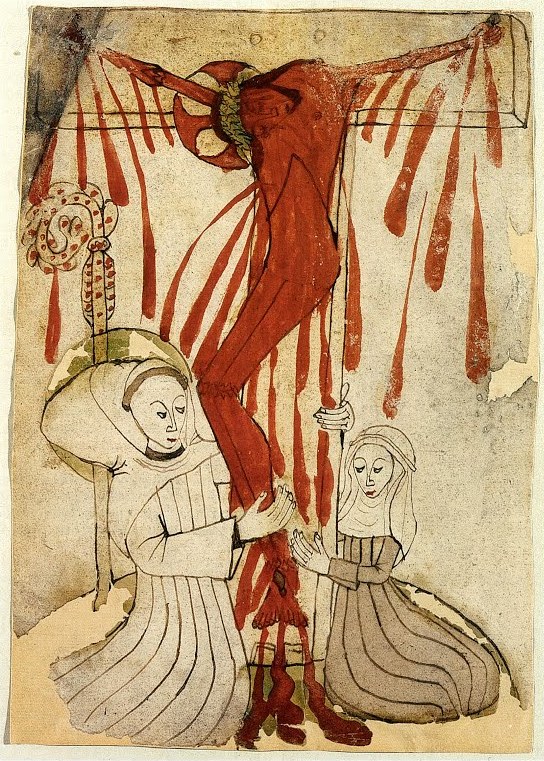
Nobody who accepts churches displaying bloody crucifixes should be complaining about the violence to bodies in these movies or arguing that such violent displays preclude any sense of transcendence.
Much popular horror fiction works like medieval morality plays, and the Hostel and Saw movies especially so. But morality plays are philosophically simple and morally unambiguous; their power is in the reiteration and reassertion of moral ideas the audience is already familiar with, ideas of good and evil, of heaven and hell, of justice. Especially in times of social and moral uncertainty, audiences crave morality plays. (We see this in literary and film discourse today.) Using the morality play structure to work against familiar morality is disconcerting, destabilizing. Such narratives become most disturbing when they suggest that not only is conventional morality flawed, its foundations may be delusional, may quickly melt into air.
Media scholar Kathryn D. Coduto did a content analysis of the Saw films and found that they do not “adhere to the just world hypothesis: some individuals get what they deserve, some do not. Violent set pieces and unjust outcomes are hallmarks of the Saw franchise.” In complaining about nihilism, it seems that what most repels Martel, Ford, and Habib is this rejection of a just universe.
Or perhaps their objection, rather, is that the suffering depicted in films such as Saw and Hostel does not seem to them to have a purpose beyond simply the depiction of suffering. The Passion of the Christ may be torture porn, but at least it depicts a guy suffering for the sins of all humanity.
Suffering in an unjust, amoral, indifferent universe is only suffering. Where’s the meaning in that?
Suffering Ethics
I do not need to believe in a moral universe to believe that suffering is bad and it is good to try to relieve it. Suffering itself can lead us to empathy and to solidarity. Whole structures of politics and morality can be extrapolated simply from the desire to lessen suffering in the world. Some of those structures might be ones any individual person will judge as satisfactory or will find wanting, for instance structures that resemble utilitarian thinking (most prominent these days in Effective Altruism and Longtermism). I am not arguing that a concern for suffering alone can lead to inadequate solutions. I am arguing that inadequate solutions are not inevitable. A concern for the suffering of sentient beings can be a path toward meaningful ethical engagement with a meaningless universe.
Ford, as a Zen Buddhist, should be able to offer a non-Christian view of extreme horror’s aesthetic and ethical effects. We could, for instance, see the world of “torture porn” as samsara, the realm of suffering that comes from attachment to a transient world. In Buddhism, people don’t suffer because they are sinful; they suffer because they want to keep what can’t be kept: the evanescent, fleeting stuff of life.
Which brings us back to flux, a topic raised earlier in the podcast episode. The doomed nature of beauty (and everything else). The inescapability of change.
Habib paraphrases Goethe, saying, “Nowhere do we find permanence, repose or termination. We find rather that everything is in ceaseless flux. So, what you guys are talking about, in a way, is being able to distinguish between good and evil in ceaseless flux. How do I relate, myself, to flux in a way that shows me what’s horrific and what’s nourishing?” For me, this is why even clunky, unsatisfying horror stories are more interesting than other types of stories: what’s horrific is what causes suffering, and, like Buddhism, horror stories are all about suffering.
What’s horrific? Suffering. What’s nourishing? Liberation from suffering.

Our conversation before about basically the ungraspability of time, finding yourself in a flux that permits no stable point, nothing stable you can grasp — reminds me very much of the koan in the Mumonkan: “The past is ungraspable, the future is ungraspable, the present is ungraspable.” And of course, this is from the mystics’ point of view. (Of course, most Zen Buddhists don’t like being called mystics, but whatever!) This is actually a radiant truth. But it also is abyssal horror from another perspective.
There is a slight misremembering here that is worth noting.
The statement that Ford quotes as a koan appears in the commentary on case 28 of the Mumonkan or Wu-men Hui-kai, a text whose title is notoriously untranslatable, but which usually makes its way into English as something like The Gateless Gate or The Gateless Barrier. The statement itself, though, is older, certainly no more recent than the Diamond Sutra, which is what the commentary refers back to; it appears in that sutra at the end of Ch. 18. I like Ford’s memory of it — its minimalism appeals to me — but every version I have seen it translates it as past, present, future mind is ungraspable.
Closest to Ford’s memory is the edition of the great Shobogenzo (Treasury of the True Dharma Eye) of Dogen edited by Kazuaki Tanahashi, where it is quoted at the beginning of Ch. 19: “The past mind is ungraspable. The present mind is ungraspable. The future mind is ungraspable.”9Other translations I have on hand are to some extent or another farther from this. The Lian Sheng translation of the Diamond Sutra chapter that I linked to makes it: “Subhuti, the mind of the past is unattainable, the mind of the present is unattainable, and the mind of the future is also unattainable.” Red Pine, in his translation of the Diamond Sutra, goes with: “Subhuti, a past thought cannot be found. A future thought cannot be found. Nor can a present thought be found.” Katsuki Sekida’s translation of the Mumonkan renders it: “The past mind cannot be held, the present mind cannot be held, the future mind cannot be held.” David Hinton, generally a very efficient and even ascetic translator, gets a bit wordy in his version, though it’s lovely: “Mind done and gone cannot be realized. Mind now aglimmer cannot be realized. Mind yet to come cannot be realized.” I wonder if the discussion’s disparagement of perception as the limit of knowledge could have influenced Ford’s misremembering — the past, the present, and the future are so much vaster and more open to spiritual interpretation than the past mind, the present mind, the future mind. (Was the Buddha a Kantian?)
More importantly, I realized when listening to him that Ford had identified one of the primary attractions of horror for me — maybe the primary attraction, and a key element in whether a horror story feels meaningful and valuable or not: the vertiginous feeling that comes with being reminded of how vast and empty existence is.
I mean empty in as much a Mahayana Buddhist sense as a literal one. In fact, for me it is the Buddhist idea of emptiness (which proposes the emptiness of individual things and ideas because all things and all ideas are interconnected, interdependent) that answers and replaces the conventional idea of emptiness and prevents the kind of annihilating nihilism the podcasters reject. Horror stories at their best (for me) invoke the basic idea of emptiness/nothingness, the horror of the vacant abyss, and then provide the material to glimpse the interbeing that is Mahayana emptiness. Science fiction can achieve this with its vaunted sense of wonder, or even with famous ideas such as the butterfly effect of Ray Bradbury and chaos theory — SF doesn’t start from the same place as horror does, the place of embodiment in a suffering being. By invoking anxiety, fear, and disgust, horror reminds us that we are nervous systems. Horror builds outward from there.
This is not so different from what Habib, Ford, and Martel describe as wonder or transcendence. My difference from them is that I do not believe it requires us to give up materialism. (“I” do not exist; I am the person-effect of a body that includes a nervous system and brain.) Certainly, as the podcast episode amply demonstrates, the view of horror as abyssal is fully open to a spiritual interpretation, but there is nothing in the Mahayana idea of emptiness, as I understand it (likely incompletely, inadequately), that requires the leap to spiritual faith.
A Scene from an Unjust Universe
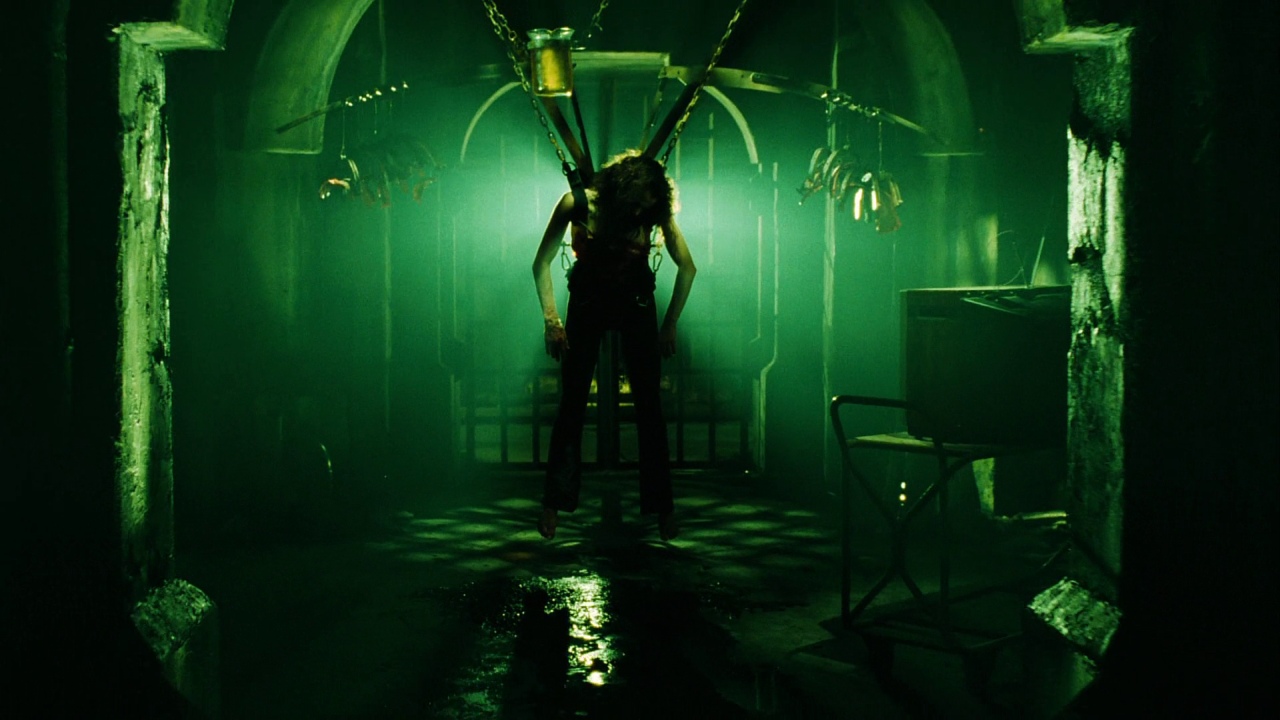
Detective Kerry was an important character in the previous film, and so the filmmakers give her a memorable send-off in this one. The artistic and the horrific meld here; one of the reasons I thought of Hannibal is that that show was, among other things, a sustained exploration of just such melding. The torture and murder are designed for a specific purpose, and, in the context of the film, the design serves as a moral lesson. That moral lesson is one intended by the designer (“Your fellow police officer caused my suffering, and you are doggedly pursuing my mentor/father-figure, therefore you must suffer and die”), but then, at the end of the film, it becomes a lesson for the designer about breaking the rules of Jigsaw’s ethical-aesthetic system. Kerry’s death was designed by Amanda Young, Jigsaw’s protégé, but Amanda is simply full of anger and a desire for vengeance against the world, not, like Jigsaw, a desire for justice (however perverted that idea of justice may be). Detective Kerry had no chance to live. Amanda was not, in Jigsaw’s view, playing fair — or, more importantly, offering a sinful person a chance for redemption. This ends badly for Amanda.
Detective Kerry is not simply a body as meat; she is an aesthetic and moral statement by both the movie and the murderer, though their statements are different ones. The movie takes a certain pleasure in and offers something like beauty from the torture and death, but it does so from a position of respect. Within any work of extreme horror, how someone dies is at least as important and meaningful as whether they die. Detective Kerry is a valued character and therefore gets the honor of a memorable death. Especially if we’ve seen Saw II, we like Detective Kerry. She has faults, but she’s dogged and smart. We’re not Amanda, not wishing her to suffer and die. We know she has the fortitude to pull a key from a jar of acid. We’re cheering her on. That she does everything right and still fails is, indeed, a violation. We don’t like it! But we are not in a just universe.
Amanda’s acceptance of not living in a just universe, her refusal of any possibility of redemption or forgiveness, seals her own fate, because Jigsaw’s work is a protest against the universe’s failure to be more just and forgiving. Amanda, in her design of Detective Kerry’s torture, reveals herself to be no different from anything else in that universe which does not bend toward justice. Jigsaw — in his grotesque, terrible, and distorted way — is imposing meaning onto the matter of existence. There is a lesson in that, too. Be careful how you find meaning, because you could end up becoming someone like Jigsaw.11This is not always coherent through all the films, but I’m really just thinking about the first three Saw films here, since they are basically telling one story together.
The moment that, for me, sets the scene of Detective Kerry’s death apart from more mundane scenes is the moment where she realizes the game is rigged against her. We see her from the back. She raises her arms up and grasps the chains. It feels like some sort of strange religious painting, the depiction of a moment of martyrdom. Having done all she was supposed to do, having fought against her circumstances, she now accepts her fate. She relinquishes any pretense of power. She (quite literally) lets herself open to the world. And transforms.
Ciphering Horror
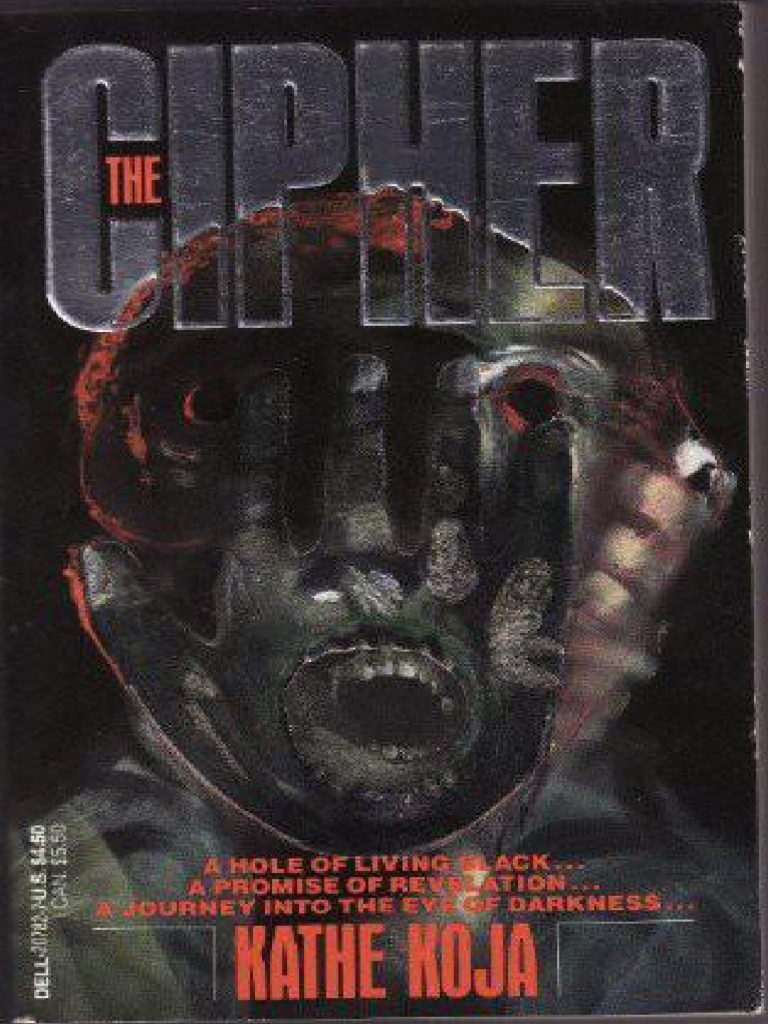
Like many horror novels, The Cipher could have been a whole lot shorter — but in this case, the ongoing length is its secret weapon. Yes, it’s sometimes tedious, sometimes repetitive. But that’s the point. It grinds you down. In this way it is similar to the film I Saw the Devil. It goes on and on, daring you, the reader or viewer, to close the book or turn the movie off — to make it stop.
In an astute and even thrilling academic article about Koja’s novel, Steven Shaviro writes:
The Cipher never offers us any causal or narrative explanation for the monstrosity it recounts. It does not allow us to characterize its supernatural events in terms of good and evil. It does not allow us to read it as social allegory. It does not offer us any scenario of the ‘return of the repressed’: there are no secrets to be uncovered, no debts to be paid, no crimes to expiate. In consequence of all this, it also does not move toward any sort of catharsis or revelation.
We get trapped in the obsessive consciousness of the narrator, Nicholas, a vaguely aspiring poet who works in a video store. He is not in any way an appealing or especially sympathetic character, but the narration is vivid, pushing our reading ever forward even as, during a first reading, we recognize that we might not be going anywhere on a standard narrative arc, might be trapped in repetition and compulsion, might not be doing anything except circling back and back again (in what Shaviro calls “a logic of unsteady yet relentless intensification”) around the fulsome nothingness that is “the Funhole” that Nicholas and his girlfriend, Nakota, discovered in Nicholas’s apartment building, an absence that is both attractive and disturbing and, in the best tradition of weird fiction, so beyond human understanding that it is only describable via negations and approximations:
Not darkness, not the absence of light but living black. Maybe a foot in diameter, maybe a little more. Pure black and the sense of pulsation, especially when you looked at it too closely, the sense of something not living but alive, not even something but some — process.
What horrors the Funhole perpetuates are not its alone. After some experiments, Nakota realizes this. Describing her encounters with it, she tells Nicholas: “nothing happens. It just sits there. It doesn’t have a smell, it doesn’t — it’s not active without you, Nicholas. You’re a catalyst.”
This is the truth of all narrative, all fiction: nothing happens without a reader to imagine the words into life, to give meaning, to interpret.
The same might be said of the universe. It’s just there. But as with the Funhole (and, in some ways, The Cipher itself), we can recognize that there is something there, something happening, something changing, but it is beyond our ability ever to know or understand. Contemplating the universe, we obsess over its refusal to conform to our expectations, we fear its power to annihilate, we fixate on its mysteries, we yearn for its regard. But that’s all on us. And we’re probably only marginally any better at anything than Nicholas, all things considered. A cockroach crawling around the Funhole knows as much about it as he does, as we do.
At the end of The Cipher, Nicholas asks: “What if somehow I’m crawling blind and headfirst into my own sick heart, the void made manifest and disguised as hellhole, to toil in the aching stink of my emptiness forever?”
A good question for us all.
Make It Stop
I’m not interested in philosophy. Just tell me how it ends.
—Len Jenkin, Dark Ride
Let’s return to that most interesting question, “Why horror?” Or: “Why this kind of horror?”
Why read a novel like The Cipher, populated entirely by unpleasant characters, centered on a mystery that can never be solved?
Why watch a movie like Saw III or even Texas Chainsaw Massacre (which even if it is a masterpiece is hardly pleasant to sit through)?
In his podcast with the Weird Studies guys, Conner Habib discusses Dennis Cooper’s 2004 novel The Sluts (which won the Sade Prize). It’s not a novel I had ever thought of as horror, but it certainly is horrific, and achieves an alienating effect similar to that of The Cipher. (I would love to see a seminar of brave students tackle The Cipher, The Sluts, and Samuel Delany’s The Mad Man.) Habib says The Sluts is “so upsetting because you feel completely implicated with what’s happening in the book as you read it, because it’s so awful and … and you notice a prurient interest in yourself as you read it, and so you therefore start feeling responsible for this book existing, and it’s really like, really upsetting.” It is upsetting because it forces you as the reader to confront something in yourself, something you perhaps did not want to confront — or maybe you did, because you picked up this book, you kept reading even as you grew more uncomfortable, you made the choice to satisfy some urge and to make some sort of meaning.
Years ago, I taught a course called “Outlaws, Delinquents, and Other ‘Deviants’ in Film and Society” and assigned the students to watch The Snowtown Murders. I warned them about its intense violence and gave them the option not to watch it, however. This was a class where a lot of students were proud of being able to stomach what other people consider repulsive. I said to them, “I am telling you, at any point when you are watching it that you want to turn it off, you are completely welcome to do so. You are probably a better person for it.”
At the next class session, a couple of students said they had started watching the film and decided not to continue. One was one of the louder voices proclaiming his tolerance for things other people couldn’t take. He had an important insight, saying something to the effect of, “I thought it was going to be gross and violent. It was violent, but not super gory. It wasn’t disgusting, it was disturbing. And I just couldn’t go there.” I told him I thought that was great — the movie did what I think any artist would want their work to do: it provided the viewer, even this viewer who rejected the artwork itself, knowledge and insight. That student learned something about his own desires and limits. He was beginning the work of defining an aesthetics and an ethics for himself.
Going toward the disturbance, seeking it out even, is a philosophical exploration, but not one with great appeal to most people. Popular horror fiction doesn’t tend to be this kind of horror fiction. (The Cipher won major awards, but it was first published as a mass market paperback, went out of print for years, and has only been brought back to print by small presses fairly recently.) The effect is also not limited to what I think of as horror fiction (or maybe Horror fiction), and in some ways it’s a more palatable excursion when not so focused on heightening horrific, unpleasant aspects of a tale. Phil Ford talks about Philip K. Dick’s The Three Stigmata of Palmer Eldritch as a kind of horror story, a story with as much or more power to unsettle as many books marketed as Horror. I myself experienced exactly this with Dick’s novel Ubik and his short story “The Electric Ant”. The ending of Ubik provided one of the most vivid reading experiences in my memory. I was probably 16 or 17 years old, an experienced PKD reader at that point (it took me a long time to track down a copy of Ubik in those days when most of Dick’s novels were out of print in the U.S.), but though I was used to his unsettling of realities, there was something about the particular surprise in store at the end of Ubik that undid me. Reading the last paragraphs of the novel made my own reality feel unstable. “The Electric Ant” had a similar effect, though in a more concentrated way because it’s a short story; that effect was perhaps less horrifying in an existential sense and more a kind of nagging question, something like, “What is my reality tape? What does that say about reality?” (Again, I was a teenager, these were new and shocking questions, but even in my jaded, agnostic, rumpled old age, I continue to find these sorts of questions to be the most disconcerting and destabilizing.)
Christopher Priest’s novel The Affirmation similarly undid me when I first read it. No horror novel, not even The Cipher, has disturbed me as deeply. Partly, this was a matter of circumstances at the time, as I wrote about in my Mumpsimus post about the novel when I first read it in 2007. My life was in something of an upheaval both geographically and psychologically, making the narrative upheavals of the novel especially fraught. But it is also a quality of the novel itself, a book that in some ways collapses into itself, smothers itself. The effect on the sensitive reader is vertiginous. We are left to ask what is left. We are left with the memories of our reading, the world we have imagined from the sentences and paragraphs, that readerly magic, and we are left with the book itself, its bare material fact.
What is here, what do I hold in my hands, this sticky infusion, this rank flavor of blood, this poetry by which I live?
Coda
What is there to enjoy in being horrified?
Nothing. Emptiness.
The “enjoyment” is in seeking, and now and then encountering, ideas and feelings that bring some flash to the universe that was not there before, some zap of consciousness, some awareness — dare I say: a glancing hint of enlightenment…
What is horror?
Everything.
Absolutely.
If the pages had become unworded,
if the story was now untold,
then it meant I could start again.—Christopher Priest, The Affirmation
Images
Solar eclipse, 11 August 1999 by Luc Viatour via Wikimedia Commons
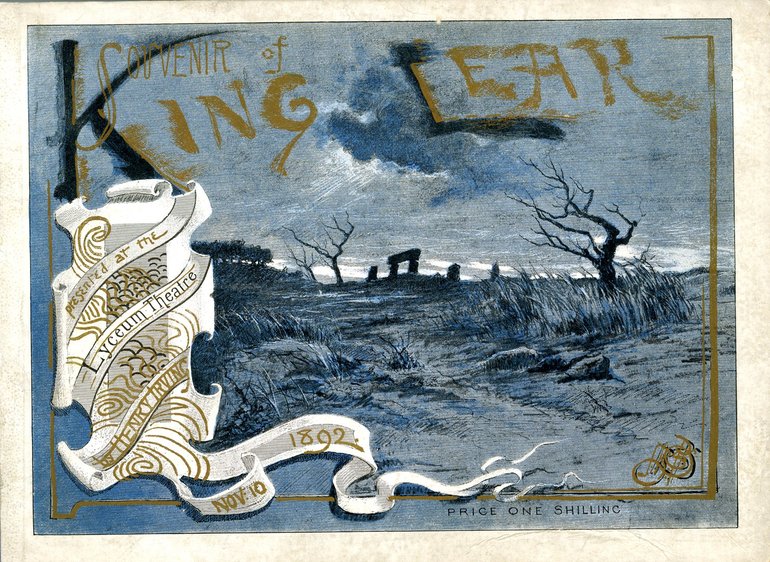
Program for Henry Irving’s 1892 production of King Lear via Shakespeare Birthplace Trust
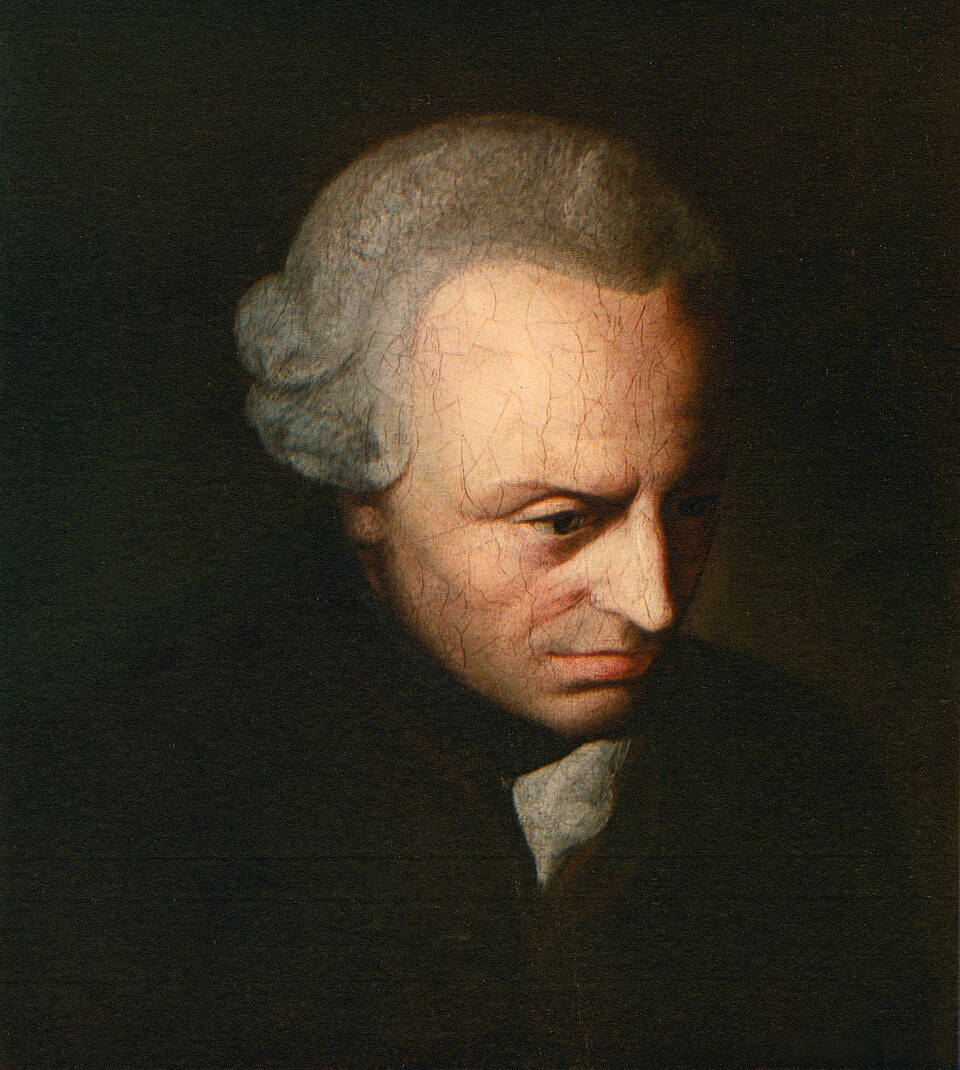
Painted portrait of Immanuel Kant, c. 1790, possibly by Elisabeth von Stägemann, via Wikimedia
Cats (Alex and Oliver) on rampage among books, 2017, photo by MC
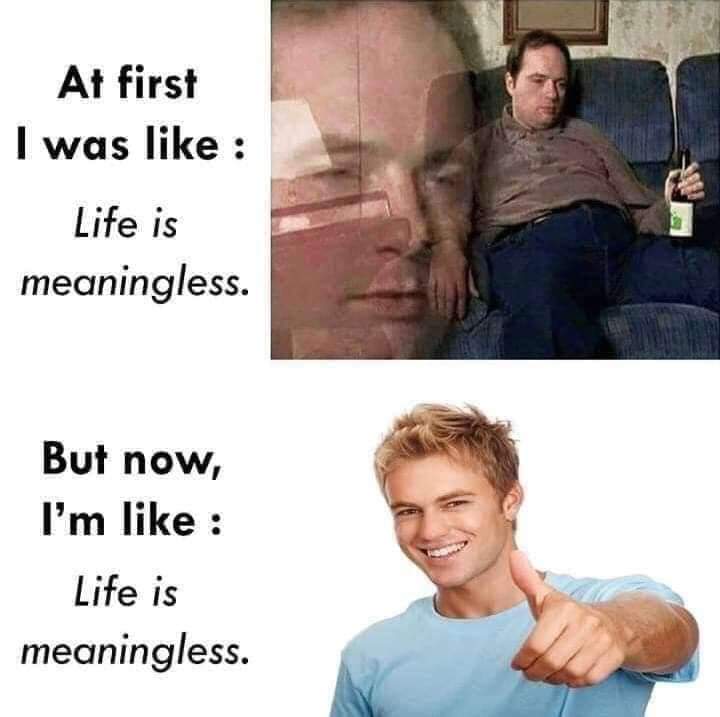
“Life is Meaningless” meme via Noumenal Matrix (Nihilist Memes) on Facebook
Still from Martyrs, written and directed by Pascal Laugier, 2008
Vision of Saint Bernard by a nun from the Lower Rhine, 14th century, via Art & Theology
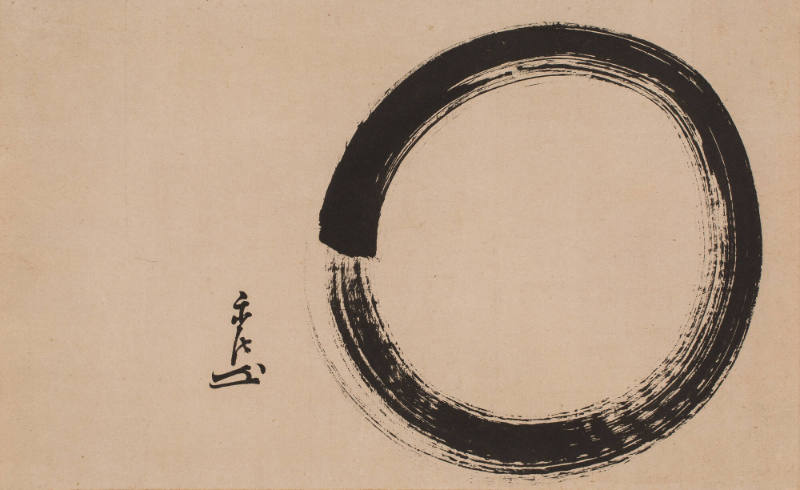
Enso drawing by Ryoryosai Koshuku (1775-1825) via Cornell University
Photo of Senbon torii gates at Fushimi Inari-taisha shrine, Kyoto by Flora Hon on Unsplash
Still from Saw III via IFC Center
The Cipher by Kathe Koja, Dell/Abyss, first printing cover
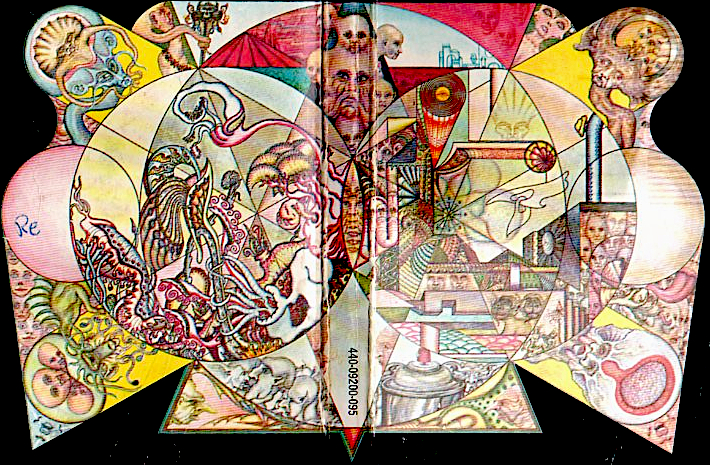
Detail from cover of Ubik by Philip K. Dick, Dell, 1970 by Jeff Jones, via ISFDB
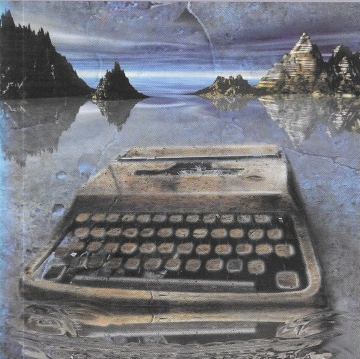
Detail from cover of French translation of The Affirmation by Christopher Priest (La fontaine pétrifiante), Gallimard, 2003, by Éric Scala, via ISFDB
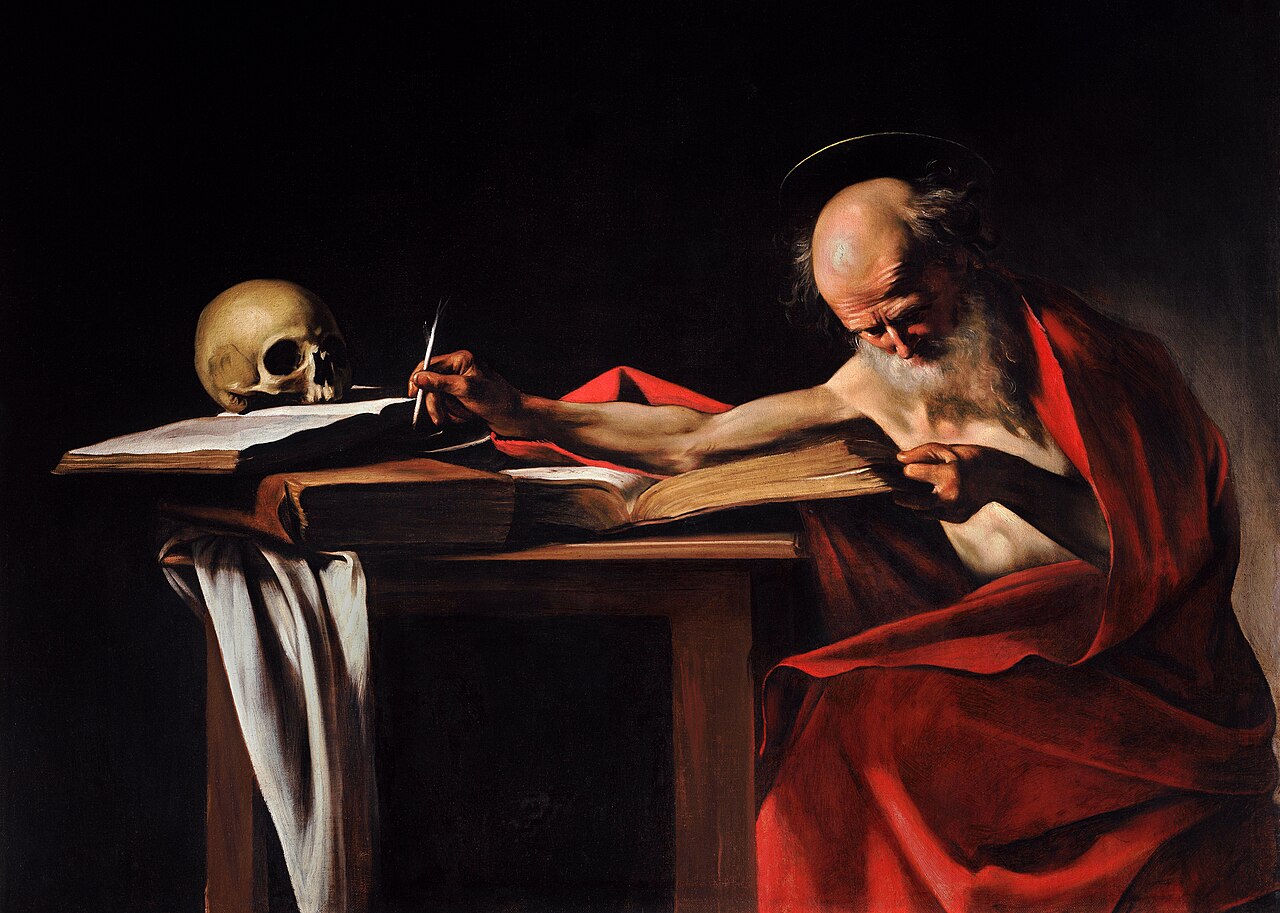
St. Jerome Writing by Caravaggio via Wikimedia
-----
- 1World as Will and Representation volume 2, Ch. 37 (“On the Aesthetics of Poetry”), trans. E.F.J. Payne, 1958, Dover Publications, p. 433 ↩︎
- 2World as Will and Representation volume 2, Ch. 37 (“On the Aesthetics of Poetry”), trans. E.F.J. Payne, 1958, Dover Publications, pp. 433-434 ↩︎
- 3Whether it’s actually another world intruding into ours or it’s simply other, previously unperceived aspects of our world becoming briefly apparent might be something to argue over, but it’s not a point important to this discussion. ↩︎
- 4That post is very much a companion to this one, as it also draws from podcasts by Conner Habib, Phil Ford, and J.F. Martel. Obviously, while I come at things from a different perspective than they do, and have some disagreements with a few of their conclusions, their approach to horror and weirdness is one I find useful, productive, and stimulating. ↩︎
- 5van der Lugt p. 370 ↩︎
- 6All sorts of things our brains and bodies do together can be both amazing and material — see, for instance, Annie Murphy Paul’s book The Extended Mind. ↩︎
- 7If you want a less reductive approach, see John Phillips’s Very Short Introduction to the Marquis de Sade for an overview; for more fun, seek out Angela Carter’s The Sadeian Woman. ↩︎
- 8I don’t think the director of a lot of the Saw films, including III, Darren Lynn Bousman, has similarly distinguished himself, but I’m sure he has some fans. ↩︎
- 9Other translations I have on hand are to some extent or another farther from this. The Lian Sheng translation of the Diamond Sutra chapter that I linked to makes it: “Subhuti, the mind of the past is unattainable, the mind of the present is unattainable, and the mind of the future is also unattainable.” Red Pine, in his translation of the Diamond Sutra, goes with: “Subhuti, a past thought cannot be found. A future thought cannot be found. Nor can a present thought be found.” Katsuki Sekida’s translation of the Mumonkan renders it: “The past mind cannot be held, the present mind cannot be held, the future mind cannot be held.” David Hinton, generally a very efficient and even ascetic translator, gets a bit wordy in his version, though it’s lovely: “Mind done and gone cannot be realized. Mind now aglimmer cannot be realized. Mind yet to come cannot be realized.” ↩︎
- 10The third film is, by most fans’ accounts, one of the best of the Saw movies, having more story and character development than many of the others. I would put it behind Saw, Saw X, and Saw II, but I’m also pretty repulsed by medical horror scenes, and there are a lot in Saw III, so I may be discounting it because of that. I also find Shawnee Smith’s portrayal of character Amanda Young in this movie to be fingernails-on-blackboard annoying. But the film is significantly better than a lot of the ones that came after it. ↩︎
- 11This is not always coherent through all the films, but I’m really just thinking about the first three Saw films here, since they are basically telling one story together. ↩︎
Discover more from Matthew Cheney
Subscribe to get the latest posts sent to your email.


.jpg)