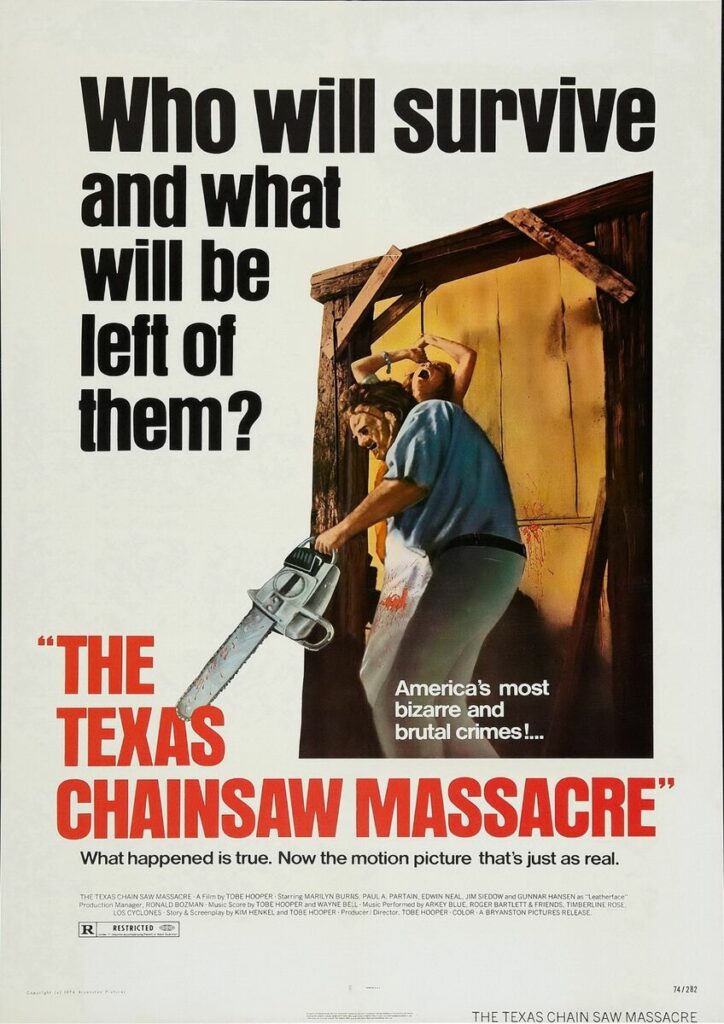
Fifty years ago, the world ended and a new world was born.
*
The Texas Chain Saw Massacre, a movie made for less than $100,000, had its general release in the U.S. on October 11, 1974.
October 1974 saw some other notable low-budget releases, including one of Larry Cohen’s best films, It’s Alive, and my favorite John Waters movie, Female Trouble. The number one film in the U.S. that week was another of my favorites, 1972’s Cabaret, which had been re-released in theatres, though it would soon be eclipsed by a less memorable movie, Airport 1975.
That month, Ed Sullivan died, the Provisional IRA set off bombs in England, multiple earthquakes killed many people, Puerto Rican separatists planted bombs in Manhattan, an elementary school in West Virginia was bombed during a textbook dispute, terrorists took hostages in The Hague, fifty-two people died when a bag of fireworks exploded on a train in northern India, Carl Eugene Watts (said to be the most prolific serial killer in U.S. history) committed his first murder, a father in a suburb of Houston laced his children’s Halloween candy with cyanide, and, in Pittsfield, Maine, a fire in a chicken house killed 29,000 hens. Ed Gein was still living in a mental hospital.
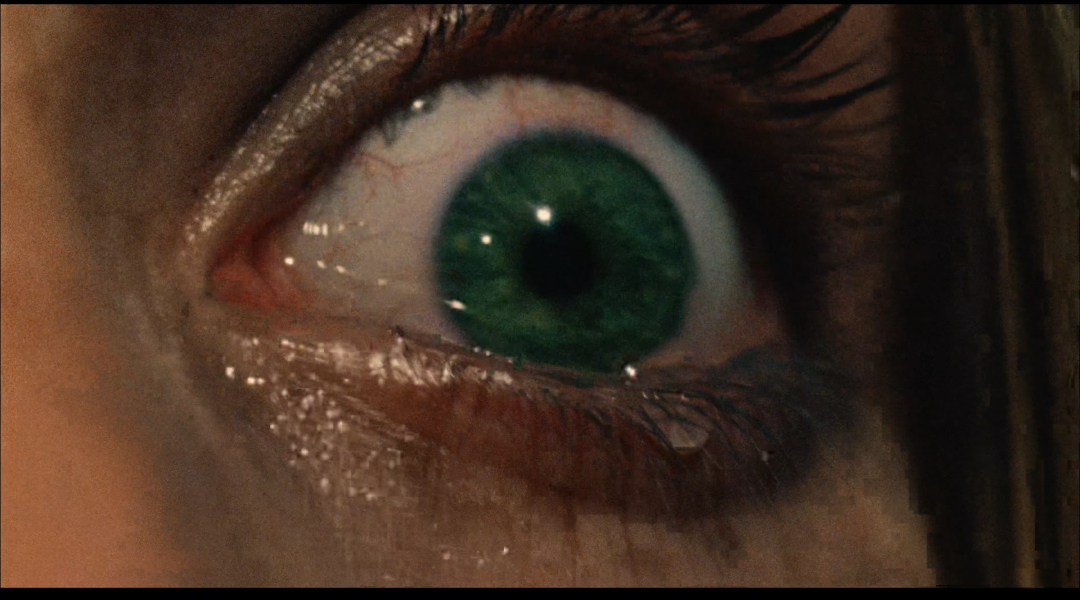
The Texas Chain Saw Massacre is about two groups of people at the end of the world: one of those groups — the nice young white people common to so many stories — will be destroyed as the world ends, while the other — a family devoted to meat and death — persists, as they have always persisted, with little change over the generations (indeed, with a resistance to change, as shown by their dislike of new, more “humane” ways of killing and butchering cows). Even though Sally ultimately (and, thanks to Carol Clover’s concept of “the final girl”, famously) escapes, we have no sense that she will ever be able to return to normal life. She has been rendered into this new world, born again into a form better suited for a world of chaos, suffering, murder, and unreason.
Different as they are, the two groups are interconnected. Sally and Franklin’s family home abuts the property of the people who will destroy their lives. Sally and Franklin’s uncle worked in the slaughterhouse, but their grandfather was a cattle man — he sold the cattle rather than killed them — and they must have come from a more middle-class background, having gone off to college and begun to live the American dream. Their house was made of stone. And yet, the house is now a ruins. The family has moved out of the countryside, has escaped into post-industrial civilization, presumably no longer dealing in death and meat. This is a group of young people with names: Sally, Franklin, Kirk, Pam, Jerry. The family of their nightmares have labels and nicknames: Hitchhiker, Old Man (or Cook), Grandpa, Leatherface. Yet the named characters are not more complex and rounded than the labeled characters; the opposite, really. We know Pam is into astrology, we know Franklin is morbid and whiny and confined to a wheelchair, but other than that … not much. They are blank youth, blank possibility, blank futurity. Once upon a time, maybe in the legendary 1950s of their childhoods, they might have been the hopes and dreams of a nation. But no.
This is a story of supposedly liberated, free young people returning to their roots and encountering the pure products of America.
*
The first horror movie I remember seeing was Poltergeist when I was seven or eight years old. All I remember is thinking it was interesting but not especially scary. (The tree banging against the window I remember finding unsettling. Mostly, I remember annoying my friends and family afterward by saying at any vaguely opportune moment, “Theyyy’re heeeeere…”)
Poltergeist was directed by Tobe Hooper, director and co-writer of The Texas Chain Saw Massacre. I do not remember knowing this for a long time. People thought of Poltergeist as a Steven Spielberg movie. E.T. came out at about the same time, the aesthetics of both films are not hugely different, Poltergeist was rated PG … Texas Chain Saw Massacre just wasn’t the first film to pop into mind on seeing Poltergeist, even if you recognized the director’s name (which you might have, given the uncommon spelling of his first name. For many years, I pronounced it phonetically, as if it rhymed with robe or globe, not as what it is, a variant of Toby).
My parents were quite liberal with what movies I was allowed to watch as a kid, but three films were expressly forbidden: Psycho, which had permanently terrified my mother when she saw it as a teenager; The Shining, which both my parents found deeply disturbing (perhaps because of its subterranean echoes of things never spoken of in their marriage); and Texas Chain Saw Massacre, which my father (something of a connoisseur) considered to be the scariest horror movie ever made. For a long time now, those have been my three favorite horror movies. I don’t rank the others on my ever-changing list of favorites, but I can easily list those most forbidden films as the top, and in order: 3. Psycho, 2. The Shining, 1. Texas Chain Saw Massacre. That ranking has been solid in my mind for at least 20 years.
Psycho made Texas Chain Saw Massacre possible in a variety of ways (just as Les Diaboliques made Psycho possible), and both films’ stories and designs were inspired by the crimes of Ed Gein. Texas Chain Saw Massacre was one of the only horror films Stanley Kubrick is known to have admired, and though the extreme control and polish of The Shining is the aesthetic opposite of what Hooper created, the films are similar in their relentless approach to terror. And, like many horror movies, all three films are about the relationship of family to monsters.
*
The emotional sequel to Texas Chain Saw Massacre is not Texas Chainsaw Massacre II, which (smartly, I think) took a different tone from the first, but rather is Rob Zombie’s astonishing Halloween II, one of the few horror movies to delve deeply into the question of what it means to survive a monstrous, nightmarish, annihilating experience.
While countless creators of horror movies, books, art, comics, etc. have been influenced by Texas Chain Saw Massacre, few have found any way to build from its power rather than mimic it, often weakly. Rob Zombie is the contemporary horror filmmaker who seems to have both learned from Texas Chain Saw Massacre and developed its artistry further — his first film, House of 1,000 Corpses, is a overt homage, but his second, The Devil’s Rejects, takes the idea of a group of murderous maniacs even further, more deliberately complicating viewers’ repulsions and attractions. (For more on this, see my “Rob Zombie and the Cinema of Cruelty”.) Then, with Halloween and, especially, Halloween II he deconstructs the slasher film into a study of intergenerational violence, trauma, and suffering. Tobe Hooper never again achieved anything close to his masterpiece, but Rob Zombie did.
*
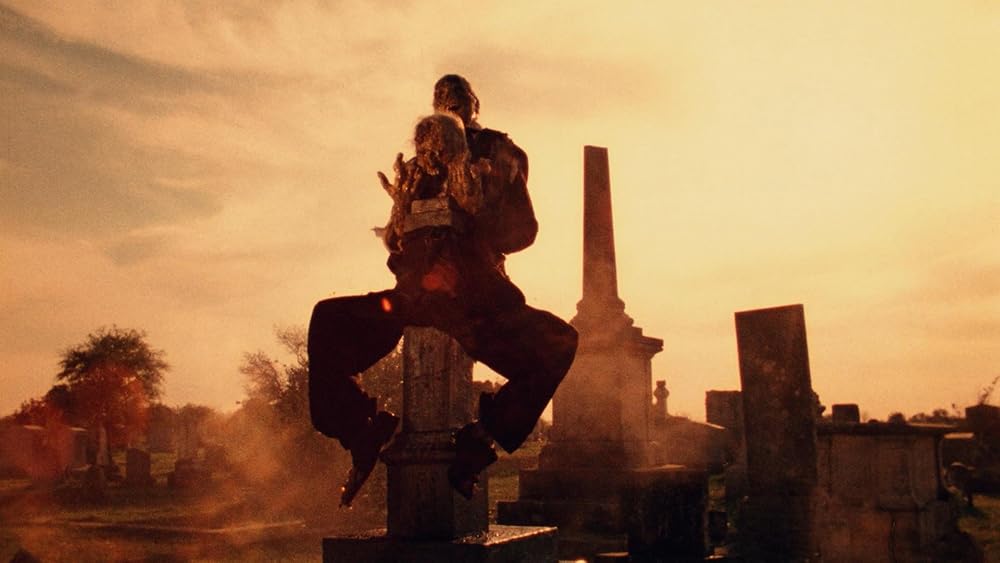
In the original script, the Hitchhiker’s identity as an artist is made more explicit through dialogue than it is in the finished film. “I was the killer,” he says of his time in the slaughterhouse. “I don’t do it anymore. Now I’m an artist. With the gun and knocking box, they don’t need me anymore.”
Sally replies, “Pam’s an artist, too. She’s really good.” And then: “Are you a painter or what? I know this
crazy artist. He never knows what he’s doing.”
The Hitchhiker replies, “I work with leather. I’m a sculptor too.”
(But Franklin just wants to talk about the slaughterhouse.)
The film smartly cuts down on a lot of the script’s dialogue. What people say doesn’t much matter in this world. The Hitchhiker’s artistic inclinations are clear, anyway. His work prefigures the artistry of the killers in Hannibal. That artistry is the first thing we see after the narration at the film’s beginning. First, we see it in flashbulb light, perhaps assuming crime scene photography. It will become clearer once we see the Hitchhiker with his camera, and we will realize that he was taking pictures of the raw material for his sculpture. That sculpture is the first image we really get to gaze on, sitting out in the hot morning light, with the sound of a radio announcer sharing all the ghastly, apocalyptic news of the day.
Thus are we welcomed to the art of death.
*
With our massive arms industry supplying the world’s conflicts, with our high rates of homicide and suicide, with our mass shootings and our mass incarcerations, the United States is one of the most death-dealing countries in the history of the world.
And yet, like any good psyche practicing repression, we Americans don’t like to talk about death. People these days don’t even like to use the word. We euphemize. Don’t say died, say passed away. Everybody just passes away. Nobody dies anymore. Like a kidney stone or a bit of gas, they pass.
(Ernest Becker, we need you now! We are an entire country devoted to the denial of death!)
The one thing all living beings have in common is that they die. Death is the predictable end for every story. How we get there is different, but the end is the same for everybody and everything: death, death, death. And no matter what anybody tells you, we don’t know what death is. Our one commonality is a complete mystery.
One might argue that people who understand meat as meat, and who make art and furniture from dead bodies, are the most sane people in a world plagued by the denial of death. In Texas Chain Saw Massacre, death is everywhere, but we only really know that because of the radio announcer. The nice white hetero young people, happily jaunting about in their van, think they have escaped what the soldiers in Vietnam, the victims of earthquakes, and the people murdered by serial killers all discovered: death is everywhere, always.
More than present, death is commodified. Murder makes the world go round. Our governments profit from it, our restaurants serve it.
(I still like a hamburger now and then. But I’m not about to say to the spirit of the cow whose cooked flesh I am eating that I am more civilized than Leatherface.)
*
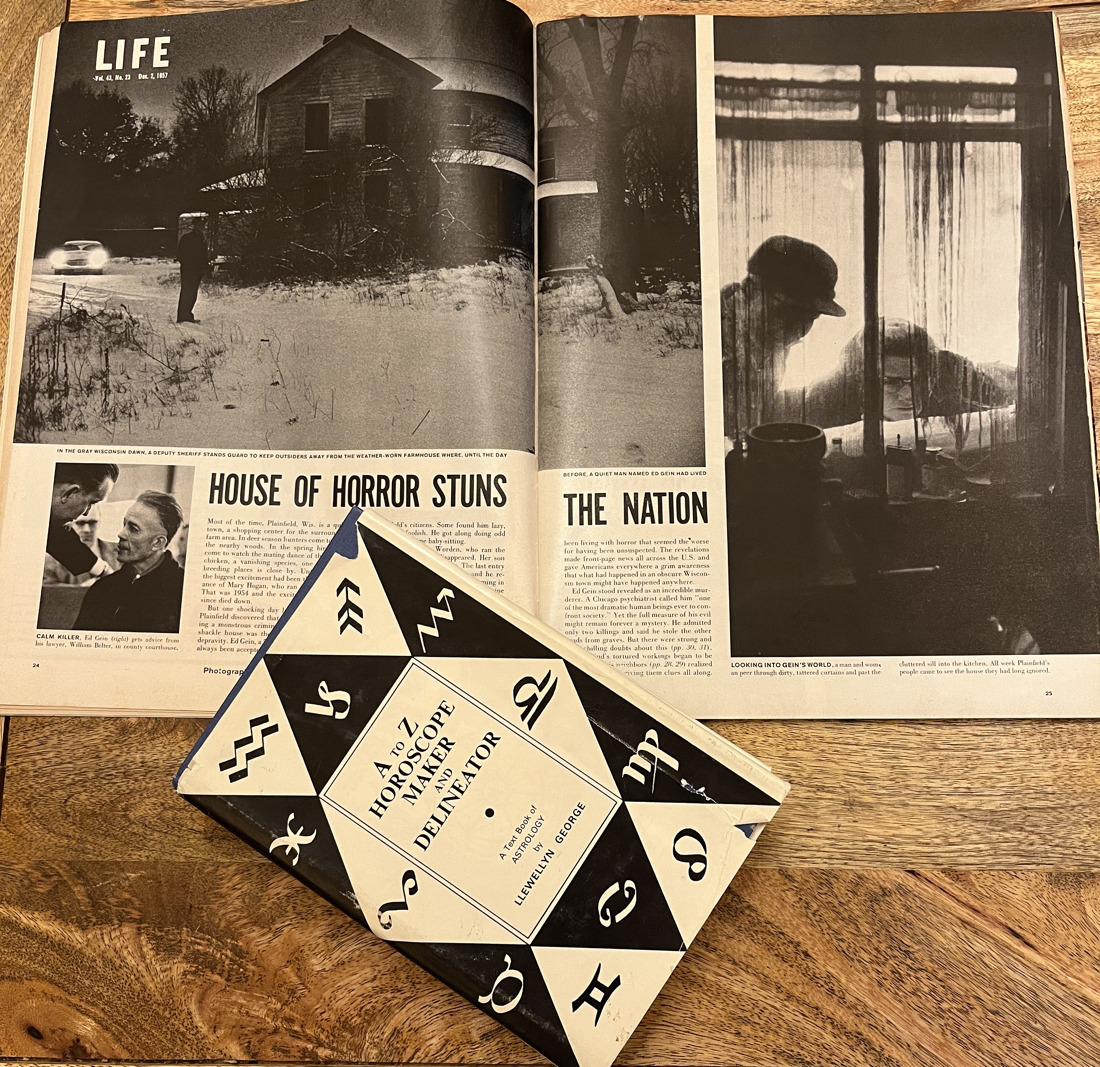
When Ed Gein’s crimes were shared in terrifying black and white photos by Life magazine in 1957, my parents were more or less the age I was when I became obsessed with figuring out how to convince them to let me watch Texas Chain Saw Massacre. I wish I had talked with them about what it felt like to learn about Gein — I’m wouldn’t be surprised if one or both of their childhood homes had Life delivered each week (they were good, middle-class Massachusetts families, and Life would have been a staple). This was a decade after the Nazi atrocities were publicized, and there must have been some feeling of a demonic evil having followed the G.I.s home to now metastasize in the heartland. (Similarly, we should remember that Texas Chain Saw Massacre was conceived and released while the Vietnam war was in its last, desperate years.)
Gein kept relics, as if he could control and contain time by preserving the remnants of people. This is part of what Robert Bloch took from the Gein story to create Norman Bates in Psycho. The family in Texas Chain Saw Massacre is a bit different. Though their house looks a lot like Gein’s, there is less sense of anything being preserved for its own sake, like Gein preserved his mother’s rooms, than there is of a house filled with the detritus of life. Their world is not one of time stopped so much as time ignored. Flesh rots away, but bones take a lot longer, bleached in the oppressive Texas sun. Eventually, though, even bones find their way to dust. In the long run, preservation is always a lost cause. Entropy always wins.
Some of us who are not murderers also keep relics. I tracked down a copy of the exact astrology book Pam reads from in the movie, a 1972 edition of A to Z Horoscope Maker and Delineator by Llewellyn George. Some years ago, I found a copy of that December 2, 1957 Life magazine with the Gein photos and keep it now alongside other books and magazines. I’m not Christian, this isn’t any sort of weird relic worship, but rather something more like … innoculation. Or confirmation. For years, I thought there was no way Life really published those photos, come on, no way. It wasn’t until I held the magazine itself in my hands, and saw those photos in amidst the most banal sorts of 1950s advertisements and news stories that I felt the absolute strangeness of that past. Similarly, I thought maybe the astrology book would have some secret clue to the ultimate meaning of Texas Chain Saw Massacre, but of course it doesn’t. Ultimate meanings are for weak art, not great art. And anyway, it’s just an astology book, bewildering and ordinary in equal measure. A prop. I can look through its pages — pages older than I am — and remind myself that still, somehow, against all odds, the world has not yet come to an end.
*
Leatherface.
The word itself is captivating — enough so that it was one of the original titles for the movie, before someone suggested The Texas Chain Saw Massacre, and later it became the title for two other films.
Gunnar Hansen’s performance as Leatherface was so powerful that it became a gravitational force he could never escape for the rest of his life. He had a master’s degree in poetry from the University of Texas at Austin, and, according to his book Chain Saw Confidential, when he was first hired, people were worried about the effect of playing the character on a sensitive poet. He got more movie work later, but it was mostly low-budget horror movies, more than one with chainsaw or massacre in the title.
His huge body was an asset in any monster role, but it was the sensitive poet who made Leatherface unforgettable.
One of the failures of modern horror tales is the idea that origin stories are important. We don’t need to know anything about Leatherface’s childhood. We don’t need to know about the first moment he picked up a chainsaw. That adds nothing and detracts a lot. Gunnar Hansen’s performance alone is enough. Even though we never see his face, there is an expressivity that Hansen gave to the body that communicates, that lets us extrapolate in our minds all we need to know. It’s a performance at the level of the great silent movie actors.
Hansen wrote insightfully about the three Leatherface masks:
Each of these masks represents something to — and within — Leatherface. Early on, Tobe told me that Leatherface wears different faces because he is showing who he is right then. He uses the masks to express the context he is in and hjow he will behave — his state of mind. When the Hitchhiker and the Cook bring Sally to the house, Leatherface, in his Old Lady mask, is making dinner and being “mom” for a while. He later puts on the Pretty Woman face to dress up for dinner. In a way the masks are theatrical for Leatherface. They are performance.
…Behind the mask he is, in essence, unknown and unknowable. I began to feel that each mask did not merely represent how he felt; it was how he felt. Everything was in the mask, and beneath it there really was nothing at all. Eventually this extended to my thinking of Leatherface as having no face at all. Take off his mask and you find nothing — featureless skin or even nothingness itself. Leatherface is empty.
(Chain Saw Confidential pp. 54-55)
Leatherface is thus an embodiment of both The Presentation of Self in Everyday Life and Gender Trouble. But also of Zen: Leatherface as emptiness and nothingness is Leatherface as enlightenment. In an apocalypse, might a bodhisattva, seeking to relieve all the suffering in a world of chaos and misery, be a butcher?
Leatherface is not a sadist. Some of his brothers might be, but he’s more a worker with a job. Kill the animal, cut up the meat. Unlike the Hitchhiker, he is not an artist, he is a craftsman. Art may benefit from a bit of sadism, but craft needs a clear and practical mind. Leatherface doesn’t put Pam on a meathook to torture her or because he likes the aesthetics of bodies hanging from hooks, he puts her there to stop her flailing. When he kills, he kills quickly.
The family celebrates their grandfather’s efficiency in killing. That’s the highest achievement in their eyes, something that can make someone legendary. Not torture, not the creation of suffering, but the skill to “process” as much meat as possible in the shortest amount of time. Good, honest work.
*
The Hitchhiker, the Cook, Grandpa, Leatherface … they’re a family, but they’re also the end of the line. There is no sense of these characters as sexual beings. There are no living women around. (There’s a corpse, presumably grandma, upstairs.) This is the apocalypse of the American family, the nihilistic queer No Future of Lee Edelman, denying the reproductive futurity of heterosexual aspirations.
The young, hetero white people, coupled and presumably fertile, likely imagine themselves as continuing their lines, giving the future its due. But no apocalypse allows that. They have reached the end of history, the end of the future. To produce new life is to produce new suffering beings. The end of suffering is the end of life. The young people who dream of the future will soon learn that they are nothing but meat, blood, and bones, their hopes and dreams and desires all irrelevant to a world where the future is impossible and the past is a graveyard.
*
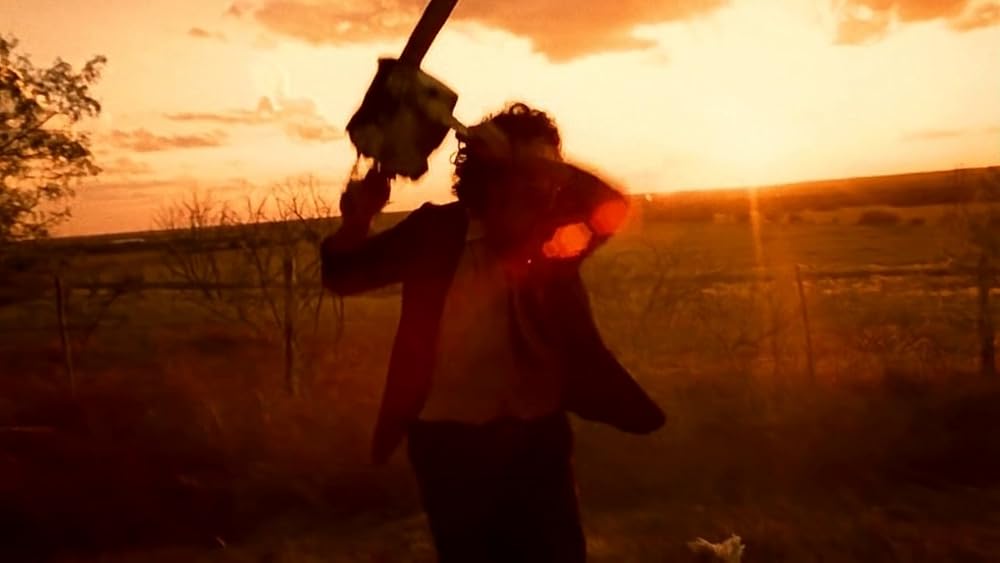
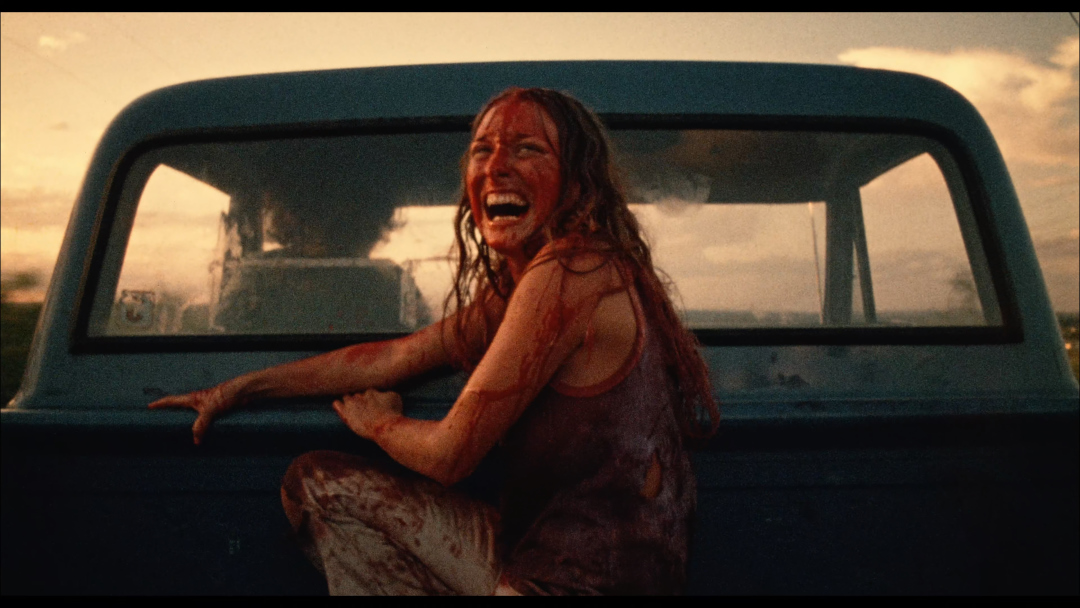
The Texas Chain Saw Massacre ends with the sublime. The greatest horror always does. Not just escape. If there is escape, it is not escape into the same world of the beginning of the story. Horror is about extreme emotion, about apex experiences. It is about ecstacy. About transcendence.
Sally escapes, fleeing to a future that we know will be its own horror story.
Leatherface, frustrated, defeated, having failed at his job of rendering Sally, dances. What else is there left to do at the end of the world? There will be more meat. Meanwhile, make art from bones. Dance with a chainsaw.
Fifty years later, the movie itself is an embodiment of those last moments. Art from bones. A dance of death.
And what about us?
Here we are in the future. Look around. Glance at the news. Can you honestly say that the apocalyptic vision of The Texas Chain Saw Massacre was wrong about what was to come?
Discover more from Matthew Cheney
Subscribe to get the latest posts sent to your email.
