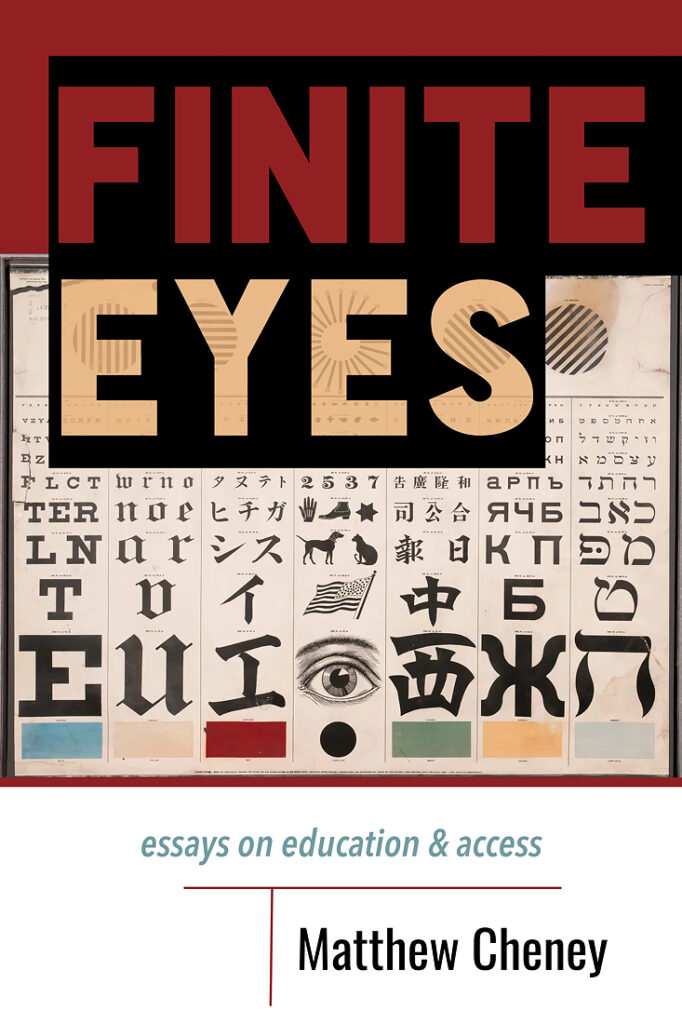
I’ve been working on a secret project: a new book.
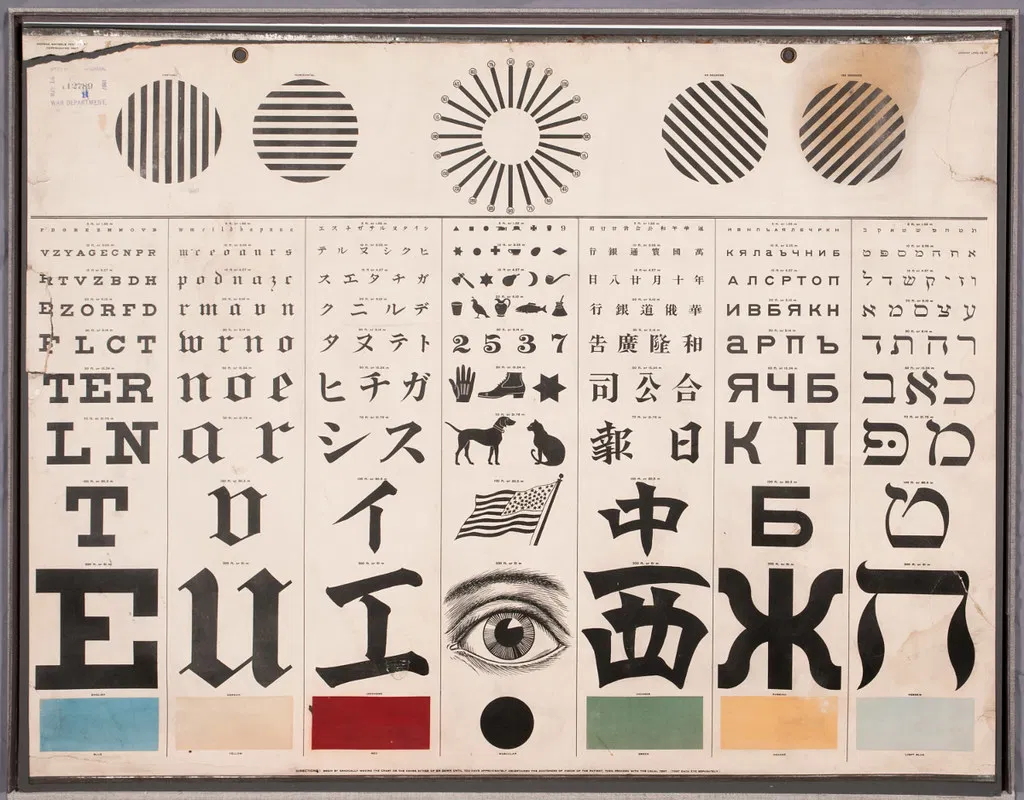
From 2018 to 2024, I wrote a blog called Finite Eyes (the title comes from a poem by Emily Dickinson), where I explored ideas about education, teaching, learning, academic publishing, and open access resources. It was closely tied to my work as Director of Interdisciplinary Studies at Plymouth State University and our Open Learning & Teaching Collaborative (CoLab). I ended the blog in September ’24 because I wanted to consolidate my web presence to matthewcheney.net, so I moved all the old posts over here and gave up the finiteeyes.net domain.
This fall, as things at Plymouth State took a new turn and my friend, supervisor, and mentor Robin DeRosa lost her job, I looked back on some of the old posts and realized that I had written something of an intellectual memoir of our time at PSU together, of the CoLab, and of my own journey. Maybe, I thought, I could put together a selection of the best of these posts as a book.
Thus, this October I began working on what is now a book: Finite Eyes: Essay on Education and Access. It is available at that link for free in various electronic formats and there’s also a link to buy a paperback copy from Amazon for the lowest price I could make it and still have a small royalty to help offset the cost of printing proof copies, buying an ISBN, etc. In the next month or so, it should also be available at other vendors than just Amazon. (For the story of why it’s not elsewhere yet, see below.)
The book speaks for itself, I hope, but for anyone interested in the how and why of it all, as well as what I’m thinking The Mumpsimus Press will work on next, here’s a peak behind the scenes:
Writing and Editing
The book actually contains more chapters than I originally planned. My first concept was a kind of Best of Finite Eyes volume, but once I created a Scrivener project that brought all the posts together, I realized that though there are 4 or 5 posts that have gotten more attention than any others, on the whole the strength of the blog was as a body of work more than as individual essays. I’d been writing a book without even realizing it! And it was a book. It didn’t feel like I was ever doing much, just writing a post here or there, but if you write a post here or there for six years, you do actually end up with quite a pile of writing.
And that pile of writing told a particular story — a story of early excitement and enthusiasm and ignorance, of the challenges of the COVID pandemic (which hit our office especially hard, since suddenly we had to teach the entire university how to do remote learning), and of the many, many losses that have hit public higher education over the last few years. The school I started working at in the fall of 2018 no longer exists. That school got utterly, completely shattered — repeatedly. This month, it starts on a new journey, one that I will be, for a little while at least, part of. But the old journey has come to an end. I’m proud of a lot of the work we did, and feel lucky to have gotten to be a small part of it, and I wanted to capture some reflection of our experience in between covers before it slips from all our memories. (I actually wrote most of a new essay that I intended to be a more direct memoir of those years, but I abandoned it. I am still too close to it all to be able to write the history directly. The essay oozed anger and despair, and that wasn’t what I wanted to dominate this book. The anger and despair is about the present, not the past.)
It took me a lot longer than I expected to edit the book. I had completely underestimated that work. After all, I did not plan to rewrite the posts. I was just going to collect them. But two things slowed me down. First, there’s actually a lot of editing necessary to move from something being a blog post to it being pages in a printed book. What to do, for instance, with all those hyperlinks? I decided to turn any ones that felt useful into footnotes. Not hard work, in most cases, but a bit tedious. The challenge was what to do about dead links or links to things that are useful in a blog post but less so in a printed book; for instance, Google Books links. There’s rarely any point in putting a long URL into a footnote. But if a long URL led to useful information … how could I replicate that? There ended up being a lot more judgment calls than I expected.
The other thing that slowed me down was just how emotionally draining it was to go back to this body of material at this time. I’ve got time — I’m on sabbatical this year, and though I’m supposed to be working on a different book project, I can’t spend all my time working on it or I’ll go nuts. So I’ve got time for what I thought would be the generally mechanical work of putting together this book. But as I said, this book revealed itself to be an intellectual memoir. And thinking back to better days from the often terrible now was … hard. I kept thinking about one of my favorite Tori Amos songs, “Gold Dust”. We held gold dust / in our hands… Ultimately, I was able to edit only one or two posts per day, which slowed it all down a lot.
But it got done. And then I had to figure out how to publish it.
Why Not a Traditional Publisher?
Though this is my seventh book to be published, it’s the first I’ve published myself.
Certainly, I could have sent the manuscript off to traditional publishers, either one of the ones I’ve worked with before, or one that might be more specifically interested in the material in this book, like West Virginia University Press, whose Teaching and Learning in Higher Education series has published some of my favorite recent books on teaching and learning. But I was skeptical that any publisher would be interested. The contents are all available freely on the internet, covered with Creative Commons licenses, for one thing. Yes, I revised a bit and added some new afterwords to a few pieces, but 95% of the book could be read as posts on my website. That’s no way to pique a publisher’s interest. If they’re going to spend the time and money on making a book, they need some hope of at least breaking even, and it would be tough to convince most publishers that enough people would want to buy a print copy of a book they could more or less just read online for free. And it’s not a small book! The printing and shipping costs alone would force the paperback retail price to be at least $25 from most publishers, probably higher. Not really a recipe for big sales.
Though the prospect of doing everything for the book myself was daunting, I liked the idea of having control over it all. Of being responsible for everything, good or bad. I’ve been lucky with my previous books to have had some great cover and interior designs, and to have had any reasonable (and a few unreasonable!) requests met.1Even Bloomsbury agreed to go against their own standard practices and allow my preference for footnotes rather than endnotes. And I’ve worked with some marvelous editors. It could all have been a lot worse. But ultimately the editing and design of a book is up to the publisher. A couple of recent experiences, including with a cover design I really dislike for an upcoming work, have reminded me that the publisher is the one in control of the final product. The words may be mine, but the book is theirs.
If I thought Finite Eyes had a chance of selling lots of copies, I would not publish it myself. In addition to having editors and designers, actual publishers are better positioned to do the business work than I am. I have very little patience with any of the marketing, publicity, and business stuff of publishing. But Finite Eyes is a book on a niche topic, a book that I wanted to make available open access online, a book by a writer whose other books have not sold more than 1,000 copies each. Publishing it myself really was the only good option.
And so — The Mumpsimus Press was born.
Learning How to Publish a Book
One of the reasons I’ve never gotten into self-publishing before is that I know my limits. I love physical books, cherish their shapes and forms, but as anyone who knows me can tell you, my skills with anything in the actual world are pathetically weak. I can’t measure anything. I can barely tie my shoes.
But I figured I could learn enough to at least make a passable book. And I did! It’s hardly perfect, but it looks pretty good and, despite a few design challenges I never quite solved, it’s very readable, even with my ever-worsening eyesight. (There are three or four stubborn typos that I’ve found so far. In coming weeks, I may fix the one that bothers me most, a lost blockquote that makes a paragraph by my friend Karolyn Kinane look like it’s part of my own prose. It’s clear from the context that it’s Karolyn’s, so I’m not too horrified, and right now I’m just kind of exhausted with book, so I’m going to wait on fixing the files.)
Since I’d used Scrivener in the past to create ebooks, I knew that I could at least make an adequate EPUB file. Also, I’d designed the cover of my first book, Blood: Stories, so I knew I could do that. But I did not have the first clue about how to design a book’s interior.
The one rule I set myself was that I did not have time, patience, or desire to learn Adobe InDesign. Aside from just generally resenting Adobe since they moved to a subscription model for their bloated software, I do not have the program on my computer; if I’d had to use it, I would have had to go to campus and work on a designated computer with the Adobe suite on it.) I only needed to learn enough to be able to make this book and one or two others that I plan to create. I have no aspirations to become a book designer — I’ve been lucky to work with some brilliant designers, and I respect their skills and talents immensely. So, keeping my aspirations simple, I hoped I could use Scrivener plus Microsoft Word to do what I needed to do. Using Word for typesetting is not what any professional in their right mind would recommend, but sometimes familiarity beats precision. (I would have preferred to use LibreOffice, which I’ve used for everyday word processing for a while now, but there are a couple features I needed for the book that I never quite figured out how to replicate in LibreOffice; maybe I’ll try with the next book.) I got the book into shape in Scrivener, exported to Word, cleaned up some formatting, did a final proofread, then exported to PDF. That part was ultimately faster and easier than I expected — if you learn Scivener’s various settings for compiling and exporting, you can do quite a lot.
Then I had to charge into completely unfamiliar territory — the printing. I started with Lulu.com, because I know people who have used it successfully and it seemed like it would provide a nice alternative to Amazon. With my files in good shape, Lulu was not all that hard to use. I got everything done and ordered a couple proof copies. I look forward to seeing them one of these days.
Yes, here’s where I learned something especially useful: Amazon dominates the self-publishing world because Amazon dominates everything and is thus able to move far faster than other services. Certainly, I wanted the book to be available via Amazon because, for all its evils, it’s still one of the most convenient ways for people to get books. I don’t do most of my own book shopping there, but I haven’t yet brought myself to boycott them completely. But I didn’t want Amazon to be the only source for the print book.
But even though Amazon was the last service I uploaded files to, the last service I put an order in with … I got proof copies in a couple days, made some final edits, uploaded the revised files, and ordered copies to give to the book’s dedicatees — and, meanwhile, I’m still not going to receive proof copies from Lulu for another 2 weeks yet. I’ve also been wrestling with Ingram Spark, but that’s been utterly befuddling. There’s something about the files that they don’t like but I can’t figure out what. The book seems stuck in limbo even after everything got approved. So I’ll probably have to contact their customer service, or just stick with Lulu. I don’t know. The point is: Amazon makes the whole process quick and relatively painless. And I hate that they do, because I don’t want to be stuck with Jeff Bezos’s world-destroying machine. But welcome to life in this awful reality! Eventually, the book will be available at the very least via Lulu. More than that, I don’t know.
You’ll also see that the ebook is available via Amazon Kindle and Kobo, which was mostly to make it easily available for folks who use their subscription services. There is no way to put a book up for free on either, however, so they are priced at $0.99 if you’re not a subscriber. It’s the same file as is available for free on my site, though, so there’s no need to pay for them unless you just like the convenience.
Coming Attractions
Aside from wanting to preserve a chronicle of the last 7 or so of my professional life, a big motivation for creating Finite Eyes was that I wanted a low-stakes way to test various self-publishing tools so that I could create a tenth anniversary edition of Blood: Stories. Thus, my plan is for Finite Eyes to be the first of a few Mumpsimus Press books.
Blood went out of print in the early fall, so the rights reverted to me. I’m hoping to have that ready by March, which is the actual tenth anniversary of its release. This will allow me to publish not only a new print edition but, most importantly (since most of the people who want a print copy seem to have gotten one) its first ebook edition.
After that … I’m not sure. Maybe a collection of my writings on Virginia Woolf, which a couple of people have suggested I should do, and which, like Finite Eyes, is not all that appealing for a regular publisher because quite a bit of that material is freely available online. Maybe I’ll dig around in the Mumpsimus archives and create something from that material. I don’t know that there’s much worth reprinting there, since the stuff I most value was mined for my upcoming essay collection from punctum books, Asterisks. But there’s twenty years and millions of words or material. So who knows?
I do know that I don’t have any aspirations to become a regular publisher. While it would be helpful to have a little bit of income from the sale of print copies of whatever I publish (print copies do create a few expenses), I’ve got a day job, an aversion to spreadsheets, and zero business sense. So, barring some weird event, the scope of The Mumpsimus Press will remain extremely limited.
But as any poet can tell you, limitations can be exciting…
-----
- 1Even Bloomsbury agreed to go against their own standard practices and allow my preference for footnotes rather than endnotes. ↩︎
Discover more from Matthew Cheney
Subscribe to get the latest posts sent to your email.
