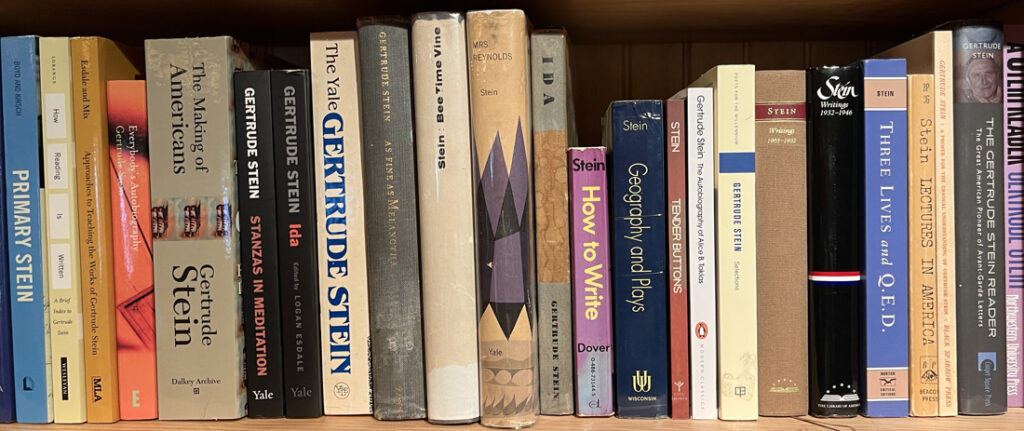
Francesca Wade’s new book, Gertrude Stein: An Afterlife, has been cause for some good writing about Stein recently. I have most appreciated Adam Thirlwell’s LRB essay “Devotion to the Cut” (more about Stein than about Wade’s book) and Ryan Ruby’s Bookforum review “In Search of Lost Stein”.
Reading these pieces made me remember that I had never gotten around to putting my essay “How to Write and Gertrude Stein and How to Read” up on the website. It was published in 2021 in Teaching Modernist Women’s Writing in English edited by Janine Utell for the Modern Language Association, and the MLA has a thoughtful publishing contract that is one of the few I know to square the circle of an academic publisher’s desire to maintain control of what they publish and the author’s freedom to share their writing widely.1The terms during a 12-month period of exclusivity are that we writers “may display your manuscript on your personal or departmental Web site, or archive it on MLA Commons or in an institutional repository, on the condition that the Contribution be accompanied by a statement that it will be (or has been) published in the Volume” and then after the period of exclusivity “you may license, publish, and distribute (including by making available online or otherwise) the Contribution, and exercise any other right of copyright in the Contribution, at your discretion. In connection with any exploitation of the Contribution, you agree to include appropriate attribution for the MLA’s original publication as follows: ‘[The Contribution] originally appeared in Teaching Modernist Women’s Writing in English, edited by Janine Utell, published by the Modern Language Association of America.'”Though not quite Open Access, and a bit more restricted than a Creative Commons license (since only the MLA and I have the right to reprint without permission — you do not), this strikes me as an eminently reasonable contract and one I would be happy to sign again, because though I usually insist on some sort of Open Access these days for my academic writing, this contract allows me to make the work openly available, which is my primary goal.
My essay looks at how I used to use Stein’s book How to Write and others of her writings in high school and college classrooms. I haven’t taught English for quite a while now, so I rarely get to talk about Stein to students, and writing about her for Janine’s really excellent anthology was a great pleasure. There is also a webpage for the book that includes a resources page for Stein that I created, though most of the resources there (and more!) are now incorporated into the hyperlinks in my new online version of the essay.
One of the things I did not get to write about in the essay is how I learned to love Stein myself. It would have been appropriate, because it’s all about a great teacher I had, but my essay was straining the book’s strict word limits already, so I left out everything inessential. But it’s a story worth telling.
When I was an undergrad student at New York University’s Tisch School of the Arts Dramatic Writing Program, one of my favorite teachers was the writer and performer David Greenspan. I arrived at NYU already loving his work, having read his plays Dead Mother, or, Shirley Not all in Vain and Jack in popular anthologies of the ’90s. When he started teaching at NYU, I immediately signed up for one of his classes. I ended up taking either two or three classes with him, and nobody had a keener understanding of my own (floundering, flailing) attempts to write something meaningful and innovative for the theatre. (The quest failed, as I was really not cut out to be a playwright, but I learned a lot.) David’s kindness toward and insight into a rather lost young man kept me from total despair in ways I can barely put into words.
While I was in one of David’s classes, he gave a reading of some of Stein’s work somewhere downtown. (In my memory, it was at The Knitting Factory, but I don’t trust my memory about any of that sort of thing nowadays.) He might have read “Susie Asado” and “If I Told Him, A Completed Portrait of Picasso” — those are two of my favorite Stein writings, and I would swear I hear them in David’s voice in my head, but he might have shared them with us in class, not at that particular reading — but what I most vividly remember is that he read some of the Lectures in America. David was not an ostentatious reader (though he can certainly be a wild performer when he needs to be), but his very matter-of-fact reading brought out the text’s rhythms, insight, and, perhaps most importantly, humor. It was just a small group of us sitting around him as he read from an old paperback book, but we were laughing and listening and listening and laughing. It was glorious. (You can get a sense of it from this video of David performing Stein’s lecture “Plays”, though that’s pretty recent and more of a rehearsed performance than the reading I attended.) The laughter was of delight at Stein’s surprising phrases and connections, the wise absurdity and absurd wisdom of her statements — it was not, as so much dismissive writing about her is, laughing at her. It was a sense that this was oddball writing but also insightful, unique. “Sentences are not emotional and … paragraphs are” became something of a motto for me, and I still think it to be a real truth of writing, even as it makes me chuckle to think about it. By presenting Stein in his unique way, David Greenspan brought her alive for me, and she has remained so ever since.
I have been relieved to see reviews of Wade’s book making it clear that she has a far more informed and nuanced view of Stein’s World War II years than did Janet Malcolm in her disingenuous (and lazy and even hateful) book Two Lives.2I do not understand the world’s veneration of Malcolm. Her greatest talent was selling herself, it seems to me. She was a modestly talented writer and a bad thinker. Charles Bernstein edited a phenomenal collection of materials about Stein and Toklas during the war for Jacket, and Wade has had access to material others have not, so I am looking forward to seeing what she has to say.
I was also pleased to see in Ryan Ruby’s review a full-throated defense of The Making of Americans, Stein’s great novel:
The Making of Americans presents a no less radical challenge to the realist novel’s concept of character than Finnegans Wake, written twenty-eight years later; in this respect, it also predates the formal innovations of Samuel Beckett’s The Unnamable and Alain Robbe-Grillet’s Jealousy by over four decades. The appearances of the Stein character in The Making of Americans, who comments in the first person on the writing of the novel, are an early instance of the now widespread technique of incorporating the process of creation into the created work. With its stripped-down diction and its repetitive, paratactic, run-on sentences, The Making of Americans synthesized minimalism and maximalism long before these two tendencies split to form the stylistic poles of American high literature. More than any other writer, including Joyce and Pound, Stein invented high modernism, and—if you take Fredric Jameson’s word for it—postmodernism, too.
Might we be on the cusp of a Steinian renaissance? I certainly hope so. There’s a lot of Stein’s work that remains out of print, a lot that remains unexplored. We are only now beginning to catch up to her.
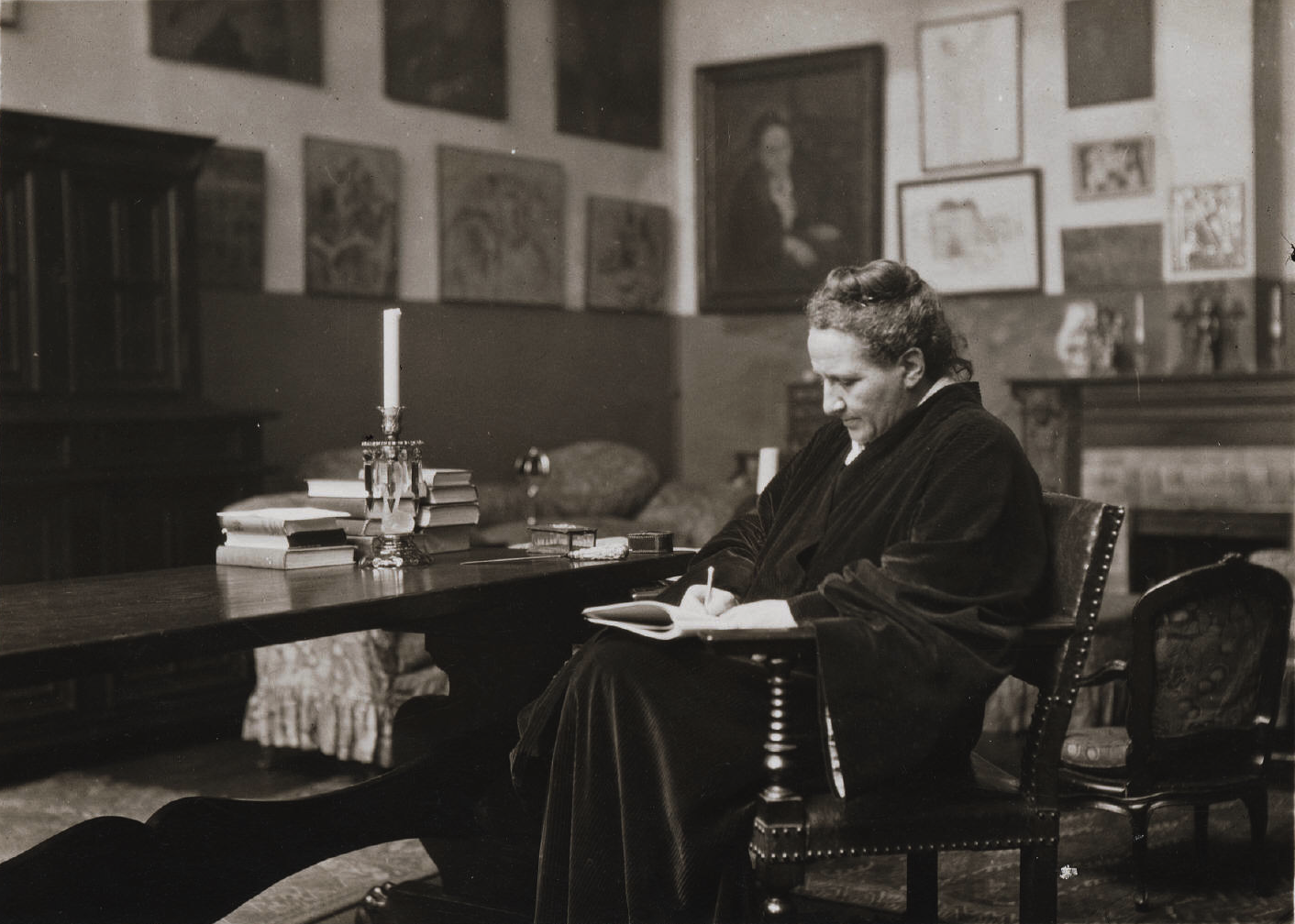
Images: My Stein bookshelf this morning (M. Cheney, 2025, CC-BY-NC); Gertrude Stein by Man Ray via Yale University Libraries
-----
- 1The terms during a 12-month period of exclusivity are that we writers “may display your manuscript on your personal or departmental Web site, or archive it on MLA Commons or in an institutional repository, on the condition that the Contribution be accompanied by a statement that it will be (or has been) published in the Volume” and then after the period of exclusivity “you may license, publish, and distribute (including by making available online or otherwise) the Contribution, and exercise any other right of copyright in the Contribution, at your discretion. In connection with any exploitation of the Contribution, you agree to include appropriate attribution for the MLA’s original publication as follows: ‘[The Contribution] originally appeared in Teaching Modernist Women’s Writing in English, edited by Janine Utell, published by the Modern Language Association of America.'”Though not quite Open Access, and a bit more restricted than a Creative Commons license (since only the MLA and I have the right to reprint without permission — you do not), this strikes me as an eminently reasonable contract and one I would be happy to sign again, because though I usually insist on some sort of Open Access these days for my academic writing, this contract allows me to make the work openly available, which is my primary goal. ↩︎
- 2I do not understand the world’s veneration of Malcolm. Her greatest talent was selling herself, it seems to me. She was a modestly talented writer and a bad thinker. ↩︎
Discover more from Matthew Cheney
Subscribe to get the latest posts sent to your email.
