How to Write and Gertrude Stein and How to Read
This essay originally appeared in Teaching Modernist Women’s Writing in English edited by Janine Utell (MLA 2021). I am grateful to the MLA’s contract allowing authors to republish their work freely after a short period of exclusivity. All other reprinting without permission is prohibited.
How to Write and Gertrude Stein and How to Read
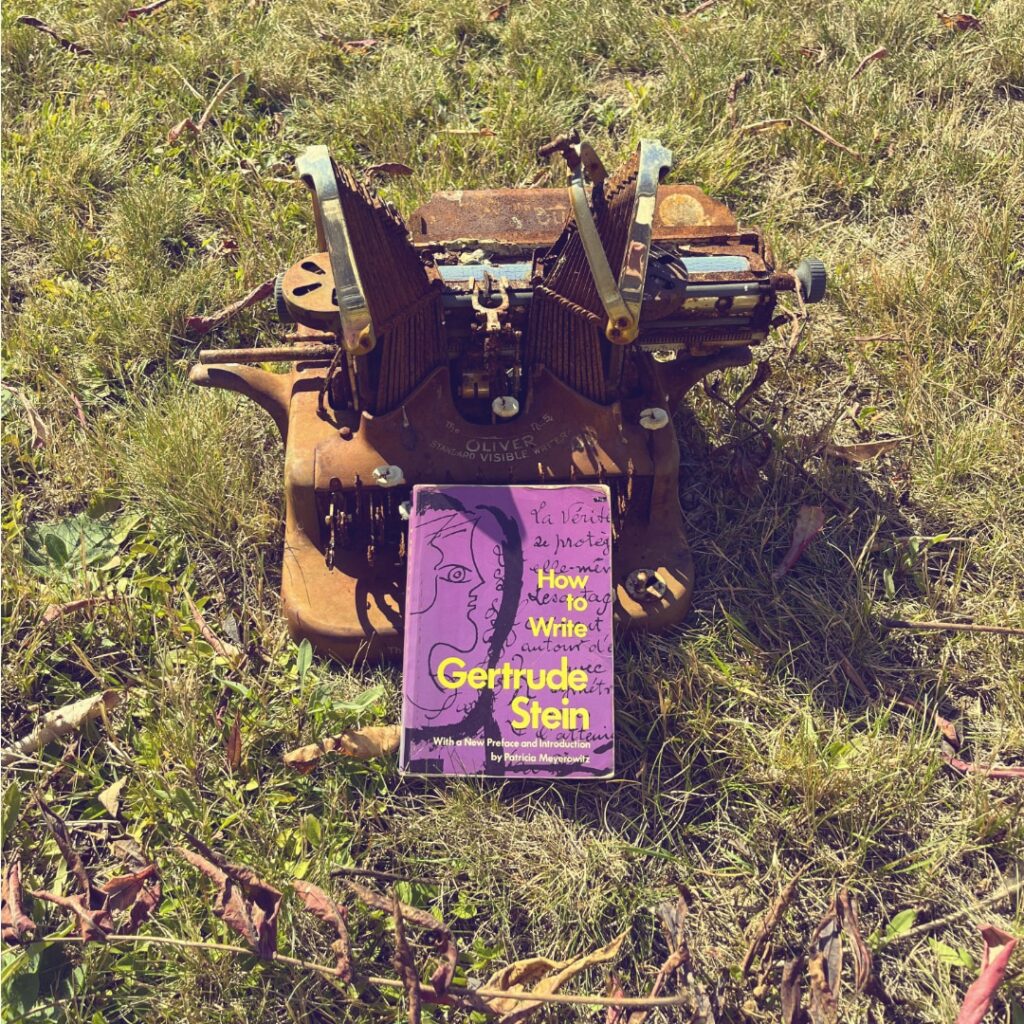
I first stumbled on the usefulness for students of Gertrude Stein’s most abstract writing when I was a high school teacher. At the beginning of one of my first years of teaching, I set on my desk a few conventional writing handbooks as well as a ragged copy of Stein’s How to Write (bought at a yard sale). I used Stein’s book primarily as a paperweight, and never thought about incorporating it into my classes. And then one day I was sitting at my desk, talking with a student about her writing, and, for whatever reason, I was struggling and failing to help her understand that her obsession with grammatical correctness was keeping her from being able to write much of anything for fear that whatever she wrote would be, somehow, wrong.
In desperation, I grabbed How to Write. “Gertrude Stein is a famous writer,” I said. “She wrote a book called How to Write. On page 109, she says, ‘Forget grammar and think about potatoes.’”
My student flipped through the pages. “I don’t understand,” she said. I told her to read something aloud. She opened to page 187: “A sentence is made when they like the sun. If they like the sun.” She glared at me. “I don’t understand,” she said angrily.
I told her she was excused from doing any other homework until she had completed the assignment I was now giving her: she was to write two pages in the style of Gertrude Stein.
It took her a week or so, but she did it, and not only that, she wrote three pages. Her writing wasn’t a convincing imitation of Gertrude Stein, but that didn’t matter, because it was nothing like anything she had written before, and everything she wrote for my class afterward showed at least a little bit more playfulness, a little bit more freedom.
Stein’s work can serve as an excellent model not so much of a finished product, since her own texts remain on the more avant- side of the avant-garde, but rather as a model of a compositional process and of an innovative attitude toward language and play. Hazel Smith writes that “language-based strategies encourage you to think in ways which are non-linear, and to make unconscious connections. They coax the associative modes of thinking which are pivotal to creative endeavor” (4). Encouraging student writers to be inspired by Stein not only helps them develop creative thinking skills; it may also strengthen their awareness of the possibilities of language and help them overcome the debilitating habit of thinking that there is one right way to write.
I still keep How to Write nearby for moments when I need to appeal to an authority that will shock students out of their assumptions about writing, but when introducing Stein in class nowadays I typically use her poems — “Susie Asado,” “If I Told Him: A Completed Portrait of Picasso,” or sometimes selections from Tender Buttons.1For other approaches to teaching “If I Told Him” and Tender Buttons, see essays in Esdale and Mix, Approaches to Teaching the Works of Gertrude Stein. A substantial list of resources for teaching Stein is available on the companion Web site for this volume. In literature courses and writing courses, my goal in using Stein is for students to imagine new ways of reading and writing. I use similar exercises across all courses I teach, because even when I’m not teaching a course for an English department, my interests are similar: analysis, research, and writing. I offer students an environment where they can experiment and play, an environment that will help them expand their imaginations. My experience as a literary scholar and a creative writer influences my feeling that the separation between literature, on the one hand, and writing courses, on the other, is artificial and sometimes, in fact, detrimental. Nonetheless, different types of courses obviously require different emphases.
Many students find comfort in formulas and templates, and in introductory courses particularly, I do provide some. But formulas and templates must be strategic and provisional. At some point in every course, I want students to move beyond their perceptions of what reading and writing should be.
How to Write
The most common assignment for which I use Stein in writing courses is a simple one: I tell students we are going to perform an experiment, and I ask for a volunteer to read aloud, carefully and seriously, the poem “Susie Asado.” They inevitably struggle a bit, and sometimes a tone of disbelief or mockery enters their voice (if it’s noticeable and consistent, I stop them and ask them to continue reading more seriously). When the first student is finished, I hand the poem to another student and have them read it aloud. The other students do not have the text in front of them, which is important because I don’t want them to be thinking about how they would read it themselves; I want them to be listening to their peers and hearing the different tones and styles each reader uses. Depending on time and the class’s patience, I sometimes pass the poem to a third reader.
After this, I give a copy of the poem to everyone in the class. Usually, students want to discuss what the poem means, because previous English classes have taught them to treat the reading of poetry like cryptography, the cracking of the poem’s code yielding a succinct summary of theme or a chart of symbols. Depending on where we are in the course and my goals for that day, I will sometimes tell students that the poem was intended to be a portrait of a flamenco dancer; usually, however, I will say that the poem has no referential meaning.2The decision of whether to mention the flamenco dancer is significant: if my goal is to help students appreciate the sound and shape of words stripped of denotative meaning, then I don’t want to say anything that will, for instance, make them search the text for analogues to dancing. I save that sort of discussion for “If I Told Him” and selections from Tender Buttons, where the possibility of representation is more clearly offered by the titles. No matter what I tell students about the poem, though, my ultimate goal is to encourage discussion of its unique features: How would students describe this poem to somebody who hasn’t read it? How is this poem similar to, say, Robert Frost’s “Stopping By Woods on a Snowy Evening”?
Early on in our discussion of the poem, I begin a list on the board of the poem’s unique features. Then, I give students copies of “If I Told Him.” Often, I play a recording of Stein herself reading the poem, which is illuminating because of the serious, fluent, and rhythmic manner in which she reads it. Students are always a little afraid that Stein’s abstract writings are some sort of joke whose punchline they don’t get, but hearing Stein herself read helps dispel that fear. After reading “If I Told Him,” we return to our list of the unique features of Stein’s writing and see if we need to add anything. If there is time, we move on to some pieces from Tender Buttons.
For homework, I give students a simple prompt: write at least five hundred words in the style of Gertrude Stein. It is important that this assignment be of some significant length, because it will be much more frustrating that way, and, illogical as it may sound, frustration is key to the success of this assignment. Thus: at least five hundred words.
In every class, there are one or two students who have a lot of fun with the assignment and who hardly struggle, but the majority usually find the assignment nearly impossible, and some don’t even complete it. The ones who do complete it usually apply a kind of surrealism or absurdism to their writing that is different from Stein’s nonsensical use of language. “Your words conjure images,” I often say. “If you write, ‘The purple cow jumps over the wombat-dog,’ that’s very different from what Stein writes in ‘Susie Asado’: ‘A lean on the shoe this means slips slips hers.’” Recognizing this difference can be revelatory for students, and they can go on to discuss what Stein’s radical move away from referential meaning does to language. We can discuss shapes and sounds, rhythms, repetitions, and patterns.3A comparison of Stein’s work with instrumental music and abstract painting can also be helpful, as students do not have the same expectation that such nonliterary art forms must be referential.
Texts such as “Susie Asado,” “If I Told Him,” and Tender Buttons are so far removed from what most people think writing must be and do that reading, discussing, and imitating these works helps broaden students’ perspectives on writing more effectively than would a text easily shoehorned to fit students’ expectations at the beginning of the semester. The radical shock of an encounter with Stein gives students permission to move away from what Peter Elbow calls defensive writing: “Defensive writing means not risking: not risking complicated thoughts or language, not risking half-understood ideas, not risking language that has the resonance that comes from being close to the bone” (xix).
If there is time after our discussion, students revise their writing assignments in an attempt to make them more like Stein’s writing. At this point, their efforts are usually successful. It’s important, however, to highlight the point of our imitative work: the imitation is a means, not an end.4See also Tate in this volume. I don’t want students to write like Gertrude Stein; I want them to be freed by Stein’s radical choices to find their own way. In keeping with that goal, I draw connections between Stein’s abstract writings and less obviously experimental work by other writers. Hemingway is an obvious choice, given how his sentence style is a kind of popularization of Stein’s rhythms, and the children’s book Goodnight, Moon also works well.5For connections between Stein and Margaret Wise Brown, author of Goodnight, Moon, see Anne E. Fernald’s delightful essay “In the Great Green Room: Margaret Wise Brown and Modernism.” But I typically end up using the first few pages of Jean Rhys’s Good Morning, Midnight, which is distant enough from Stein’s aesthetic to provide a productive comparison and allows us to expand our ideas about rhythm, repetition, and reference while we also, by means of Rhys’s concrete prose, trace the complexities of what might at first glance seem so simple.
Whatever texts and authors I choose, all of my lessons after reading Stein focus on transfer, on finding our own voices after being liberated by hers. Her work remains a reference point throughout the semester: if students seem to be falling back into old and unhelpful patterns, if they are allowing their assumptions about form and convention to limit their language and imagination, I remind them of Stein’s experiments.
How to Read
In an excellent essay on using Stein’s texts in a creative writing workshop, Laura Mullen concludes that
perhaps the first lesson Stein has to teach us is also the simplest: How to read. We think we know that already, yet no one who has sat in on a workshop is unaware of how reading, in that location, is attested to most often not by an accurate description of what is on the page but by a perfect tornado of opinions about what should or could be on the page instead. (207–08)
Stein’s lessons on reading are equally valuable for the literature classroom, where an accurate description of what is on the page is both as important and as difficult to come by as it is in a writing class.
In literature courses, I introduce Stein in the same way that I do in writing courses, through an imitation exercise, because when students only read Stein and don’t try to imitate her style, they undervalue the difficulty and precision of her particular methods of avoiding and undermining conventional sense. What students need to see right away is not that Stein doesn’t make sense, but, more precisely, how she doesn’t make sense.
Sequence is important if a teacher decides to include some of Stein’s more abstract texts to explore her place within certain conceptions of modernism (or within groups such as the lost generation writers, literary exiles, women writers, queer writers, etc.). The intuitive approach is to move from some of Stein’s more accessible and popular texts toward the more abstract ones, but I’ve preferred the opposite approach, for a few reasons. The shock effect of writings like “Susie Asado,” “If I Told Him,” Tender Buttons, How to Write, etc. can be a valuable pedagogical tool, and I fear weakening this effect by providing context for these writings before students encounter them. And, more important, I find it easier to work toward denotative or referential meaning than to work away from it. Wrestling with the sorts of writings in the selections of Stein’s works edited by either Ulla E. Dydo or Richard Kostelanetz helps students confront assumptions about language and meaning.6Dydo’s Stein Reader comprises experimental and lesser-known writings based on consultation of the manuscripts and presented in the order in which they were written. Particularly useful for teachers is the preface to each text, which offers not only information on the text’s composition and publication but also some guidance for reading. Kostelanetz’s Gertrude Stein Reader volume is subtitled The Great American Pioneer of Avant-Garde Letters, which the book seeks to substantiate with some of Stein’s most experimental and difficult writings, many of them short enough to be practical even for teachers who aren’t able to spend a lot of time on Stein. Kostelanetz writes a thoughtful introduction and adds short headnotes for many of the texts to highlight what he sees as their notable features, e.g., “‘Old and Old’ is sustained wordplay. If you think such writing is easy, try it sometime and discover how the constraints can be defeating” (50). Starting with Stein’s more difficult texts, we quickly learn that we cannot fall back on typical habits of reading, and must instead develop new strategies.
Introducing Stein can be especially productive for group work. In small groups, students share their impressions of Stein’s text or texts, then come up with a list of advice for a reader, a task that always proves challenging because, at this point, students are the ones who themselves would like some advice. For that reason, the content of the lists usually ends up being of limited value, but the process of trying to imagine what such advice would look like is useful, particularly in a group, where students can share their ideas, build on one another’s insights, and feel not quite so alone in their befuddlement. The lists typically include such advice as “Read it aloud” and “Don’t try to make every word make sense” (perfectly good advice), and in their discussions, students must justify the reading strategies they propose. These group discussions often lead to richer insights. This inductive approach to Stein fits with a key recommendation in James M. Lang’s Small Teaching: “When you are teaching a new cognitive skill (e.g. writing in a new genre), let students try their hand at it (and receive feedback) before they feel ready” (60).
Learning to read Stein is very much a new cognitive skill, and after students have practiced it, I begin introducing some explications of and critical approaches to her work as a way to help them see beyond what we can come up with on our own. The opposite approach could be stifling—without real experience as readers of Stein, students could too easily defer to the authority of scholars and critics, depriving them of the “unlimited latitude for personal response” that Mina Loy celebrated in Stein’s work and in modern art generally (436).
Early readers of Stein’s texts often had direct access to the context (literary and otherwise) in which Stein wrote, and especially in a survey course, teachers can provide access to certain contexts for students. There is much value, for instance, in having students look at modern art (of which Stein was an important collector), listen to modernist music (especially Virgil Thompson, with whom Stein collaborated), and read other literature of the period (anything from Dada sound poetry to Hemingway) that provokes productive dialogue with Stein’s experiments. Such an approach is enriched with selections of reactions to Stein’s work by her contemporaries, many of which are easily available in The Critical Response to Gertrude Stein edited by Kirk Curnutt.7W. H. Auden’s 1941 review of Stein’s Ida can be especially useful, as it is difficult to tell whether Auden is being imitative, parodic, or both. Logan Esdale’s critical edition of Ida includes a section of reviews of the novel from its first release in 1941, including the Auden review (303-305), and these show how common it was for reviewers to attempt parodies of Stein (291-324). With no recourse to the readings of other critics, Stein’s early readers and critics had to figure out their own ways to read her work (if they didn’t simply dismiss it outright), and the history of how intrepid readers have found ways to read Stein is useful for students after they have themselves grappled with her writings.
Stein can also be a guide to her own work. While some texts such as “Composition as Explanation” and Lectures in America are relatively accessible, they are hardly simple guides, and may not be especially useful in courses where Stein is taught for only a few class sessions at most.8Both “Composition as Explanation” and Lectures in America are available in the two-volume Library of America edition of Stein’s writings. Also worthwhile is A Primer for the Gradual Understanding of Gertrude Stein edited by Haas, which is out of print but worth tracking down, as it includes not only a helpful 1946 interview with Stein but also short selections from her writings arranged and introduced to provide an approach to reading her work. Dydo offers another approach to understanding Stein, one that could be adapted to shorter and longer class sessions. In the seventh chapter of Gertrude Stein: The Language That Rises, Dydo reads some of the essays in How to Write alongside short texts Stein was working on at the same time, seeking “to find echoes as much across pieces as chronologically,” with the effect that “incomprehensible passages can suddenly connect and open meanings as exhilarating discovery” (337).9The problem with following Dydo’s approach, though, is that few of the texts she discusses alongside How to Write are easily available, and so a teacher would need access to a library with Stein volumes that have long been out of print. Even without access to the specific texts Dydo explores, however, readers can gain much from her example of close reading, and can engage in new analyses of more readily available Stein texts alongside How to Write.
Comparing different Stein texts with one another can be illuminating, but in survey courses especially, comparing Stein’s techniques to those of other writers with similar goals or perspectives may produce a synergy otherwise unavailable. One of the most productive pairings is with Virginia Woolf, as Rachel Blau DuPlessis proposed in her extraordinary essay “Woolfenstein” (later revised as “Woolfenstein, the Sequel” for the valuable anthology Primary Stein). DuPlessis finds particular resonance between Tender Buttons and The Waves: “The Waves is Woolf’s most Steinian novel and shows Stein’s striking reverberations as a maker of an experimental, even drastic, poetics of writing” (“Woolfenstein, the Sequel” 53). Aside from The Waves, there is much in Woolf that may be productively compared with Stein, given the attention both writers gave not only to psychology but also to time and objects—Tender Buttons pairs at least as effectively with To the Lighthouse as with The Waves, and I can imagine interesting discussions of objects and repetition when paired with The Years as well, given the many repetitions of phrases, objects, colors, and sounds throughout that novel.
Joan Retallack has described Stein as “an experimental literary humanist who developed a fundamentally investigative poetics” whose “work leaves more questions than answers for her readers” (74). This investigative poetics and experimental ethos allow students the freedom to broaden their own processes of reading and writing. The writings of Gertrude Stein cannot be reduced to multiple-choice questions or standardized tests. Instead, Stein’s texts demand that we reimagine our expectations of language and writing, and that we broaden our sense not only of what is allowed but also of what is possible.
At the end of one of the most illuminating studies of Stein that I’ve encountered, How Reading Is Written, Astrid Lorange declares that “epistemological anarchism,” a concept from Paul Feyerabend, is valuable to the study of Stein. Lorange describes as an approach where a reader does not seek “the one or essential key to Stein, but reading Stein for her exhausting and itinerant suggestions and finding a way to put their generous energies into writing” (247). Such reading leads to writing. This is, perhaps, the ultimate liberation that teaching Stein’s works allows: whether we start with writing or start with reading, we must always return to the other, so that our reading process informs our writing process and vice versa, as the two realms united by a shared practice of experimentation and play.
Works Cited
Curnutt, Kirk, editor. The Critical Response to Gertrude Stein. Greenwood Press, 2000.
DuPlessis, Rachel Blau. “Woolfenstein.” Breaking the Sequence, edited by Ellen G. Friedman and Miriam Fuchs, Princeton UP, 1989, pp. 99–114.
———. “Woolfenstein, the Sequel.” Primary Stein: Returning to the Writing of Gertrude Stein, edited by Janet Boyd and Sharon Kirsch, Lexington Books, 2014.
Dydo, Ulla E. Gertrude Stein: The Language That Rises, 1923–1934. Northwestern UP, 2003.
Elbow, Peter. Writing with Power: Techniques for Mastering the Writing Process. 2nd ed., Oxford UP, 1998.
Esdale, Logan, and Deborah M. Mix, editors. Approaches to Teaching the Works of Gertrude Stein. Modern Language Association, 2018.
Fernald, Anne E. “In the Great Green Room: Margaret Wise Brown and Modernism.” Public Books, 17 Nov. 2015, www.publicbooks.org/in-the-great-green-room-margaret-wise-brown-and-modernism/.
Lang, James M. Small Teaching: Everyday Lessons from the Science of Learning. Jossey-Bass, 2016.
Lorange, Astrid. How Reading Is Written: A Brief Index to Gertrude Stein. Wesleyan UP, 2014.
Loy, Mina. “Gertrude Stein.” Modernism: An Anthology, edited by Lawrence S. Rainey, Blackwell Publishing, 2005, pp. 432–37.
Mullen, Laura. “Someone Puts a Stein Apple Together: Ways to Widen a Workshop.” Esdale and Mix, pp. 202–09.
Retallack, Joan. “Introduction.” Gertrude Stein: Selections, edited by Retallack, U of California P, 2008, pp. 3–81.
Rhys, Jean. Good Morning, Midnight. 1939. W. W. Norton, 1999.
Smith, Hazel. The Writing Experiment: Strategies for Innovative Creative Writing. Allen and Unwin, 2005.
Stein, Gertrude. The Gertrude Stein Reader: The Great American Pioneer of Avant-Garde Letters. Edited by Richard Kostelanetz, Cooper Square, 2002.
———. How to Write. 1931. Dover, 1975.
———. Ida A Novel. 1941. Edited by Logan Esdale, Yale UP, 2012.
———. “If I Told Him: A Completed Portrait of Picasso.” Stein, Stein Reader, pp. 464–66.
———. A Primer for the Gradual Understanding of Gertrude Stein. Edited by Robert Bartlett Haas, Black Sparrow Press, 1971.
———. A Stein Reader. Edited by Ulla E. Dydo, Northwestern UP, 1993.
———. Stein: Writings. Edited by Catherine Stimpson and Harriet Chessman, Library of America, 1998. 2 vols.
———. “Susie Asado.” Stein, Stein: Writings, vol. 1, 362.
———. Tender Buttons. 1914. Edited by Seth Perlow, City Lights, 2014.
Images
Top image by Matthew Cheney, October 2025 (CC-BY-NC)
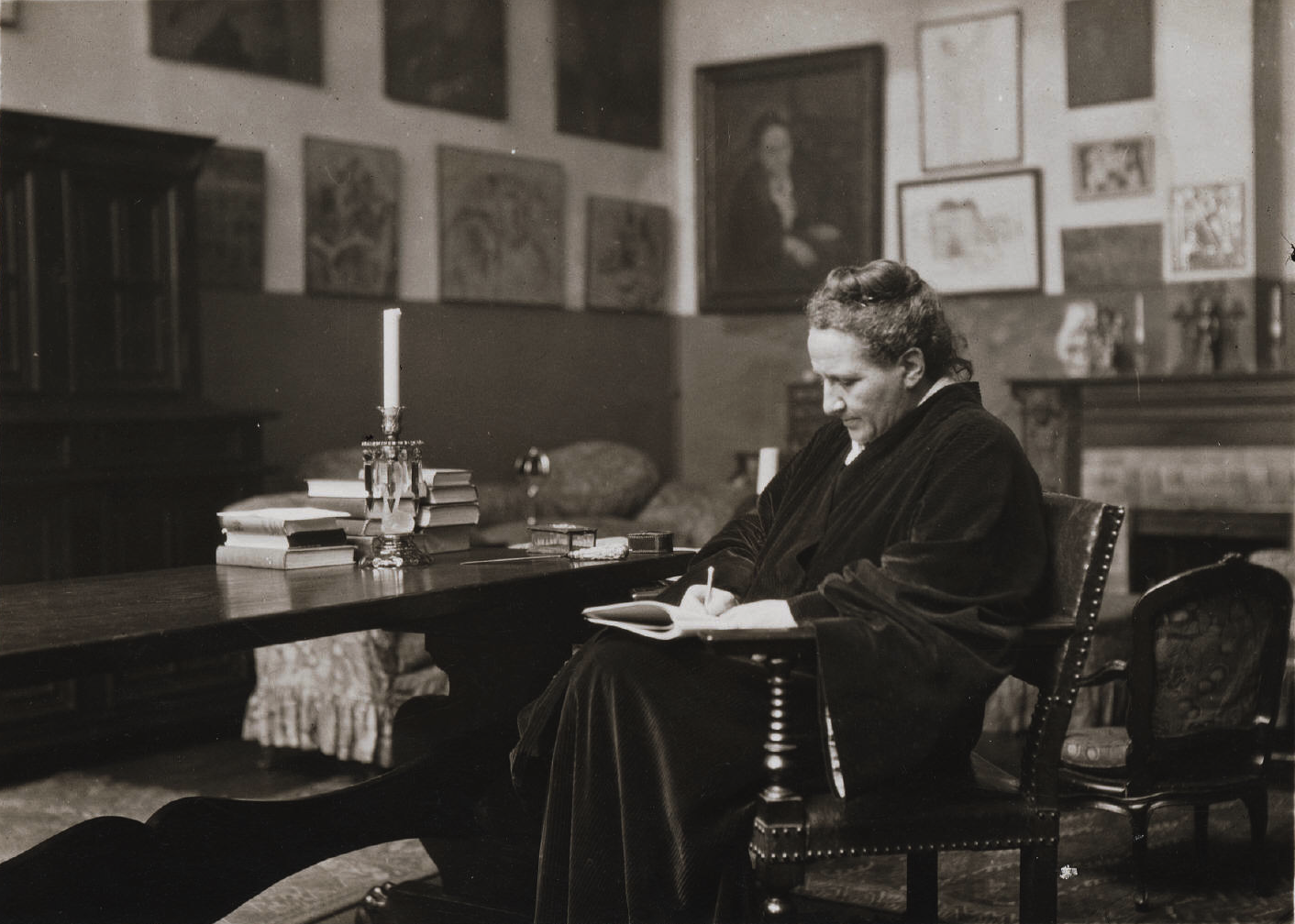
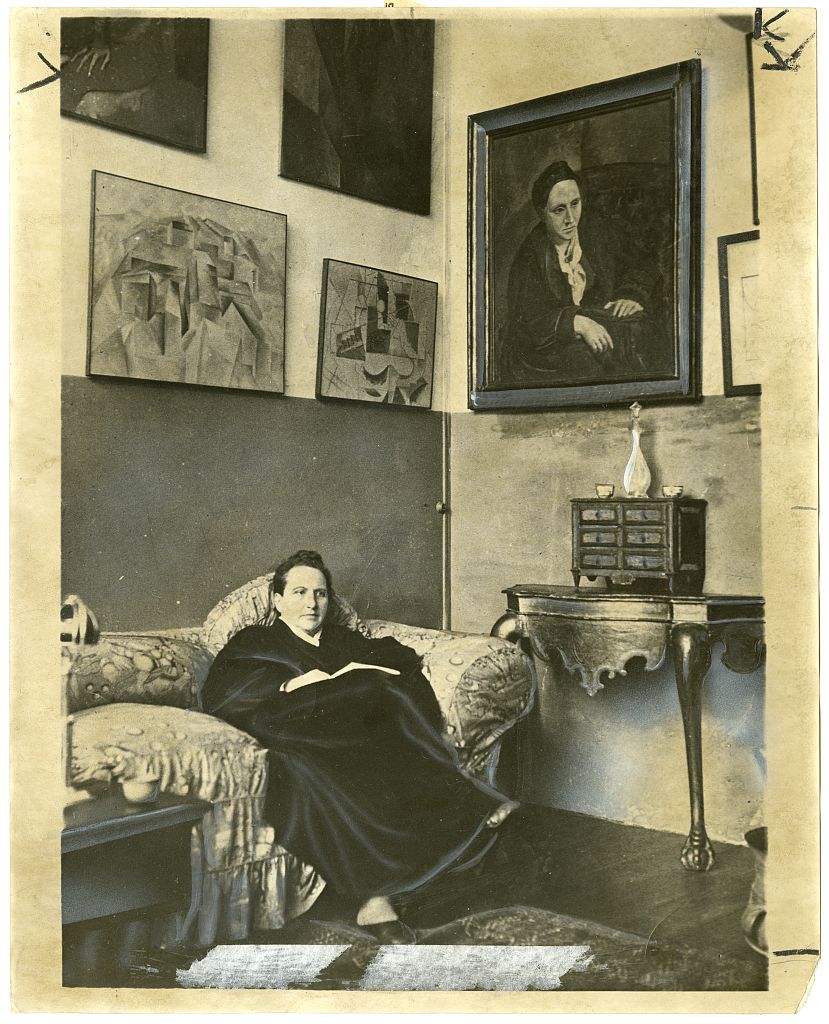
Photographs of Gertrude Stein 1.) by Man Ray, via Yale University Libraries 2.) World Wide Photos via Library of Congress
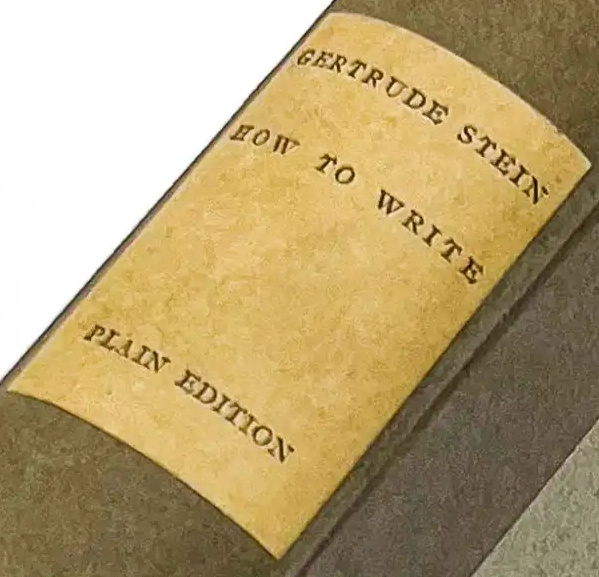
Image of binding of How to Write via Type Punch Matrix
-----
- 1For other approaches to teaching “If I Told Him” and Tender Buttons, see essays in Esdale and Mix, Approaches to Teaching the Works of Gertrude Stein. A substantial list of resources for teaching Stein is available on the companion Web site for this volume. ↩︎
- 2The decision of whether to mention the flamenco dancer is significant: if my goal is to help students appreciate the sound and shape of words stripped of denotative meaning, then I don’t want to say anything that will, for instance, make them search the text for analogues to dancing. I save that sort of discussion for “If I Told Him” and selections from Tender Buttons, where the possibility of representation is more clearly offered by the titles. ↩︎
- 3A comparison of Stein’s work with instrumental music and abstract painting can also be helpful, as students do not have the same expectation that such nonliterary art forms must be referential. ↩︎
- 4
- 5For connections between Stein and Margaret Wise Brown, author of Goodnight, Moon, see Anne E. Fernald’s delightful essay “In the Great Green Room: Margaret Wise Brown and Modernism.” ↩︎
- 6Dydo’s Stein Reader comprises experimental and lesser-known writings based on consultation of the manuscripts and presented in the order in which they were written. Particularly useful for teachers is the preface to each text, which offers not only information on the text’s composition and publication but also some guidance for reading. Kostelanetz’s Gertrude Stein Reader volume is subtitled The Great American Pioneer of Avant-Garde Letters, which the book seeks to substantiate with some of Stein’s most experimental and difficult writings, many of them short enough to be practical even for teachers who aren’t able to spend a lot of time on Stein. Kostelanetz writes a thoughtful introduction and adds short headnotes for many of the texts to highlight what he sees as their notable features, e.g., “‘Old and Old’ is sustained wordplay. If you think such writing is easy, try it sometime and discover how the constraints can be defeating” (50). ↩︎
- 7W. H. Auden’s 1941 review of Stein’s Ida can be especially useful, as it is difficult to tell whether Auden is being imitative, parodic, or both. Logan Esdale’s critical edition of Ida includes a section of reviews of the novel from its first release in 1941, including the Auden review (303-305), and these show how common it was for reviewers to attempt parodies of Stein (291-324). ↩︎
- 8Both “Composition as Explanation” and Lectures in America are available in the two-volume Library of America edition of Stein’s writings. Also worthwhile is A Primer for the Gradual Understanding of Gertrude Stein edited by Haas, which is out of print but worth tracking down, as it includes not only a helpful 1946 interview with Stein but also short selections from her writings arranged and introduced to provide an approach to reading her work. ↩︎
- 9The problem with following Dydo’s approach, though, is that few of the texts she discusses alongside How to Write are easily available, and so a teacher would need access to a library with Stein volumes that have long been out of print. Even without access to the specific texts Dydo explores, however, readers can gain much from her example of close reading, and can engage in new analyses of more readily available Stein texts alongside How to Write. ↩︎