1.
In November 2016, I was in graduate school and formulating plans for a doctoral dissertation on 20th century literature. I knew the writers I wanted to focus on (Virginia Woolf, Samuel Delany, J.M. Coetzee) and the general approach (modernism and metamodernism), but I didn’t have an angle on that work yet, nor could I explain why it seemed important to write about the topic. The election of Donald Trump, combined with various social and political crises of the time, helped clarify a lot for me. As everything seemed to be getting worse and worse, writers and other sorts of artists were asking, “What good is literary and artistic work when the world is on fire?”
I reflected on my thinking at that time in a 2018 blog post about the finished dissertation, a post I titled “Writing in Crisis”. I spent that summer revising the dissertation into a book manuscript which was published in early 2020 as Modernist Crisis and the Pedagogy of Form: Woolf, Delany, and Coetzee at the Limits of Fiction. (Little did I know, my book would be published into a crisis: the first weeks of the COVID-19 pandemic.)
In researching the dissertation, I was surprised by one “Eureka!” moment of insight, some dots I had never linked together before but that, when I saw them, suddenly seemed obvious: Starting from the question of how each writer responded to crisis, I noticed that all three had pushed fiction away from fictionality at least once. Woolf tried to write an “essay-novel” titled The Pargiters in the years leading up to World War II, Delany wrote a kind of speculative memoir with “The Tale of Plagues and Carnivals” in the early years of the AIDS crisis, and Coetzee, after the end of apartheid in South Africa, wrote a series of books as fictional essays or fictionalized memoirs (going so far in Summertime to write about a dead and less accomplished version of himself).
Importantly, the three also did not stop with this muddying of the waters of fictionality. Each actually returned to fiction: Woolf wrote the novels The Years and Between the Acts, Delany wrote a variety of novels later, Coetzee wrote the Jesus trilogy. Each writer had their own motivations for what they did, the explorations they made, and each might likely disagree with my framing of it, but the fact remains: For whatever reasons, conscious or unconscious, fiction-as-fiction felt (at least briefly) inadequate to their goals.
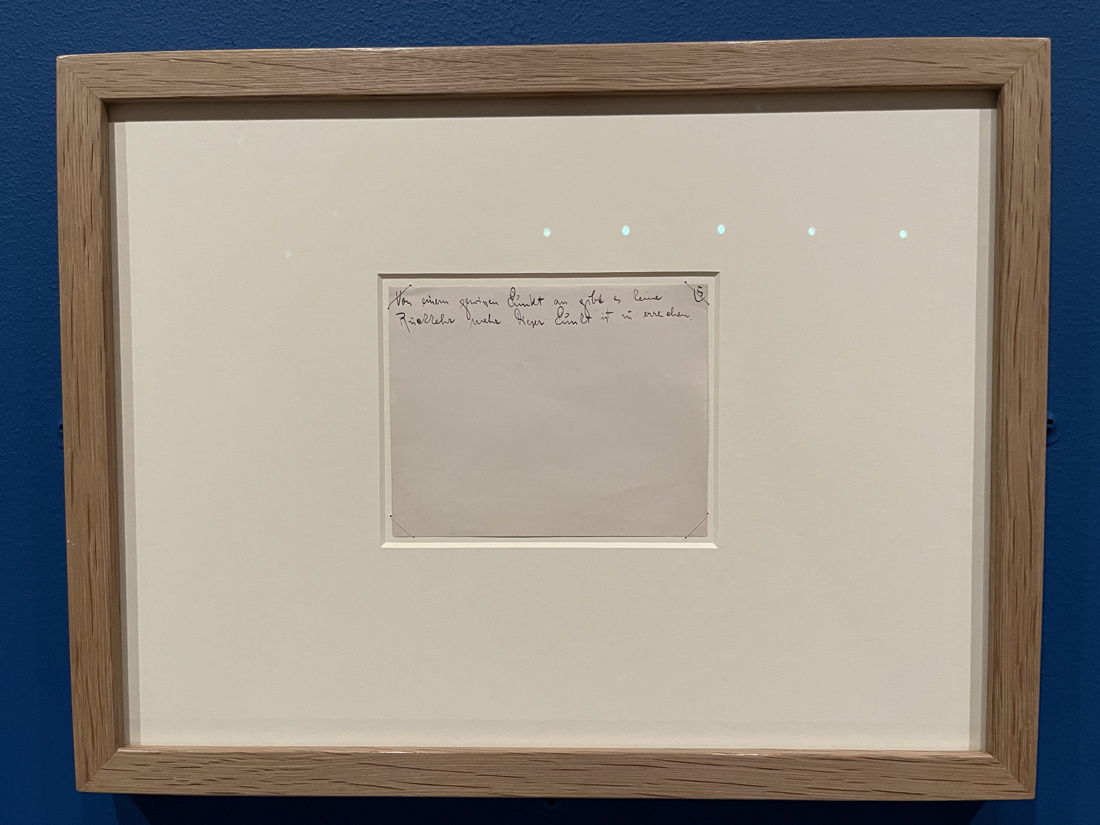
“From a certain point on, there is no turning back. That is the point that needs to be reached.”
2.
Franz Kafka is often thought to be an apolitical writer, a writer whose work sits above the fray of his era’s catastrophes. Scholarship since the 1980s has complicated this idea, and Reiner Stach’s extraordinary three-volume biography goes a long way toward showing the intersections of Kafka’s life, writing, and world. I read Stach’s books as they were each first published in English. Before reading them, I had thought arguments for Kafka’s engagement with the world beyond himself were strained.
I have loved Kafka’s work since I first read “The Metamorphosis” and “The Hunger Artist” when I was quite young; part of what I valued about him was the idea of his separation from the world, his wholly-unto-himselfness. The stories and novels are full of lone (if not always lonely) people (and animals, creatures) alienated from normality, their anxieties and passions rendering them apart from other beings, apart from the conventions of ordinary living, threatened by forces beyond themselves and beyond their understanding, even as they obsessively try to understand. I have always returned to Kafka when the events of life felt too much for me.
Stach convinced me that there was something more to Kafka than self-obsession, even though self-obsession (plus endless anxiety) was the engine of his writing. Kafka was not a political writer, but he was also not a writer divorced from politics and society.
Describing the response of publisher Kurt Wolff, who had recently been in the military, to “In the Penal Colony” in 1916, Stach writes (in Shelley Frisch’s translation):
…Kafka did not justify his work solely on the basis of inner necessity but as a symptom of the era. Evidently it took him aback that Lieutenant Wolff could look back on two years in combat and France and in the Balkans and still regard the atrocities and physical crassness in the “Penal Colony” as “painful”. Of course, the one was monstrous reality and the other mere literature. But what writer who took his own work seriously could accept this order of priority? Did he really have to explain to Kurt Wolff that literature, truthful literature, is measured by only how far it can penetrate to the core of reality? Kafka’s story had originated at a time when an orgy of violence had been unleashed in the world, a hyperreal violence that seemed to veer off into the realm of fantasy. (vol. 3, p. 134)
Stach describes Kafka’s reading of “In the Penal Colony” in Munich, the only time he read his work outside of Prague, where at least a few people in the audience seem to have felt similarly to Wolff. One Munich newspaper characterized Kafka as “a lecher of horror”.
Stach is right to highlight the apparent conflict in Wolff and other readers’ minds between “mere literature” and “monstrous reality”. That conflict remains the basis of people’s qualms today, whether with Kafka or with contemporary writers and artists who do not seem sufficiently engaged. This is the desire for art to be action, for it to take clear moral stands, to place itself in front of the guns and tanks of history and declare, “You shall not pass!”
This desire stems from a sense of helplessness. With one crisis after another bearing down on us, it is perfectly natural to want to do something. Alas, art is not that kind of something.
Here, I think of a passage from a letter Virginia Woolf wrote in August 1940 to Benedict Nicolson, which I quoted in Modernist Crisis and the Pedagogy of Form:
What puzzles me is that people who had infinitely greater gifts than any of us had — I mean Keats, Shelley, Wordsworth, Coleridge and so on — were unable to influence society. They didn’t have anything like the influence they should have had upon 19th century politics. And so we drifted into imperialism and all the other horrors that led to 1914. Would they have had more influence if they had taken an active part in politics? Or would they only have written worse poetry?
I suppose another question might be: Would it have mattered that Keats, Shelley, et al. had written worse poetry if, at least, they had found some effective way to resist the horrors of their time?
Kafka knew the nightmare of the war at least as well as any civilian in Prague, for he had seen countless men returned from the front who arrived at his office to learn what relief benefits might help them with their injuries or help them identify employers who would hire someone who had lost an arm, a leg, an eye. For years, Kafka attempted to enlist in the military, but his employers repeatedly intervened to prevent this, seeing his work for them as far more useful to the country than any benefit he might provide as cannon fodder.
One of the revelations of Kafka’s Office Writings is that as part of his job he occasionally wrote propaganda. Having been placed in charge of monitoring and advocating for therapy for people suffering from what we now identify as post-traumatic stress, Kafka made the case for psychiatric hospitals for soldiers:
…the majority of veterans with nervous disabilities who are housed in regular hospitals — what becomes of them? Even the best will in the world and greatest medical skill cannot help them today. For them there is no help in their country, which they have defended with their lives and for which they have risked their future and that of their families, for only careful treatment in a psychiatric hospital with modern facilities can help them. Since no such hospital exists, however, the fate of these unfortunate men is sealed. They will be released to their homes, their disorder still in place, thus multiplying the number of peacetime sufferers from neurological diseases, victims of never-ending, constantly increasing suffering, a torment to their families, a loss to the German-Bohemian people’s power, and candidates for the insane asylum. Is this to be the way German Bohemia rewards its sons? (p. 340, trans. Eric Patton & Ruth Hein)
The war provided daily horrors for Kafka. Many of his friends and acquaintances fought in it. Bohemia suffered deadly shortages, leading at times to starvation. The wounded were everywhere. Through his work, he was both confronted by the realities of battle and tasked with finding solutions for thousands of soldiers.
And yet Kafka’s diaries and letters barely mention any of this, and we can only see it in his fiction by reading the war into ambiguous and polyphonic allusions. In the last years of the war, his writing often became more and more abstract (see, for instance, the Zurau aphorisms), as if the stuff of the world were simply too much to bear in the words he wrote during insomniac nights.
There were, of course, more engaged writers during and after World War I. Think of Eric Maria Remarque and All Quiet on the Western Front, one of the greatest of anti-war novels. And many other writers, not writing directly of the war, wrote from its aftermath — so much of modernism as we know it would not exist without the grief and destruction of World War I.
And yet. Writers did not end the war. Writers did not prevent future wars. The 20th century continued on with all its carnage and monstrosity.
Most of Kafka’s surviving family, and many of the people he knew, were killed by the Nazis.
3.
Ours is a time when the idea of factuality has been undermined, if not destroyed. In such a time, we should look again to the idea of fictionality’s relation to fiction. For that, I think of the popularity of what gets called, often with scorn, autofiction. (My 2022 conversation with Richard Scott Larson about queer autofiction may be meaningful here.)
As readers and writers, we may be tempted toward the (fundamentally 19th century) model of the social novel, but that seems to me a dead path. More vital paths for prose narrative these days need better, less conventionalized techniques to explore and reflect on our crises of factuality, of consensus reality, of trust. Additionally, we face a crisis of emotion: everybody in America seems traumatized and flailing, with anger and despair swirling as persistent robber-baron capitalism scours the land. Ours is a crisis of knowledge, a crisis of confidence, a crisis of myth, and a crisis of everyday living — a crisis of how to make a life, how to sustain a life, how to make meaning from life. This is not a new crisis. But it is not addressed by the hapless politicians of the Democratic party, always promising hope and change, always delivering compromise and technocratic tweaks to the rotting corpse of the social body.
One path toward meaningful narrative (or anti-narrative) today may be something like autofiction, especially if it can cast off some of the more sclerotic and narcissistic conventions of memoir. The best and most innovative works of autofiction bring the personal and political together in ways that are different from journalism, different from pamphleteering, and different from obvious moral allegory. They highlight the slipperiness of fact and fiction, but do so without denying either factuality or the power of imagination and myth.
One value of narrative is that it can be humanizing. I’m not sure that’s the best word, because during a time of environmental devastation — indeed, ecocide — we need to get beyond seeing the world in terms of the human, but perhaps the word can mean more than simple anthropomorphism. It is an inescapable fact that humans are the driving force of environmental change and the dominant species on the planet. We need more books like Christopher Brown’s A Natural History of Empty Lots, books that explore and tease apart the complexities in human and nonhuman interrelations. But we also need fiction, we need the imaginative potentials that fiction alone unlocks, the power gained from saying, “Let’s pretend…”
Ultimately, what I’m seeking is something like an empathic sublime. A broadening of sensibility, one which may necessarily have to start with the human, but which does not end there.
As factuality is degraded in the current moment, so too is language. Though I have disagreements with George Orwell’s “Politics and the English Language”, Orwell’s great general insight there and in Nineteen Eighty-Four was to see that tyranny relies on the corruption of words and sentences, grammar and style. This is related to the undermining of fact, which is also the undermining of reality.
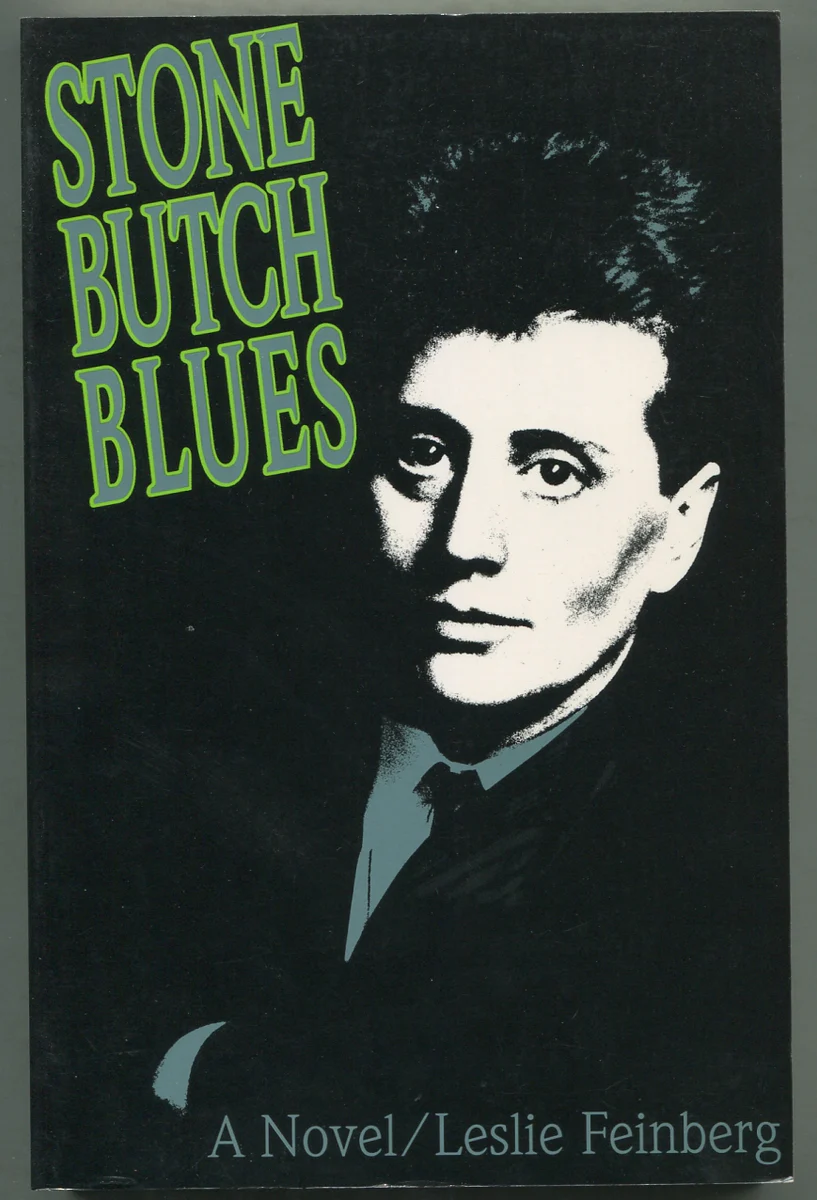
There are limitations to linguistic relativity, but we must consider the ways in which words allow or restrict possibility. The history of queerness is not just a history of identity and desire, but also a history of words. Read older queer writing and you see the ways that vocabulary made some things visible and others not. (Stone Butch Blues by Leslie Feinberg is an excellent text for this.) I’ve seen it just in my own lifetime with the rise of the word nonbinary and how it has allowed people who previously struggled to communicate their difference, feelings, and experience of living to now have an easier way to assert who they are. This is not only a matter of clarity but a matter of imagination.
Fascism is always at war against imagination. Fascism declares that categories are immutable and eternal, that words must stay the same, that vocabularies must be controlled by the ruling power. Authoritarians have only two strategies: control and confuse. Whether on the right or left, authoritarians are always prescriptivists, and the prescription is whatever fits their own narrow prejudices and fears. What they can’t control, they obscure. They empty language of meaning rather than fill it rich to bursting with multiplicity. This is why avant-gardes die when they become formulaic or conventional. Only the shock of the new has real power to reconfigure paradigms, prejudices, possibilities.
The danger of authoritarian language is not that it is obscure. Plenty of interesting, powerful, and productively shocking language is obscure — it is artistic language, language seeking not to empty meaning but to push aesthetics toward new realms of meaning. This stands against control-minded confusion.
Aghast critics point to what they call Donald Trump’s tendency to speak in word salads, but his triumph was one of tone, not logic. His nonsensical speech is the perfect weapon against a system in which a certain type of rationality has long been venerated. (In this, he has something of the gift of Ronald Reagan, who also understood that tone is more important than meaning.) News media that could not see outside the system of basic rationality, where candidates are expected to at least pretend to have coherent policy positions, were caught flat-footed by Trump and found themselves lost and manipulated. (This is partly why the New York Times, perhaps the venue most deeply committed to nostalgia for the system of basic rationality, was rarely capable of meeting the dangers of this moment.) While he was spouting gibberish, Trump did so in a tone of power, entitlement, and mocking humor. Plenty of people who voted for Trump thought he held positions quite different from the ones he actually does, or justified their support of him by saying that he doesn’t mean what he says. They liked how he sounded, his mix of entertainment and belligerence, his projection of dominance.
Any art that undermines the ability of authoritarian language to entertain with its machismo, any art that chips away at the strongman pose, is working, in a small way, to weaken the deathgrip of authoritarianism. No one work is likely to achieve much, but a mass of such art may. But we must remember that art is both a howl against the suffering imposed by cruel leaders and a slow-burn long game whose effects are rarely immediate and rarely predictable.
Sometimes, or maybe even oftentimes, it is not a matter of the work itself so much as what the work brings out in one who receives it. I think here of a conversation I had with a student recently about J.K. Rowling and the Harry Potter books. This student is trans and was struggling with his long love of Rowling’s books, wondering how he could have taken so much wonder and sustenance from the work of someone who has so publicly stood against trans rights and existence. I said that his experience of the books was what mattered, and if he could hold onto that experience, perhaps the creator of the books was not so important. He said that is what he and some trans friends who are also fans had done. They had used the material Rowling created for their own purposes, their own lives and visions, let it be part of their conversations, supported each other in writing fan fiction that Rowling would hate. That, too, is important work in any crisis. Turn the text toward you, let your understanding of it be shaped by your experience, and find comfort and liberation wherever you can. That is practice for changing the world.
5.
Writing is not everything, but writing is what some of us are best positioned to do.
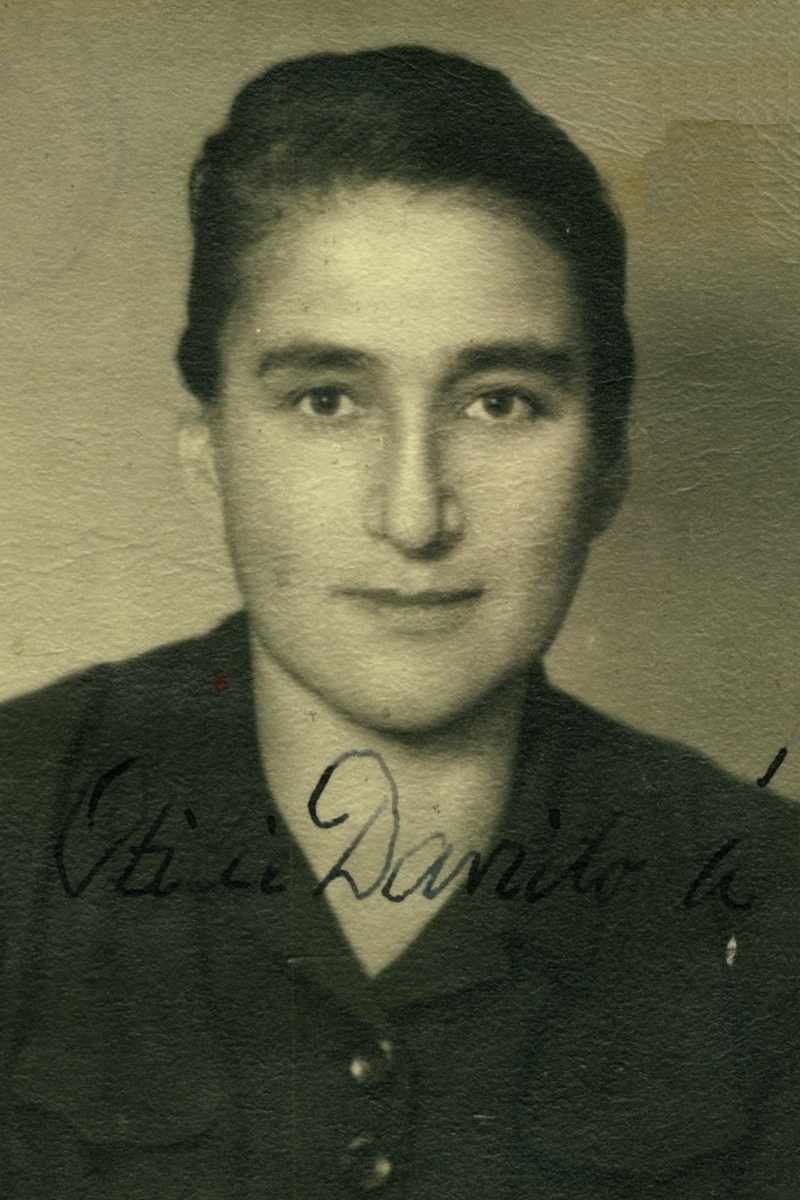
We remember Franz Kafka now because of what he wrote. When considering crisis, we should also remember his beloved sister Ottla. The description of the last year or so of her life in the introduction to Letters to Ottla & the Family is stunning.
Ottla had married a non-Jewish man, Josef David, with whom she had two daughters. Her marriage protected her from deportation to a concentration camp. For various reasons, she convinced David to let her divorce him to protect him and so that their children might have some rights to the Kafka family property. They had a loving marriage and David resisted, but Ottla convinced him eventually. They divorced, she registered as a Jew, and was transported to Theresienstadt. Translator N.N. Glatzer writes that “in October 1943, Ottla volunteered to accompany a transport of children to the death camp at Auschwitz.” There she died.
Hold it in your mind for a moment and imagine the scene: Ottla, knowing what fate likely awaited those children, chose to sacrifice herself to be able to be some sort of comfort to them, a familiar and caring person to accompany them toward the most frightful place. Ottla’s actions did not end the war any more than Kafka’s writings affected the earlier war, but she sacrificed herself to provide her family some future, and then did what she could to comfort frightened children as they rode in cattle cars to their doom.
There are many ways to write in a crisis, just as there are many ways to live in a crisis. The noble ways are the ones that produce some sort of clarity or reduce some amount of suffering in a blasted world.
—-
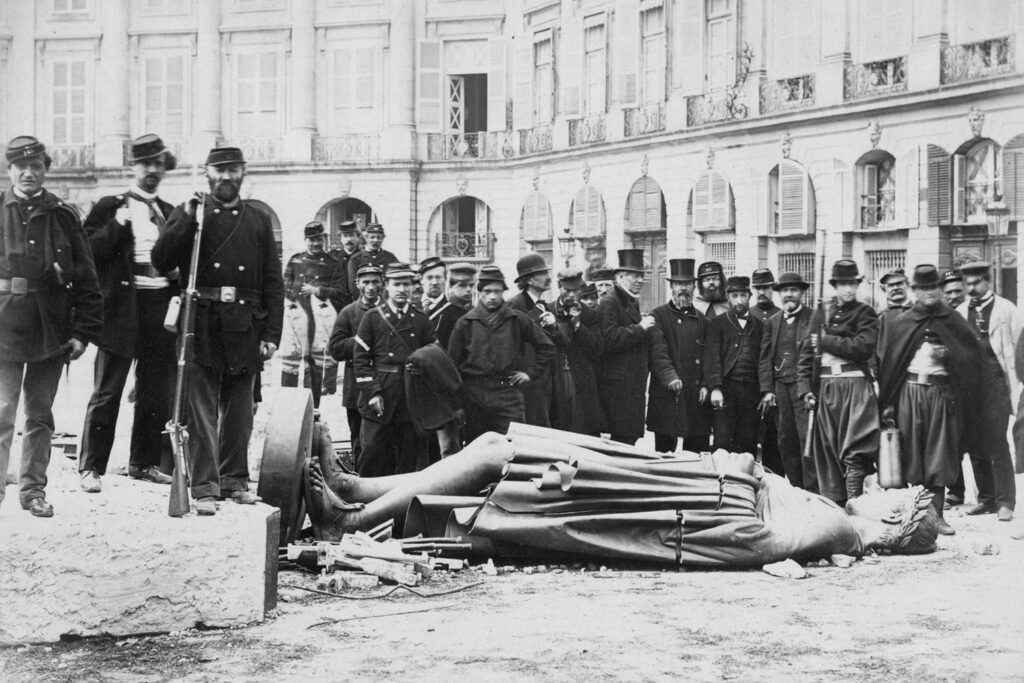
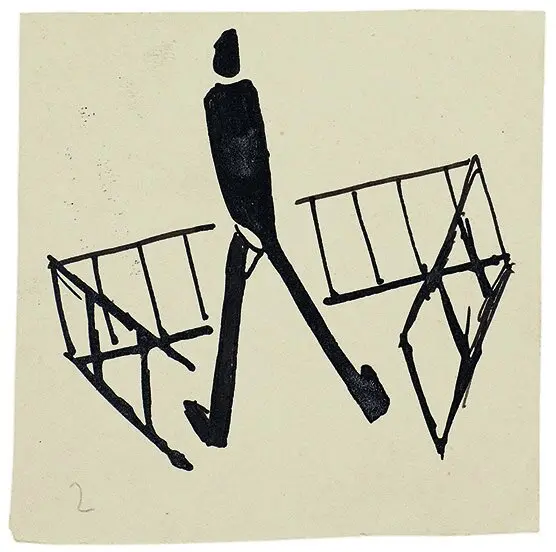
Images: Destruction of the Vendôme Colonne during the Paris Commune, by André-Adolphe-Eugène Disdéri, 1871, via History Today. Kafka’s fifth Zurau aphorism from the exhibit “Franz Kafka” at the Morgan Library (photo by MC). Drawing by Franz Kafka via NY Times. Photo of Ottla Kafka via Wikipedia. June 2021 image of Earth via Nasa.
Discover more from Matthew Cheney
Subscribe to get the latest posts sent to your email.
