1.
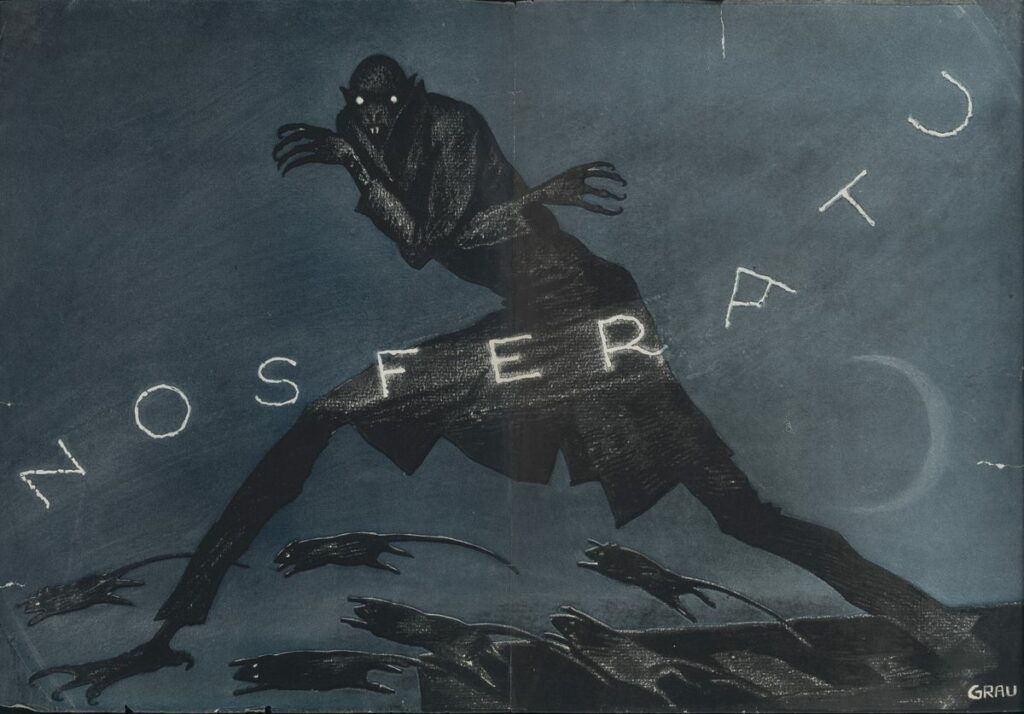
In both F.W. Murnau’s 1922 Nosferatu and Werner Herzog’s 1979 reimagining of it, the lasting beauty for me lies in the films’ presentation of love as something momentary and evanescent, and the way that real love ends up being strengthened by sacrifice — even when, as in Herzog’s film, that sacrifice is mostly futile.
This is, let’s be honest, the truth of love: It doesn’t last. Death conquers all. Most of us get forgotten a generation or two after our deaths, regardless of how deeply and purely we loved and were loved. Love is ephemeral, loss constant. Mortality couldn’t care less about our warm and happy feelings.
And yet… There seems to be something worthwhile in pretending that we do not know that we and all our loves will die, rot, and be forgotten; and there seems to be beauty in embracing the brief boons that happen upon us during our journey from birth to the graveyard. This is the lesson of the best vampire stories. The vampire is cursed to immortality, a fate worse than death. Eternal love is not possible, and so the vampire is an exquisite figure of suffering. The vampire is slave to hunger and desire and doomed to endless existence and only brief gratification.
As plenty of other writers have noted through the years (see, among many others, Nina Auerbach, Judith Halberstam, Jeffrey Weinstock, Nick Groom, Simon Bacon) vampire stories are tales of foreignness, otherness, consumption, repression, and sexuality. Donna Haraway describes the figure of the vampire as “the one who pollutes lineages on the wedding night; the one who effects category transformations by illegitimate passages of substance; the one who drinks and infuses blood in a paradigmatic act of infecting whatever poses as pure; the one who eschews sun worship and does its work at night; the one who is undead, unnatural, and perversely incorruptible.” Terrifying and alluring, alien and familiar, the vampire holds us in its cold embrace.
Stoker’s genius was to find a nearly perfect balance between the details of his story and a nearly infinite possibility of meanings for his monster. (Halberstam is particularly good on this feature of Stoker’s creation.) The shallowest vampire stories try to turn the vampire into a representation of only one such meaning, one possibility, one implication; the best stories never narrow the vampire’s meaning, but uncover in the undead a fruiting body of signs and wonders.
For me the power of the vampire as a figure has always been in a mix of loneliness and queerness. Certainly, there are presentations of vampires that are not lonely or that are strongly heterosexual, but since at least Le Fanu’s “Carmilla”, they are the minority.
I try not to be too possessive about such things, but for a long time I’ve simply felt that the vampire is ours. In The Culture of Queers, Richard Dyer writes:
The vampire returns time and again in popular homosexual writing. Nina Auerbach suggests that the foundational texts of the modern vampire tale, Lord Byron’s ‘Fragment of a Tale’ (1816) and John Polidori’s ‘The Vampyre’ (1819), are based, and fairly evidently, on their authors’ morbidly homo-erotic relationship. Der Eigene, a gay male magazine published in Berlin by Adolf Brand from 1896 to 1931, contained much vampire imagery in its fiction and at least one complete vampire story. The British ‘bisexual’ magazine of the early seventies, Jeremy, published in one of its first editions Count Stenbock’s ‘The True Story of a Vampire’, a queer vampire tale first published in 1894. Although not written by a gay man, Anne Rice’s vampire novels, beginning with Interview with the Vampire in 1976, became cult gay reading, not least because homosexual love is in them an inherent part of the ecstasies of vampirising.
I’ve elsewhere recounted that when I was in the eighth grade I wrote a vampire story and my teacher recognized the homoerotic subtext that had not been consciously apparent to me. (I loved vampires when I was a kid. Alan Ryan’s anthology Vampires was a cherished book, one I still have on my shelves.) Hearing (with horror) my teacher’s reaction to my story was the first time I remember being aware of nascent, confusing feelings that would ultimately coalesce into a desire for love from men. Those feelings felt deeply shameful … but more than that, they felt terrifying, alienating, annihilating.
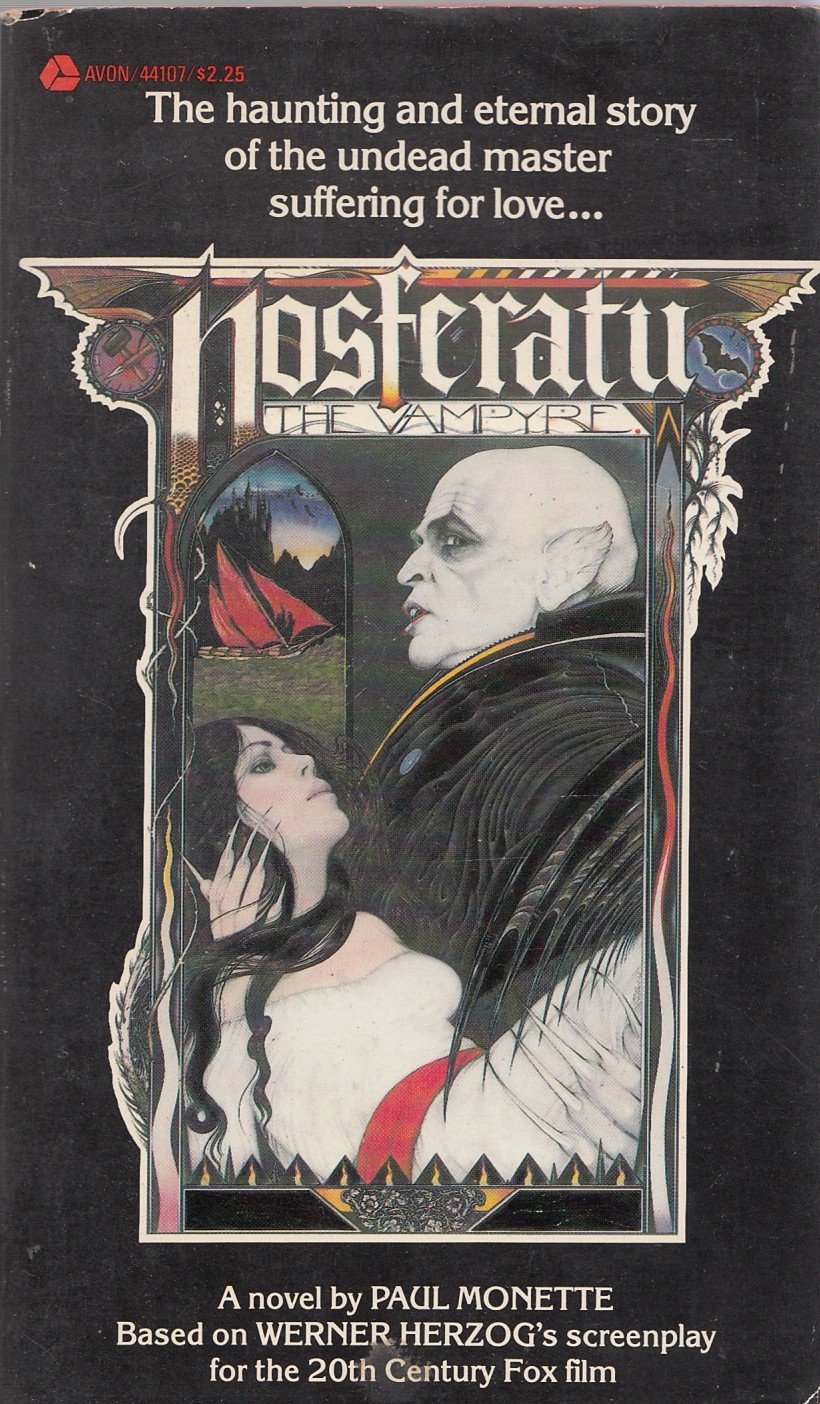
In his novelization of Herzog’s film, Paul Monette describes the end of Jonathan Harker’s first conversation with Dracula:
There was something more that Jonathan wanted to say, something he was terribly sorry for. He felt his limbs going numb as if he’d been drugged. Only a minute ago, he thought deliriously, he had committed some kind of crime. But he couldn’t remember now. He swooned and went under, and the last sensation that gripped his heart was guilt. He was in a state of sin, and he didn’t even know what it was.
2.
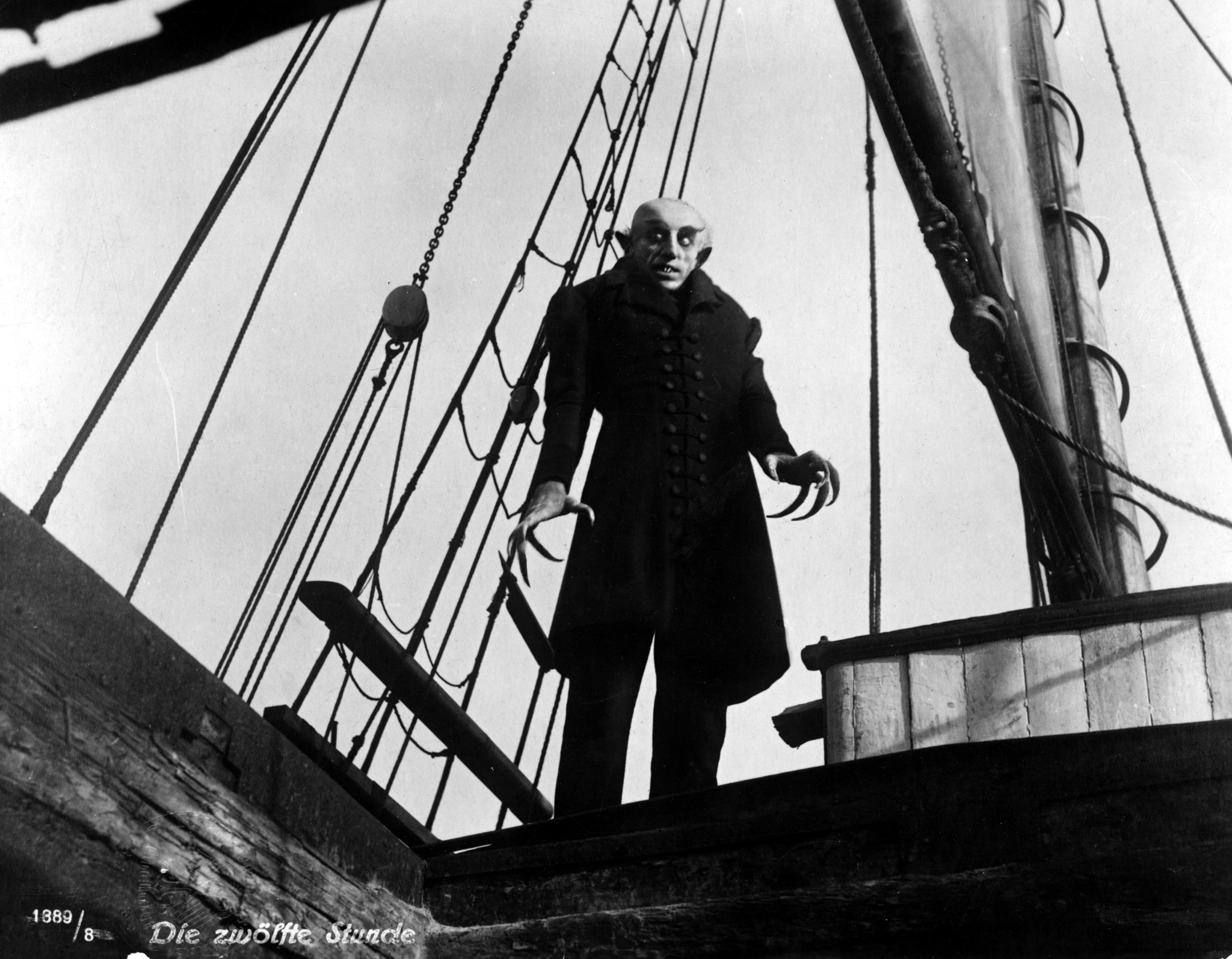
I don’t remember when I first saw Murnau’s Nosferatu. High school, I expect, on a VHS tape. A recommendation from my father, who was obsessed with all things German, especially if they were horrific. He probably videotaped it when it played on tv on night. In library books about horror movies, I had seen pictures of Max Schreck as the title character before I saw the film. I expect the movie disappointed me at first, seeming slow and primitive. But something about it stuck in my imagination. In college, Nosferatu became a bit of an obsession. I was at New York University and so had access to a world-class library and some of the best video rental shops on the planet, so I soon was able to study Nosferatu closely, and I did. I did not care about much except the scenes with Max Schreck. Something about Nosferatu’s plight moved me deeply. Condemned to life, condemned to loneliness, condemned to feed off of people he could never really understand and who could never feel anything for him except revulsion.
A year or two after college, I was visiting a friend who worked at the University of New Hampshire. Her daughter was going to the nearby city of Portsmouth to see a schoolmate’s play being performed, a play first produced at their high school, but then invited to be staged at one of the little theatres in the metropolis. Would I like to go along? The show was an adaptation of the old silent movie Nosferatu.
I remember thinking how odd and precocious it was for young people to adapt a very old German movie … but also so typical for the children of that university town. To be honest, though, intrigued as I was, and despite being a high school theatre teacher myself at the time, I was not enthusiastic about seeing a show created by high schoolers based on one of my favorite movies. Still, I was also curious, and my friends were going, so why not…
It was quite a production. I remember very little of it all these years later except that the theatre felt small and cramped, reminding me of many black box theatres I had been an audience member or performer in in New York. The costumes, set, and make-up were all in black and white, one of many bold design decisions. While I had been afraid the show would be a lark, making fun of how silly an old movie was, the students seemed to really love and respect Murnau’s film.
My friend’s daughter’s friend Rob was the director and writer, as well as the actor playing Count Orlok, the vampire. We talked with him afterwards briefly. I congratulated him, probably without any ability to hide my astonishment that high schoolers had not only pulled this off, but had wanted to do it in the first place. I remember feeling admiration and a certain envy. Imagine going to a high school where such efforts would be supported and encouraged, where other students would share your esoteric interests! I had never experienced anything like it, even in college in Manhattan. Every interest of mine always seemed to push me more toward the margins. That was one of the reasons I left New York and abandoned all aspirations to enter the world of professional theatre and film. I could find no room for myself there, no air, no space, only constriction, confusion, and rejection. I remember thinking: I hope the world doesn’t crush this kid the way it has crushed me.
Years later, my friend’s daughter asked me if I remembered that production of Nosferatu we’d seen. I said yes, and she said the kid who created it, Robert Eggers, had just made his first movie, a strange New England horror story called The Witch. He eventually wanted to make his own Nosferatu movie, she said.
A few days ago as I write this, Eggers’s Nosferatu was released in movie theatres around the world.
3.
In 1979, Werner Herzog’s film Nosferatu the Vampyre was released. The film pays homage to and reimagines Murnau’s 1922 Nosferatu, melding the animalistic weirdness of Max Schreck as the monster with the predatory loneliness of Klaus Kinski, a true monster in real life whom Herzog alone was able to corral and, for brief moments of filmmaking, tame.
As publicity for the film, Twentieth Century Fox released a novel based on Herzog’s screenplay, a novel written by Paul Monette. Monette was at the beginning of his career; he had published a book of poetry in 1975 and his first novel, Taking Care of Mrs. Carroll, had been published in 1978. Along with Nosferatu, he had his second original novel, The Gold-Diggers, out in 1979. His own novels were gay comedies, light and forgettable.
Nosferatu is something else. Monette would go on to write other novelizations through the ’80s, including for Scarface and Predator. They were quick and easy money. Nosferatu was his first, with the studio and publisher perhaps thinking an arty European horror movie was a safe way to test out a new writer, since expectations for sales were likely small. And Monette seemed to want to prove himself — as 1970s and ’80s cheap novelizations go, this one is remarkably well written and compelling. We might assume that, as a gay writer, Monette would play up the campy elements of the story or heighten the homoeroticism, but he does not.
The only person I know of to have paid any attention to Monette as a novelizer is Ander Monson, who wrote a fascinating book about the first Predator movie. Of that novelization’s surprising artfulness, he says something that is also true of Nosferatu: “[Monette] didn’t need to make it beautiful; he only needed to make it fast. Yet he did both things. Did he find the story itself beautiful? Or did he find a way to locate beauty in the story? Maybe as a poet he couldn’t stop himself from orienting toward beauty in whatever guises he could find it.”
What is most haunting now about the Nosferatu novelization is how much Monette turned it into a story of apocalypse. He emphasizes the plague in narrative ways that Herzog’s film does not, and all of the most grotesque and horrifying imagery is related to the plague rather than to the vampire’s monstrosity. Monette writes with bleak power occasionally leavened by dark humor. For instance, this bit of grisly surrealism describing the plague-maddened city:
Outside the old hotel, a cluster of urchins played hide-and-seek in a pile of lacquered furniture and damask drapes. A man with sores all over his face was wearing a horse costume — the rear half of it anyway. He drank a long draught of claret out of a wine-skin, and then, as the doctor passed, he let out a long whinney of laughter. The doctor looked over. His eyes widened in disbelief when he saw that the carcass was real. The rats had eaten their fill, and the man crawled into the corpse as if he could change his fate and run away on ringing hooves. Van Helsing knew, as he hurried along, that no plague had ever so dehumanized a people. The maniacal laughter of men in the streets mocked his love of reason. Nuns flagellated each other on the convent steps. A man sold a tulip to a corpse. The foaming policeman arrested a goat. All of them told him his science had come to an end.
This is significantly more grotesque than anything in Herzog’s script (which was published in 2019 by University of Minnesota Press).
Of course, when he wrote this, Monette had no way to know that about five years later he and his friends and loved ones would be facing a plague of their own. In Borrowed Time, he would write: “Many full-blown AIDS patients on long-term AZT have become transfusion-dependent. They have also gotten fairly blasé about the vampire part; but we still thought of transfusion as a grave and unsettling procedure.”
And in an essay (“Sleeping Under a Tree”) in Last Watch of the Night, he wrote of insomnia: “What the uninitiated can’t seem to understand is the core banality of our empty nights. We may see ourselves in zombie terms, as a species of the undead, especially when we gaze at our gray and clammy faces and raccoon eyes in the mirror. But we most definitely lack the glamorous enervation of the vampire, pricked by insatiable hunger and a ravening of need, the fallen-angel mascot of the waking night.”
How, I wonder, might Monette have written Nosferatu five or ten years after he actually did?
4.
In a 1980 article, James Twitchell (who the next year published The Living Dead: A Study of the Vampire in Romantic Literature) wrote: “The [vampire] myth is loaded with sexual excitement; yet there is no mention of sexuality. It is sex without genitalia, sex with out confusion, sex without responsibility, sex without guilt, sex without love — better yet, sex without mention.”
Of course, that’s not been the case with vampire books and movies, plenty of which are at least erotic, if not outright pornographic. Nonetheless, I think Twitchell is right about the myth itself having a kind of embedded repressed sexuality. And that’s a part of its allure: sexuality rendered into metaphor. It makes me think of Mark Doty’s discussion in The Art of Description of May Swenson’s poem “Little Lion Face”, a highly sexual poem that does not mention sex:
“Little Lion Face” is decidedly a poem of female sexuality. The vehicle provides a bit of a “veil” here that allows Swenson to explore a heated, charged experience, one I doubt she would have inscribed directly. … There is a certain pleasure, isn’t there, in pretending the poem’s only about picking a flower? A delight in a (thin) disguise? When I discussed this poem in a lecture in Logan, Utah, a number of Swenson’s surviving relatives were present, and one took exception to my characterization of this piece as a poem of same-sex love. “That,” she said, “is just how we used to play with dandelions.” I felt a little bad for May, dead all these years and her family still wanted her to hush up! But I also remembered a student of mine who wept when we read this poem in class, because it was the first poem by Swenson anyone ever discussed in my student’s academic experience, and a poem in which her own erotic experience felt so clearly mirrored. This is an excellent example of the way a good veil works: you can see just the veil itself, if you choose to. But if you want to, or you know how, you can read what lies beneath.
5.
In 1920, F.W. Murnau directed a film that, like many of his early films, is presumed lost: an adaptation of Robert Louis Stevenson’s Dr. Jekyll and Mr. Hyde titled Der Januskopf (“Janus-Head”) in which Dr. Jekyll’s butler was played by the Hungarian actor Béla Lugosi. The cinematographer of Der Januskopf was Karl Freund, who in 1931 would be the cinematographer for Todd Browning’s Dracula, with Lugosi in the title role. (Conrad Veidt, star of Der Januskopf, scored a Hollywood hit with The Man Who Laughs and was considered for the role later offered to Lugosi.)
How might we read Murnau’s homosexuality into Nosferatu? Murnau was a fiercely private man who cultivated an image of aloofness that served him well as armor — and continues to do so to this day, as we can see from the relative paucity of biographical writing about him within the large secondary literature on Weimar German cinema. (It is not, then, surprising that one of his few close friends was the similarly private and aloof Greta Garbo, herself almost certainly bisexual.) In an interesting and provocative reading, Barry McCrea argues that Stoker’s novel is filled with homoeroticism because it is a story written from within the closet looking outward at heterosexual relationships, and thus is obsessed with the “clearly defined relationship between private and public would be disrupted and complicated, how alienating it would be, if one’s innermost sexual desires were authorized and scripted by official, exterior discourses.” The same could certainly be said of Murnau’s film, but there is the added element of loneliness within inescapable monstrosity.
In the 1922 Nosferatu, unlike many other adaptations of Dracula, the vampire is not debonair or sexy — he is repulsive, alien, rat-like. He is not someone ordinary humans would fall in love with. His appearance causes screams, revulsion. He is immortal but utterly alone, doomed to live only for his hunger, his desire. In the end, it is this desire that leads to his downfall, for he is tricked by Ellen into believing she loves him and wants to be with him, and he stays with her too long, forgetting all he knows, letting go of his caution, dying in the morning sunlight. In Murnau’s film, he is tricked into sacrificing himself for love, just as Ellen sacrifices herself for her beloved husband’s life, purifying the world. It is a noble and romantic ending.
When Werner Herzog, who ranks Murnau highest among German filmmakers, made his adaptation of Nosferatu in 1979, he changed the ending a little bit to render all the characters’ sacrifices ultimately fruitless. Murnau’s film is in many ways a work of German Romanticism; Herzog’s is quite the opposite, despite drawing on Romantic imagery and tropes. For Herzog, sacrificing oneself for love makes no sense at all in a universe indifferent to human joy and suffering. Nosferatu’s yearning in Herzog’s film is no more or less pure than Jonathan Harker’s, no more or less deserving of respect, though the vampire’s love may ultimately be more effective in the world, because the vampire is a predator, bound, like all of nature, to carry death wherever he goes.
The lesson of the creatures cursed to be undead is that all living ends. Undeath is a purgatory, a long last gasp of existence, but existence hollowed out, reduced to nothing but appetite, emptied of the meaning that life’s ephemerality provides.
6.
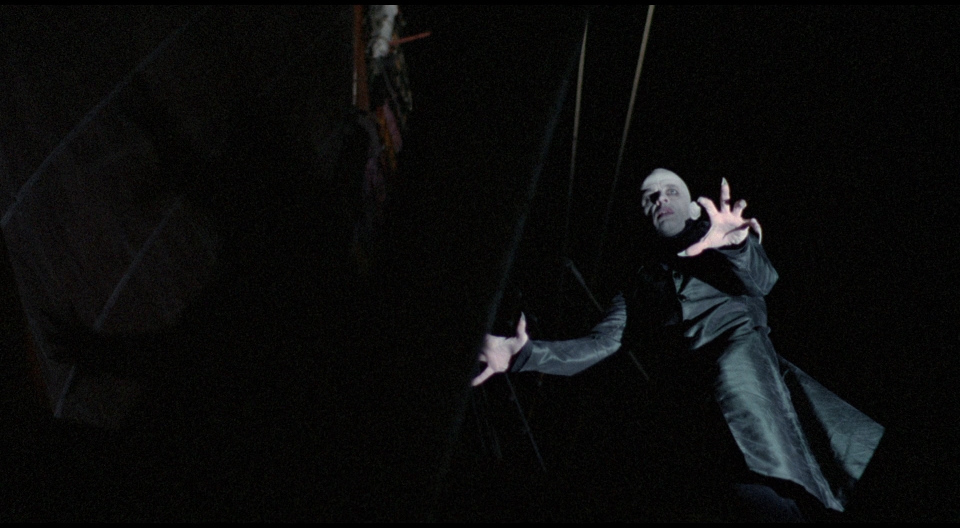
In his novelization of Werner Herzog’s Nosferatu, Paul Monette again and again captures and accentuates the apocalypticism and loneliness inherent in Herzog’s vision. Monette’s novel is, if anything, even bleaker than Herzog’s film. It is a portrait of doomed people in a doomed world, a world where love cannot survive, cannot triumph, cannot achieve anything like transcendence. By the end, it presents a landscape of annihilation and absolute solitude, a place where even the greatest power in the universe is not able to escape the isolation of existence:
“There is no need for all this drama. Everything will be fine. The Lord will hear our prayers, as he always has.”
“The Lord?” she asked, as if she could not place the name. She drew her hand away from Mina and stood and stared out onto the canal. “The Lord is so far from us now. He cannot hear a word. The sound of the whirlwind drowns us out. But I think I do not blame Him. He has had to bear so much evil. I think he is quite as alone as we are now.”
The sacrifice of the lead woman in Nosferatu (named Ellen in 1922 and 2024; Lucy in 1979) is never worthless, however, even in Herzog’s bleak construction of the story. In 1922 and 2024, the sacrifice successfully saves the world; in 1979 it saves the city and gives the world brief respite. For Herzog, vampirism, like the plague or fate, always lurks, waiting in its host to grow strong, moving ever onward, seeking the ideal environment in which to thrive and feast. But isn’t that the simple condition of life for mortals? We never actually triumph. We make space for health and happiness as best we can, knowing all the while that health rots and happiness is no more substantial than whispers in the wind. The fact of impermanence shouldn’t move us toward resignation and retreat. What the experience of the vampire teaches is that impermance is the only real source of fulfilment, satisfaction, pleasure … maybe even love.
7.
Robert Eggers’s 2024 Nosferatu is, like all of his films, meticulously designed. He has said in various interviews that if he had not become a filmmaker he might have become an archaeologist: material history obsesses him. For me, this creates a certain inertness in his work, but since The Witch I’ve thought that my struggle with that aspect of his work was less a criticism of it than a simple difference of interests and priorities — I like history of all sorts, spend much time thinking and reading about it, but in art I value imagination over anything material or historical.
With Nosferatu, I think there is one significant, unfortunate effect of Eggers’s obsession with historical accounts: the monster design.
Of course, making Nosferatu, the filmmakers faced the challenge of the two previous Nosferatus, Schreck and Kinski, being so visually powerful as to have become iconic. Do you try to pay homage to those designs, or go in a different direction? Eggers chose the latter, which is probably best, but he then made the, I think unfortunate, decision to design the monster based on old Romanian legends, which posit the vampire as basically a blood-sucking zombie. So the Nosferatu of 2024 looks like a reanimated hussar corpse. (With a prominent mustache, perhaps in homage to Stoker’s description of Dracula having a “long white moustache”.) In an age of endless zombie movies, though, such a presentation of the monster doesn’t feel uncanny, doesn’t feel rich in meaning, doesn’t feel like it is taking advantage of all the imaginative possibilities the vampire figure offers. Eggers has let his historical fetish dull his sense of fantasy.
There’s a part of me that wonders — I’m sure unfairly — if this is not the consequence of an insistently heterosexual vision of Nosferatu. The film is explicit: we see a full-frontal Nosferatu (he may be a rotting corpse, but his fleshy member is intact!) and some heterosex scenes. By rendering Nosferatu as a manly-man, though, we lose the implications of decadence and effeteness the figure possessed first via Stoker and then Schreck and Kinski, and so we lose all the resonances that made the vampire a queer figure. This is complicated, because of the complicated relationship of queerness to decadence, effeteness, gender roles, etc., but the cultural history of the vampire at least since Dracula in 1897 has accumulated a rich legacy of associations.
Eggers seems to have decided that since Nosferatu is set in a time before the events of Dracula, before the 1890s era of Decadence, that the monster needed a more earthy and almost stereotypically masculine representation. The consequence of that decision is to make the 2024 Nosferatu the least vampiric of vampire movies.
8.
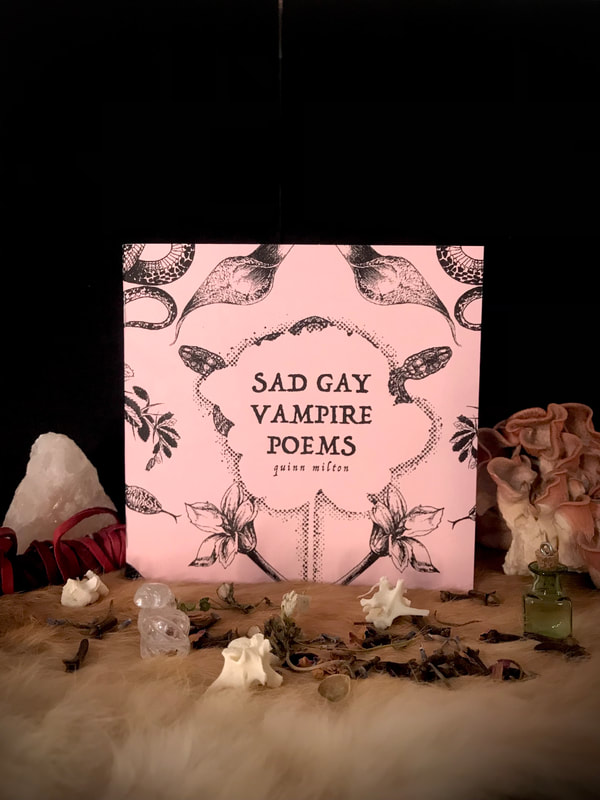
As a holiday gift, a friend gave me a copy of Quinn Milton’s Sad Gay Vampire Poems zine and Sad Gay Vampire enamel pin. I love them.
“Are all vampires gay?” you ask.
I don’t know. The ones I care about are.
“Are all vampires sad?”
Yes, certainly.
The thrill of power and immortality wears off pretty quickly.
The loneliness sets in.
From Paul Monette’s Nosferatu: “Dracula stood in the firelight, looking as if he meant to strangle every living thing. He was just another madman, Jonathan told himself, reaching across for a piece of bread. That is why they had a madhouse, even in Wismar. Sad and lonely people ended up losing their minds.”
Someone said of my book The Last Vanishing Man and Other Stories that it is queer, but doesn’t have many examples of queer joy in it. This is true. True also of my first collection, Blood: Stories. I don’t know what queer joy is. I know queer longing, I know queer alienation, I know queer bitterness and queer self-recrimination and queer emptiness.
(I write from those places, those long dark nights.)
(Even though I have not published any vampire stories,
all my stories are vampire stories.)
Can we imagine queer joy for the vampire?
Can we imagine the gay vampire happy?
Not I. A happy gay vampire or a vampire experiencing queer joy ceases to be a vampire, becomes something else. (Maybe a human.) (Maybe a clown.)
I am writing this late at night. I have not been sleeping well for the past few months. I have hungered for something beyond myself.
Many late evenings, I have stared at the moon. I have heard the creatures calling in the darkness.
Listen to them — the children of the night.
What music they make!
For a couple centuries now, we have needed tales of vampires. In their undeath, in their alienation, in their yearning … they explain something of life. They are the opposite of life and also a shadow of life, a shadow on life. We envy them, fear them, pity them, dream of them—
Let the knife slip on the bread.
Let it cut your finger.
Let the monster taste your blood.
There are not enough madhouses to contain all the vampires.
There is not enough sunlight to vanquish them all.
Save us.
Sacrifice yourself.
9.
The end of Nosferatu by Paul Monette:
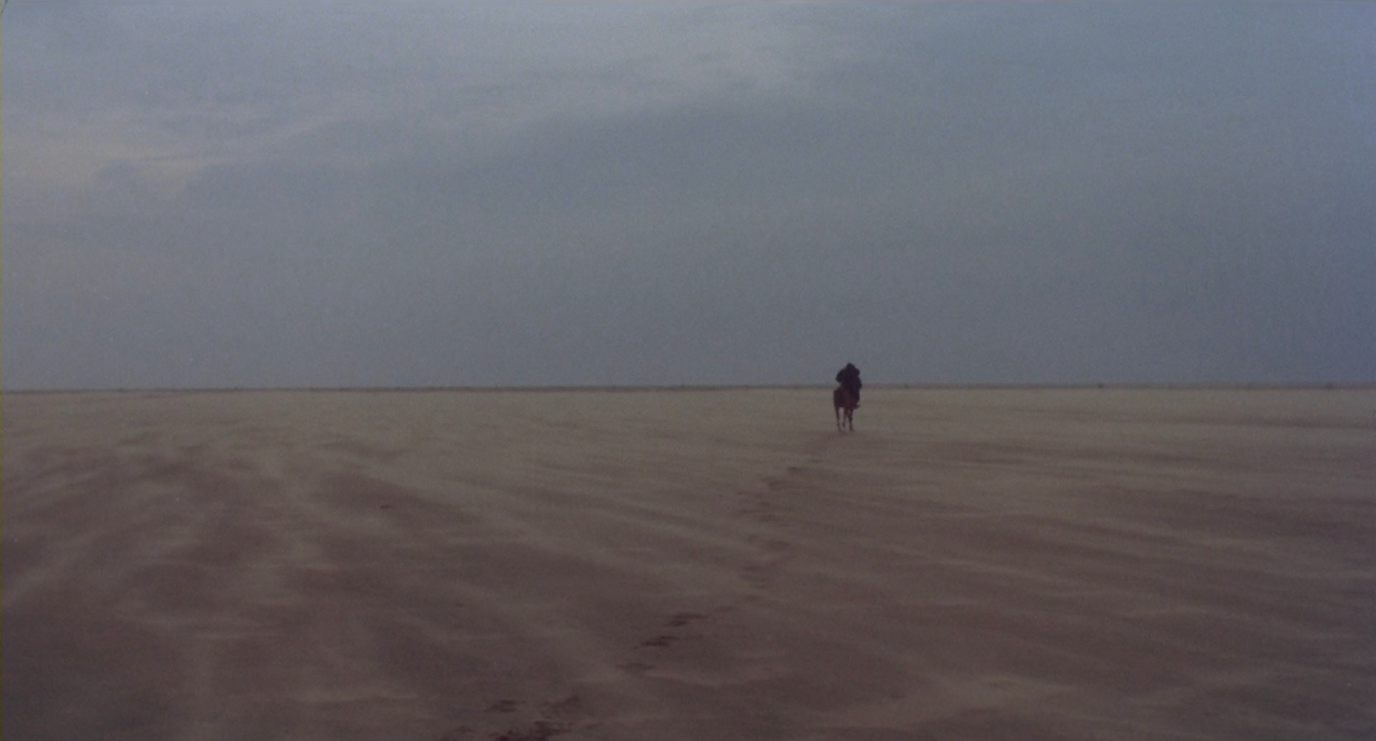
Bound across the blighted plains. Bound for the steepest mountains. There was something there that he’d only caught the glimmer of. He could not recall a single thing about it, but he knew now, down to the last shred of his being, that it had to be a better world than this. His cloak flew up behind him, whipping in the wind like a pair of wings. Though he had all the time in the world, he hurtled along at a crazy speed. There was so much work yet to be done.
Discover more from Matthew Cheney
Subscribe to get the latest posts sent to your email.
