I did not look at the election results as they came in last night, because why bother? I’d voted, there was nothing else I could do. The results were unlikely to be definitive before I fell asleep. No need to torment myself. This was the right decision. I slept well.
I woke and slowly got out of bed and dragged myself to the computer to see how things had gone. I hoped, without much belief in that hope, that there would be an uprising against the open fascism of the Republican campaign. (And yes, fascism is the right word.) During the 2016 election, I’d let myself believe the fascists were too radical to survive a general election, and I was shocked that year by the results, even though I should not have been. I’ve long known how deeply Americans are attracted to cruelty, machismo, oppression, racism. It’s a longstanding core of this country, a rotten core that holds us in its gravitational field, and which we have never, as a whole society, found the strength to escape for more than brief periods.
And there it was in the results. No need for deep analysis. The fascist side ran one of the least disciplined, most chaotic campaigns in all of American history, the other side ran one of the most impressive campaigns in modern history (faults, yes, but under the circumstances impressive) — and it didn’t matter. Let a thousand pundits obsessed with technique and nuance burn at the stake. We do not need to find complexity in the bitter truth of this morning. Tens of millions of Americans like fascism. Anger, cruelty, dominance: these are core American values, particularly among white people, and we white folks have shaped this country in our favor from the first moment our ancestors established it with genocide and enslavement … all the way to now.
So then. What do we do now that the fascists have won?
It’s important to remember that marginalized groups for centuries have built networks of mutual aid and resilience among themselves. We need to stop supporting national organizations that give cover to the failures of the Democratic party and instead support more grassroots and local groups. Fewer donations to Planned Parenthood, more to abortion funds. Support community-based programs against violence, homelessness, discrimination. Build plans for mutual aid among your friends and trustworthy neighbors. Give up on ever being able to trust the police and the courts, if you hadn’t given up on that already.
If you have any stability at all, it may not be long before someone needs your help. Ask yourself what you would do if an undocumented person showed up at your door and asked for help against ICE. Ask yourself what you would do to protect a trans person who is being hunted. What will you do?
I am not panicking. Not because I’m undisturbed and uncaring, but because this is sadly familiar territory. (It seems to me delusional to read American history as a tale of the arc of the moral universe bending toward justice.) It is exhausting to fight the same fight endlessly, but here we are. Black folks developed networks of survival in a country that didn’t see them as human. Women have had to watch out for each other in a hostile world for two thousand years. My fellow queer people have had to take care of each other always. We know what it is to be a pariah. It’s horrible that we have to fall back on our long-established practices of subversive care, and certainly more people will suffer and die than would have otherwise, but we do know how to care for each other if we have the will to do so.
That’s what’s going to be hardest and most important in the early days of the fascist takeover: maintaining the will to support each other. It’s easy to feel defeated — because we are defeated, let’s admit it. Regardless of how the exact popular vote and exit polls turn out, the machinery of government has been almost entirely handed over to the most authoritarian, cruel, abusive, xenophobic, narcissistic elements of our society. The Supreme Court is lost for a generation, the idea of the public good is dead, regulatory agencies will be gutted and destroyed, the billionaires will continue to gather most of the country’s wealth for themselves, and every marginalized group will be tormented. None of that will be easily repaired, none of the progress of recent decades will be easily regained. There’s no quick return from this descent into the worst of everything. But we can and must find ways to care for each other, and particularly for the most vulnerable people.
Now is not the time to try to “understand” the tens of millions of people who favor fascism. There’s not much to undertstand, anyway (they like authoritarianism and sadism). It’s time to attend to ourselves, to build our own resilience, to find and offer refuge. You do not need to feel compassion for someone who wants you and anyone like you dead. Leave that to saints.
Instead, let us build mechanisms of care for each other. When queer folks were abandoned in the first decade of the AIDS epidemic, with men dying on stretchers in hospital hallways where nurses were afraid to touch them, people worked together to provide care and knowledge to each other. Painful as it is, we only have each other now. There is no government to rely on, no safety-net, only each other. That’s all, really, there ever was for many of us. And we had to scrounge for that.
I think about Auden’s “September 1, 1939”, where one of the most famous lines originally appeared as “We must love one another or die”, but then in the 1950s and after, Auden insisted on a change first suggested to him by Cyril Connelly: “We must love one another and die.” Loving one another does not save us from death. But it does make the journey to the end more pleasant.
*
I have been reading Brecht’s poems (translated by Tom Kuhn and David Constantine). Here’s a brief poem he wrote after learning of the death of his friend Walter Benjamin in 1940:
At chess, sitting in the pear tree’s shade
Your favored tactic was to wear the opponent down
The enemy who drove you from your books
Will not be worn down by the likes of us
That is my own mood this morning, that despair at our own inadequacy in the face of the terrors ahead. But the enemy will not be worn down by the likes of us. The enemy must be overpowered and defeated. It would be one thing if the terrors we are about to endure moved the political landscape away from terror — if the enormity of the horror ahead were enough to shift things away from cruelty, anger, and oppression then at least the immense suffering we’re about to experience would have had some value. But I am skeptical. We have already lived through four years of this type of thing, then the aftermath for another four years, and the response of the majority of voters was: Yes, let’s return to murderous chaos, let’s embolden it.
A few poems after the little cry of despair at Benjamin’s death we find one of Brecht’s first poems written in California, “In this country I hear…” The second section reads:
The decisive thing in this country, I hear, is success.
The mere intention of butchering my brother
Is not sufficient. Only when I succeed in eating him
Do I have the right to be admired.
The bitterness and irony that Brecht fell to in exile still feels powerful and purgative to me, even as I want to try to agree with people who are calling for earnestness, sincerity, and kindness right now. A spreading of compassion. And yes, of course, right now more than anything we need to feel solidarity with the most marginalized and threatened people, we need to put our solidarity into action and do whatever we can to protect the countless people who will be targeted, attacked, and killed by the clowncar Blackshirts who will be taking power. On the other hand, we need to hold onto our irony, bitterness, and anger and let them sharpen whatever weapons we can raise against the overwhelming wave of oppression that’s about to flood this country.
Here is Brecht on returning to Berlin after the war:
When the city lay dead one of your sons
Great Mother, went back into the rubble
Excavated the workbench and constructed a roof.
Pulled nails out of charred rafters
Hammered them straight, drove them into the new
Scaffolding fitted together from the old planks.
Often, busily washing rusty gear wheels in the tin bath
He wiped his brow clean of the flies
That rose from what was dead.
This day hurts, and it hurts not only because we know what is coming, but because we may have indulged in a fantasy of progress. Martin Luther King and Barack Obama were wrong about the arc of the moral universe. There is no arc, no moral universe. That’s just whiggish optimism, utterly disproved by the history of human society. There is what we make of this blasted world, that is all. All of my life, our rulers have been people devoted to money, war, and power. Didn’t matter the political party. Some were less murderous and greedy than others. Now, our fellow citizens have chosen to return the human avatar of greed and cruelty to office.
Langston Hughes got closest to the truth: “(America never was America to me.)” As he knew, the dream of America was a powerful one, one any person could find hope in. But Hughes knew the score:
I am the poor white, fooled and pushed apart,
I am the Negro bearing slavery’s scars.
I am the red man driven from the land,
I am the immigrant clutching the hope I seek—
And finding only the same old stupid plan
Of dog eat dog, of mighty crush the weak.
The same old stupid plan.
We are now as far as ever from the dream Hughes offers of a land of equality and goodness. The voters have rejected that vision. Is it worth trying to resurrect it? I’m not sure. I am skeptical of nationalism generally. The idea of an land of the free and home of the brave has invigorated this country for a long time, but what’s the result of that invigoration? We were just as susceptible to fascism as anybody else.
Still, we need a vision of justice to work toward, even as we are huddling together out here in the cold dark night. I am less and less convinced that such a vision can be universal, but I am certain it can exist in small groups, people who are able to find affinity with each other and offer some shelter from the storm of terror sweeping across the land. We can love one another.
Let the fascists have their day. Nothing the likes of us can do about it now. But, inadequate as we may be to the big challenges, we must do everything we can to shelter those who need shelter, give refuge to those who need refuge, and build resilience with each other. Moments will present themselves to undermine and even perhaps, eventually, eradicate the fascist impulse. We must save as many people as we can, we must take the time to rejuvenate, to hunker down, to focus our care and actions, because we must be ready, no matter what, to be capable and strong enough to seize the opportunities that will, one day, appear.
We must find a way to dream new dreams.
—–
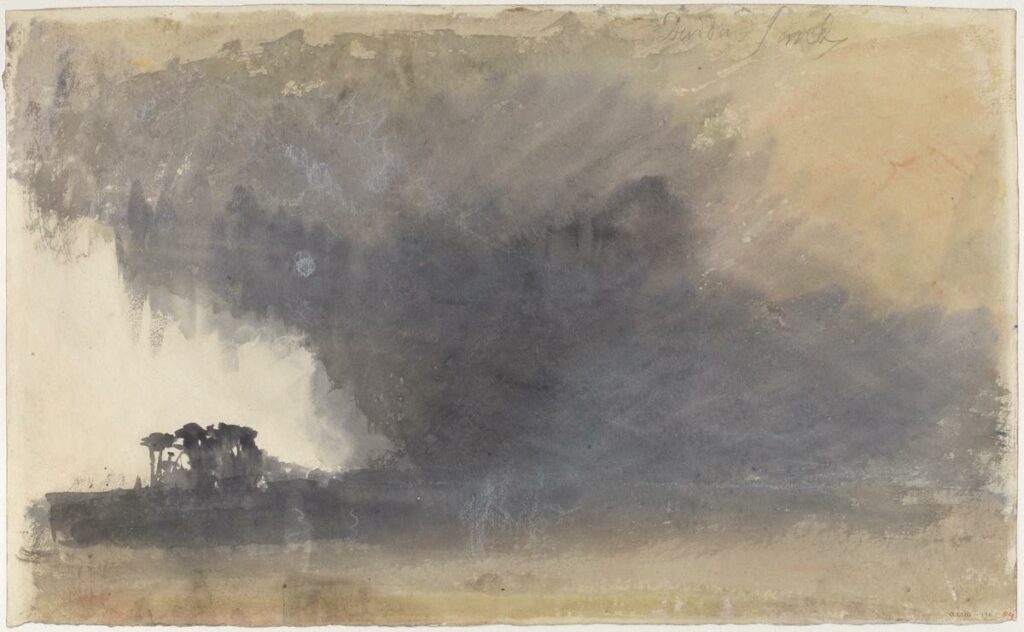
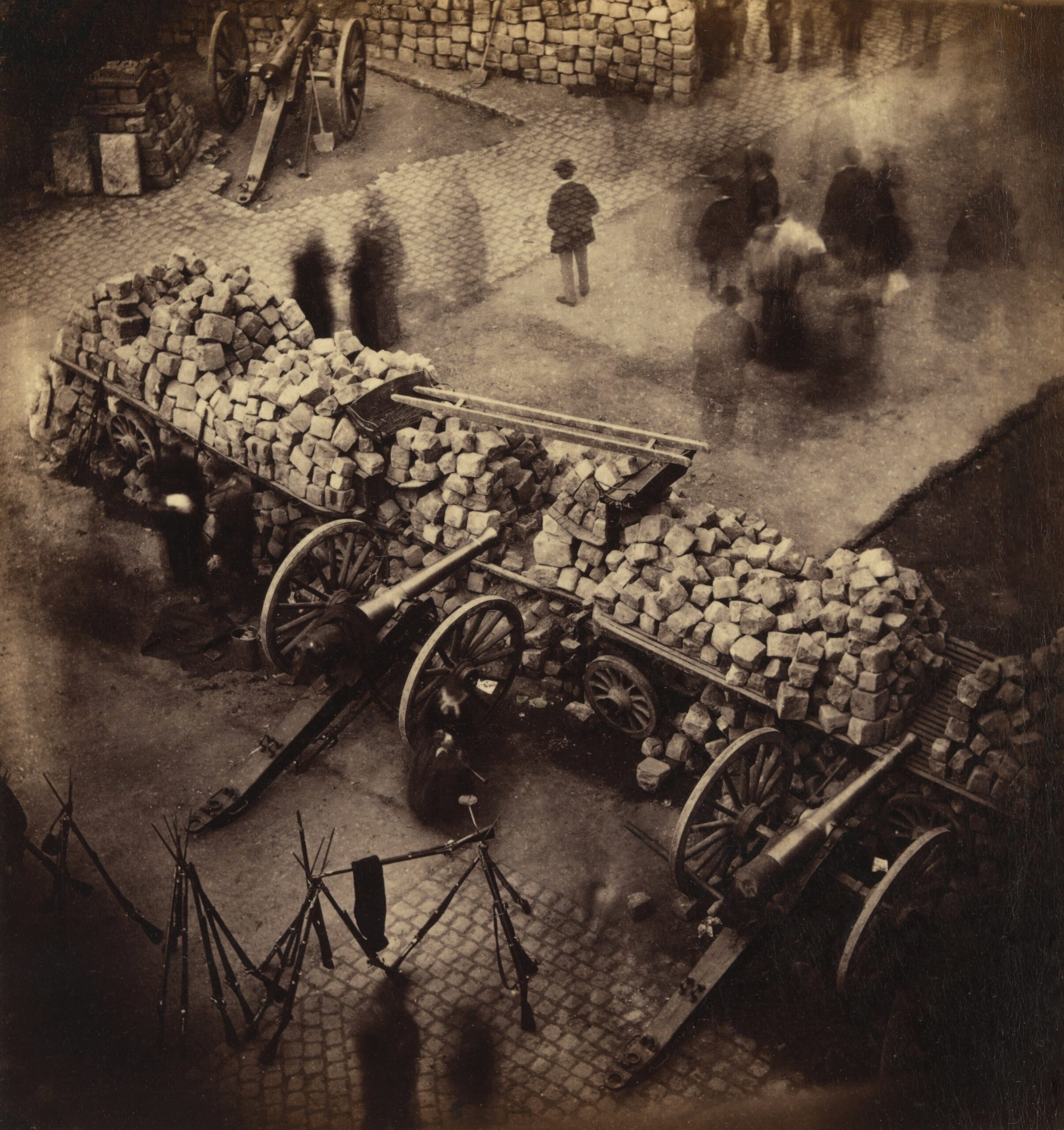
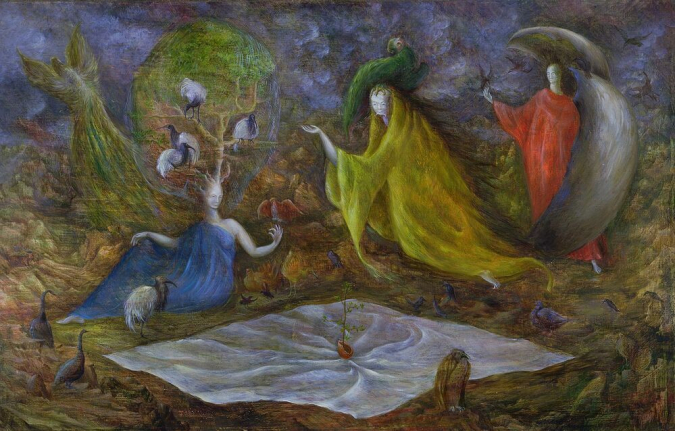
Images: J.M.W. Turner, “Duddon Sands, Cumbria”; Pierre-Ambrose Richebourg, photograph of barricade in Paris, 1871; Leonora Carrington, “The Pomps of the Subsoil”
Discover more from Matthew Cheney
Subscribe to get the latest posts sent to your email.


