0.
When I was putting Finite Eyes together, the most fascinating pieces for me were the ones from right before COVID-19 hit the world and the pieces from that first pandemic year. The earlier stuff felt like messages from a world unknowingly on the verge of destruction, while the COVID-era stuff reminded me of what we went through, what we learned, what we didn’t learn.
I vowed to try to keep writing occasional pieces with some awareness of the fascist era we’re living in. I wrote a few that seemed to be fragmentary and unsatisfying. I expect everything I write about living through this terrible now will be fragmentary and unsatisfying. But perhaps there is some value in chronicling the feeling of thinking now.
The following fragments were written in the first three months of 2026 (mostly, but not entirely, in the order presented here).
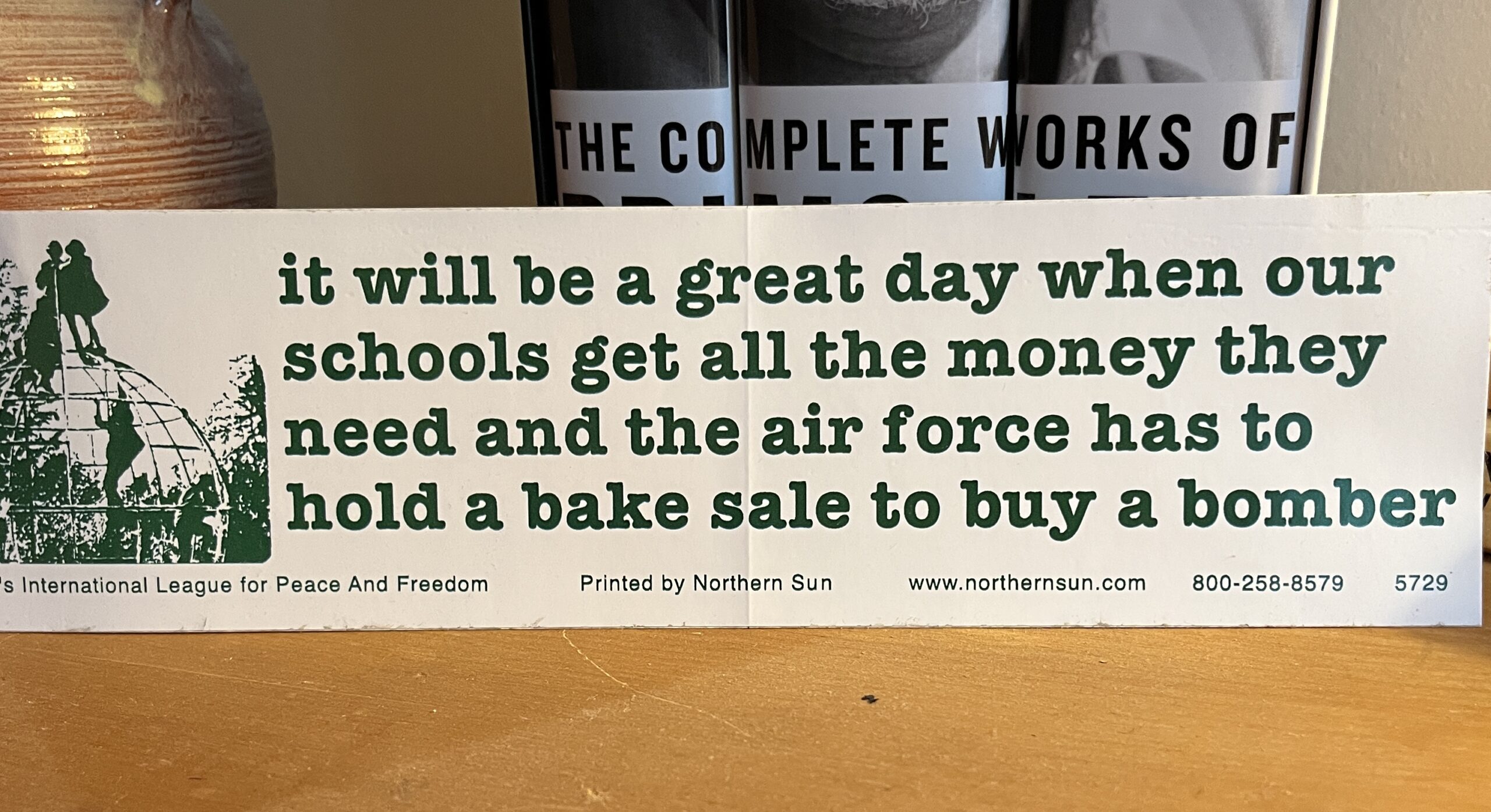
I’ve had this bumpersticker for about 30 years. It has remained relevant that whole time.
What use are my hundred thousand eyes
In the middle of the darkness?
Some stories have a sad end
Some sad stories have no fucking point
—Geese, “St. Elmo”
1.
The country I pay taxes to has started bombing another country. Again. All my life, the country I pay taxes to has bombed other countries.
In 1992, I watched George Carlin on HBO say, “We like war! We’re a war-like people!” and ever since 1992 I have had cause to repeat that statement year after year after year.
I almost lost my job because of a war. This was in the early 2000s. I wrote an occasional column for my town’s newspaper and I wrote one saying George W. Bush should resign because of the Iraq-Afghanistan war. People called the school I worked at and demanded to know how they could justify having such an unpatriotic lunatic teaching children. Thankfully, the head of the school liked me, so he didn’t fire me and in fact told me to keep up the good work. But if I’d had a less understanding boss, things could have gone very differently.
It’s mostly been forgotten now how horrendously pro-war everybody was after 9/11. All we wanted to do was kill people. And we did. For twenty years.
Now we’re killing people again. Dropping bombs again. Bombing a girl’s school, in fact. This is one among thousands of other things that feels so weirdly, obnoxiously on-the-nose for this administration that no fiction writer could ever get away with it — the President who is all through the Epstein files (a chronicle of powerful pedophiliacs and rapists committing countless crimes against women) and whose administration has led a kind of war against education throughout the U.S. is not just bombing military targets but bombing schools, and not just schools but specifically girls’ schools. You just can’t make this shit up.
I’m coming around to accepting the metaphysics of comedian Paul Oddo, who proposes that we live in chicken hell and are simply the bystanders or byproducts or non-player-characters in the hell whose primary purpose is to create eternal suffering for chickens. And so we kill 72 billion chickens every year. Often in grotesque and torturous ways. Our reality is chicken hell. Also hell for most other animals, if we’re being honest. So maybe we humans are not the main characters here, we’re just some of the tools by which the universe punishes the bad animals for their transgressions in a previous world. That makes about as much sense as anything else these days.
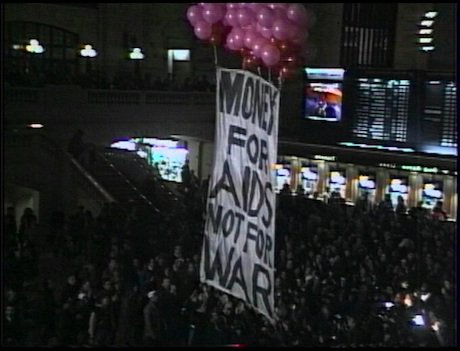
23 January 1991, ACT UP New York, Grand Central Terminal
2.
Recently, I borrowed from the library Benjamin Nathans’s Pulitzer Prize-winning book To the Success of Our Hopeless Cause: The Many Lives of the Soviet Dissident Movement, which I saw recommended somewhere or other. I haven’t had a chance to read much of the book yet, so I can’t speak to its quality, but I do love that title. It’s a reminder that one does not fight because one knows that victory is imminent or even possible. One fights because the struggle itself is what matters. In fact, the struggle is the only constant. No victory is complete, no victory is permanent. We’ve been reminded of that in recent years with the hollowing out of the last remaining bits of the legal structure of American liberalism. Laws and protections that only a few years ago felt eternal proved to be easily circumvented, ignored, erased.
If you are feeling despair, remind yourself of history. Seek out stories of people in the past who fought against oppression. Look to the histories of indigenous people, of enslaved people. Remind yourself of just what an uphill battle the abolitionists faced, of the bravery of the people who fought the slave catchers before and especially after the Supreme Court’s Dred Scott decision of 1857. Never forget what a foe of justice the Supreme Court has often been. Never forget the triumph and tragedy of Reconstruction, the dreadfulness of Jim Crow, the many battles for civil rights that continue to this day. Remember the fierce struggles of the labor movement, so often suppressed by the government and police (and the Pinkertons). Remember the Coal Wars and the Battle of Blair Mountain. Remember that women’s suffrage activists like Alice Paul were beaten, imprisoned, and force-fed. Remember that there were multiple Red Scares. Remember the deep history of racism and xenophobia on which U.S. immigration laws were based. Remember that FDR put Japanese Americans into concentration camps. As I wrote in the afterword to Changes in the Land: American history is a horror story. And yet generosity and grace existed in all those moments, too. The world is a place of unfathomable, inescapable suffering, but that fact is not an excuse to contribute to the suffering. Instead, beauty lives in the moments where some particle of suffering, however small, is relieved.
At this time of backlash against transgender people, this time of more openly virulent homophobia than we’ve seen in a decade or so, I think of the many trans and queer people throughout history who have helped each other, supported each other, and done what work they could to make the world a more just and tolerant place — even in the face of overwhelmingly painful resistance. It is really only in my lifetime that there has been anything like real acceptance of queer people in the U.S. And yet we got here.
A few months ago, I spoke to a university class about queer literature and film. The students felt threatened and besieged by the recent conservative turn in American politics — and it is right for them to feel this way, because they are threatened and besieged. But I reminded them that this may feel especially acute for them because during their lives they have only known a generally tolerant society, one where, for instance, gay people can get married. Whereas I am more than twice their age and the recent general tolerance still feels new and fragile. Certainly, I would prefer that general tolerance to continue and to expand, but I also have less fear from it not doing so because I know that we have survived and found joy during much more difficult times. One of the best things we elders can do for queer youth is to let them know how we got through bad times in the past. I wish this wasn’t a heritage that needed to be passed down from generation to generation, but I also wish we had world peace and eternal happiness and an end to suffering. We have to work with what we’ve got. As Molly Ivins titled one of her books: You Got to Dance With Them What Brung You.
History is a tale of struggle. We don’t get to live outside that. There was never any time long ago when everybody was living their best life. The Golden Age as a historical fact is a myth. But that doesn’t mean we shouldn’t carry the idea of a Golden Age within us.
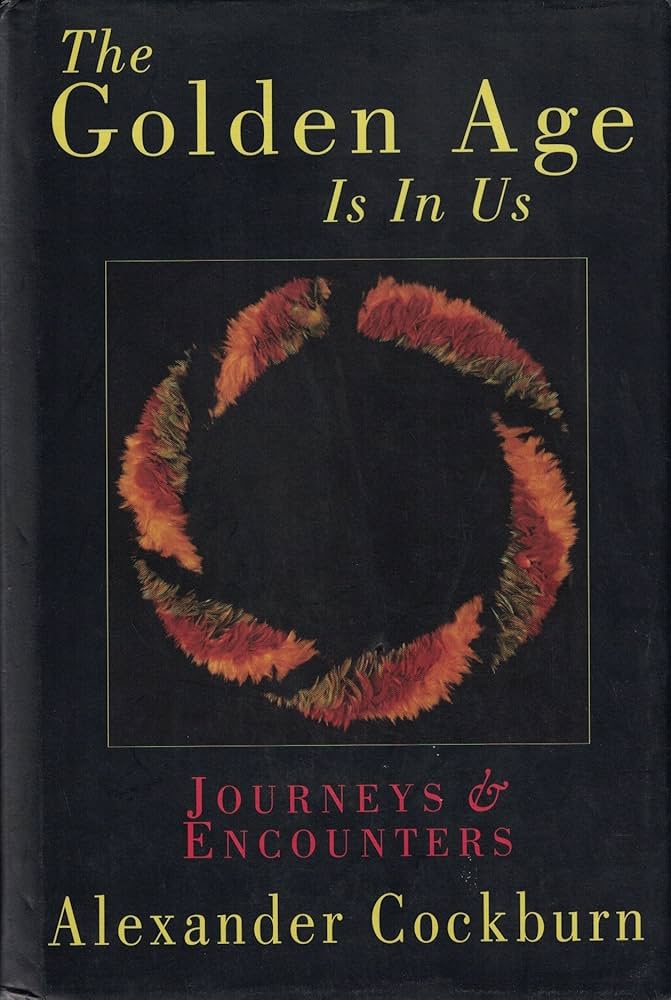
In the 1990s, I was smitten with the writings of Alexander Cockburn (1941-2012), most of which I read in The Nation, where he was a columnist. There was something about the clarity of his writing and the nature of his combativeness — different from the combativeness of his fellow columnist Christopher Hitchens — that dazzled me. Thus, when Verso published a collection of his writings in 1996, I was thrilled to find a copy at The Strand in Manhattan for a price I, a struggling college student, could afford. The book was titled The Golden Age Is In Us.
I lost the book in one of many moves years ago, but via Google Books we can read the foreword, where Cockburn explains the title. There are always golden ages “alluring to some, though not always to me,” he says, which is the paradoxical problem of utopia — one person’s utopia is not necessarily appealing to anyone else, and may even be their idea of dystopia instead. Cockburn asserts that “the Golden Age is subversive and it’s fun, which means that for us on the left, it should be our goal and our sales pitch. People love Utopias that make sense. These days most Utopias are drafted by the sort of people who drew up the plans for Pelican Bay Prison, grandchild of Quaker-inspired lock-ups of the early nineteenth century.” Nonetheless, despite the failures and paradoxes, despite the grey, punitive solemnity of planners, despite the distance between reality and utopia, Cockburn writes that there “is abundance, if we arrange things differently. The world can be turned upside down; that is, the right way up. The Golden Age is in us, if we know where to look, and what to think.”
Cockburn’s foreword was written in the wake of Bill Clinton’s election in 1992, the 1994 Republican landslide in midterm elections that led to Newt Gingrich’s ascendance to be Speaker of the House of Representatives, and the dominance of Rush Limbaugh. While Clinton moved the Democrats rightward, Gingrich and Limbaugh pushed the Republicans farther to the extreme right. The left in the United States felt empty, eviscerated, desiccated — far from golden! Hardly a unique place for the left to be. Perhaps that is why, though I remember very little else about Cockburn’s book, the title has remained strong in my mind.
There has never been a Golden Age. We could not get into a time machine and go back to an era when things were good for everybody. (All history is a horror story.) Whatever there may be for a golden age is not in the world, and has never been in the world, but it is in us, and that, I would argue, is something like Gramsci’s optimism of the will.
It is difficult these days to maintain any sort of optimism, even allowing for pessimism of the intellect. The United States has fully surrendered itself to fascism. A secret police force in paramilitary gear roams the streets of our cities, kidnapping and murdering people. The U.S. military keeps dropping bombs all over the world. The vaunted American ideals of democracy and rule of law have proved themselves to be paper dolls easily burned by the billionaires, opportunists, white supremacists, and sociopaths who infest the halls of power. The befuddled, sclerotic, deluded Democrats are lost, lost, lost. The great liberal achievements of the 20th century in the U.S. — the New Deal, various civil rights movements, the Great Society, even the Nixon-created Environmental Protection Agency — have been wiped out, almost as if they never existed at all. The 20th century has been canceled and we’re back to the Gilded Age (not a Golden Age!), but with robber barons even more crass, selfish, rapacious, and truly insane than their predecessors.
I keep thinking back to Cockburn’s title, though, to remind myself that there never was a Golden Age. Despite the definite achievements of 20th century liberal movements, most real successes have been brief. Susan Faludi’s 1991 book Backlash feels relevant to mainstream politics these days for good reason. Anti-democracy is built into the system of U.S. government: the Senate, the Supreme Court, and the horrendous Electoral College were explicitly designed to keep democracy out of the grubby hands of the rabble — that is, the people. Rampant capitalism, racism, sexism, and militarism are deep traditions throughout American history. Just ask a Native American about the U.S. rule of law, about how much our government holds to its promises and respects treaties. Ask anyone whose ancestors survived Jim Crow about truth, justice, and the American way.
In a essay for The Atlantic last September, George Packer did a good job of pointing out the ways we are now living in authoritarianism, but there’s also a certain nostalgia in his writing for a time that might have been good for white, cisgender men … but which was a rather different experience for lots of other people:
You can feel the onset of authoritarianism in your central nervous system: shock, disbelief, fear, paralysis. Familiar norms and rules disintegrate every day, but the ultimate consequences remain unclear, and Americans don’t know how to assess the danger. We haven’t lived under authoritarianism. We haven’t experienced this level of sustained polarization and vitriol since the run-up to the Civil War. During the McCarthy era, careers and lives were ruined, but the White House didn’t lead the pursuing hounds.
There’s truth there, but the “familiar norms and rules” only ever applied selectively. A lot of this feels to me similar to what it felt like being a queer kid growing up in rural America in the late ’80s and early ’90s. The horror of the moment is not that it all feels so completely different but that it feels like a particularly virulent echo of bad times from before. American history is a traumatic repetition compulsion.
Of course, there are differences — the fascism this time feels more explicit, less beholden to certain social norms. It feels accelerated, with the barbarians having learned that the best strategy is to overwhelm us with awfulness rather than, as in the past, to try for a certain amount of consensus, or at least the appearance of consensus. Fascism feels like the only appropriate word for what we’re living through now because it’s a word that signals the pride and pleasure with which the thugs go about their work. Nothing we’re experiencing is entirely unique in U.S. history, but the institutionalized brazenness of the oppression does feel different from what we’ve experienced in recent decades. There is no subtext anymore, there is no pretense of shame or even reluctance. More than the leader cult around Trump, more than the valorization of violence and paramilitary force, more than the pining for a mythic past — it’s the arrogance of it all that makes fascism feel like the only possible word.
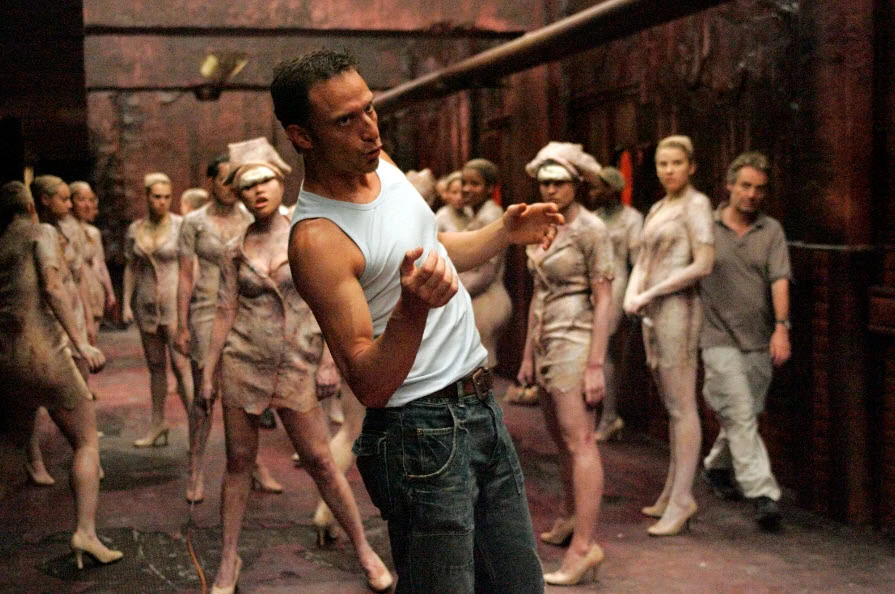
Roberto Campanella on set of Silent Hill (2006)
4.
A young actor whose name rhymes with ballet said somewhere that ballet and opera aren’t appealing to him because they are irrelevant and nobody cares about them. This has caused upset, many Takes, much Discourse. What the young actor said was obviously accurate in uninteresting ways (ballet and opera are not mass art forms) and yet it riled because the comment contained an implicit criticism of anyone who enjoys or pursues these art forms — the comment suggested not only that ballet and opera are marginal, but that people interested in them, or, worse, passionate about them, are themselves irrelevant.
Ballet and opera both require a certain amount of education to appreciate and a huge amount of training and, often, wealth and privilege to perform in. They are among the most physically rigorous and demanding arts that exist. It is interesting that the young actor whose name rhymes with ballet made his comments not long after this year’s Winter Olympics, a celebration of demanding, physically rigorous athletic performances that require huge amounts of training and, often, wealth and privilege to participate in. And yet we seem to be able to accept that ice skating and skiing, though marginal activities in comparison to more popular sports, are worthwhile. We accept and even celebrate elitism in sports while denouncing arts that don’t fill one stadium after another.
(At roughly the same time that the young actor made his controversial comment, I rather randomly happened to be watching an interview on the Blu-ray of Silent Hill with the film’s movement coordinator, choreographer, and actor Roberto Campanella, who credited his study of ballet with … everything. Measuring arts by their immediate mass effect is foolish.)
In an entertaining survey of this year’s Oscar nominees for Best Picture, A.S. Hamrah summons the ghost of critic Manny Farber to discuss the differences between the highly-nominated Marty Supreme, directed by Josh Safdie (a movie about the niche sport of table tennis starring a young actor whose name rhymes with ballet), with the significantly less-nominated The Smashing Machine, directed by Benny Safdie (a movie about the not-as-niche-as-table-tennis sports of amateur wrestling and MMA fighting, starring Dwayne Johnson, whose 2007 film The Game Plan makes the argument that ballet requires as much athletic ability as football). Hamrah uses Farber’s famous distinction between white elephant art and termite art to differentiate the Safdies’ two films, with Marty Supreme as white elephant (“yawning production of overripe technique shrieking with preciosity, fame, ambition”) and The Smashing Machine as termite art (“a kind of squandering-beaverish endeavor that isn’t anywhere or for anything”).
I’ve never been all that convinced by the particularities of Farber’s distinctions, but I like the general idea of distinguishing between work that seeks to be popularly recognized as Important and work that doesn’t give a shit.
The controversial comment from the young actor whose name rhymes with ballet does not recognize that the sign of a healthy culture is not how popular a few art forms are in it but rather how well it supports unpopular, niche art. Niche art resists monoculture, resists absorption into the mass, resists the authoritarian mandate of popularity. We need universal health care, universal housing, universal redistribution of wealth. We don’t need universal art. Art must be and remain the realm of the idiosyncratic if it is to have any integrity or durability.
5.
The Oscars were last night. I don’t watch them anymore — fifteen years ago, I enjoyed tuning in because I’d often seen most of the movies up for major awards and I enjoyed having opinions about a spectacle that I was actually marginally well-informed about. (I won the office Oscar betting pool one year.) Nowadays, I don’t care. Actually, I do care, but I care in a negative way: I loathe the money and tastemaking the Oscars represent.
Still, I have to admit that this year I was not as indifferent as usual, because there were some interesting choices up for awards. My favorite of the 2025 films I’ve seen so far, The Secret Agent, was up not only for Best International Feature Film but also for Best Casting, Best Picture, and Best Actor, all of which was a surprise — I’m not used to Academy voters agreeing with me, and they hardly ever nominate films that aren’t in English for awards beyond the International Feature category. I didn’t expect The Secret Agent to be nominated for anything, and then didn’t expect it to win anything. My cynicism was correct there: it didn’t win anything. The Academy and I continue to disagree and I feel a bit vindicated.
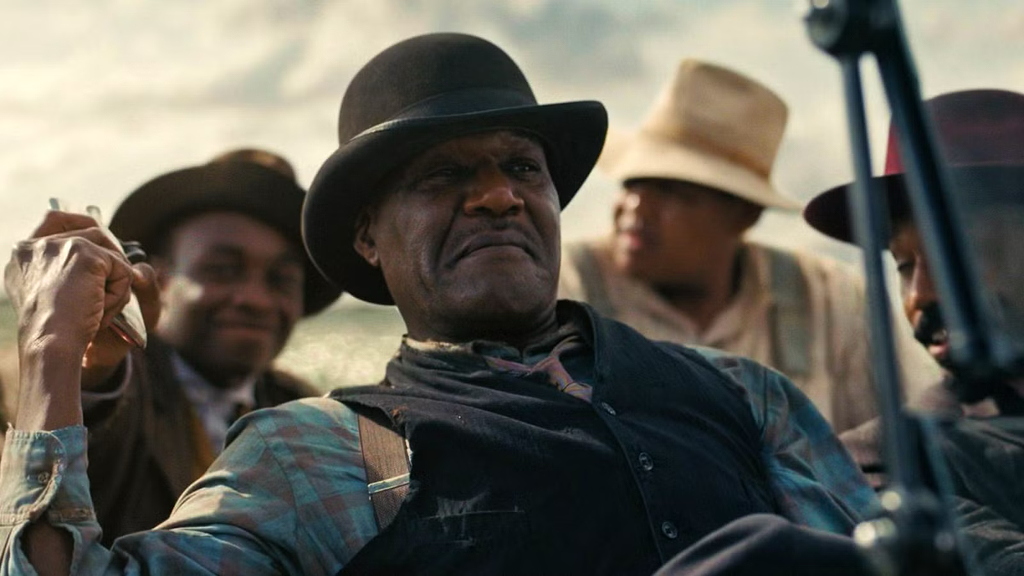
However, the only award I really hungered for anybody to win was Delroy Lindo for Best Supporting Actor in Sinners. I was quite sure he would win, because what nincompoop would vote against him? I should’ve known. The Academy is full of nincompoops. Sean Penn won. Point in Sean Penn’s favor: he didn’t bother to show up. Nominees who don’t go to the stupid awards show are all higher in my esteem than ones who do. (Except for Delroy Lindo. I’m glad he was there. They should have put on a show just for him.)
Truly, though, if you ever needed yet another reason not to take the Oscars seriously, it’s that Sean Penn beat Delroy Lindo for 2025’s Best Supporting Actor.
I actually mostly liked One Battle After Another, the film for which Penn won. I liked it more or less equally with Sinners, the film for which Delroy Lindo did not officially win but everybody who’s not a nincompoop knows he and only he was deserving of that particular award for 2025. Some people, even some people I tend to agree with, seem to me to have fallen into traps One Battle set up for them, triggering their need for ideological response and making them incapable of seeing what was directly in front of them on the screen. You’ll be amazed to hear what they, the politically pure, will tell you: an expensive Hollywood movie is not an accurate or ideologically correct representation of revolutionary politics and you should watch Battle of Algiers three times in penance.
I didn’t like One Battle enough to want to put effort into elaborating on its good qualities (or its bad), but I’ll just say: it’s obvious that Benicio Del Toro’s character is the political hero of the film, that the underground community Del Toro’s character is a leader of is the only utopian option worth considering, and that Leonard di Caprio’s character is, in the gonzo alternate universe of this story, a sometimes-well-intentioned schlub who more or less screws up everything he does, who is much too passive in his own life, who does not appreciate the people he should appreciate, who is destined to wander the world in a bathrobe … but at the very end gets a moment of grace, and good for him, I say. But you’ve got to see that his only political meaning is his lifelong clumsiness and failure. Just like most of us of his generation. Maybe the kids will do better, and maybe it’s sentimental to say so, but I’m fine with that. The ending made me cry, maybe because I’m a white guy embarrassed by my fellow 50-ish white guys’ failures to do anything much to avoid bringing about the current hellscape of existence, despite having had all the powers and privileges necessary to do so. Whatever. Another nominated movie this year — one by a filmmaker I can’t stand, even though I liked his first movie a lot when I first saw it — is called Sentimental Value, and that’s a good title for the final scenes of One Battle. But don’t lose sight of Del Toro and the underground community. Only underground communities will save us in a world so damn blighted in the overground.
(The Oscars are overground awards. Best to forget them as fast as you can. And all the other nominees for Best Supporting Actor should have declined their nominations in favor of Delroy Lindo. If they’d had half a shred of dignity and weren’t consumed by egoistic greed, they would have done so. But they’re Hollywood people, and egoistic greed is what they live on.)
This morning, Colin Dickey sent out his weekly newsletter, Glacial Errata (hosted by Beehiiv, not the Nazi-enabling Substack, so it’s safe to click that link) — this one concerned with protest songs and anger. It’s wonderful stuff, insightful and honest.
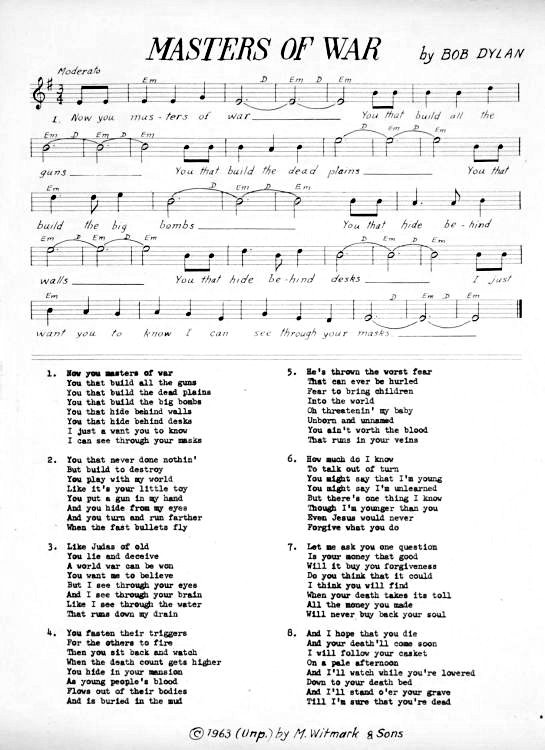
I have found myself playing Dylan’s “Master’s of War” a lot recently, because its naked anger and vitriol toward the people who support and enable war is congruent with my feelings these days. (I usually go to one of the early recordings of “Masters of War”, since they have so much of Dylan’s original sneering contempt for the warmasters, but I am also deeply moved by his performance of it at Hiroshima in 1994, the only time he performed it on that tour. The audio quality of the recording isn’t great, but nonetheless the power and meaning come through.) As much as I try for something like Zen nonattachment to poisonous emotions like anger, the world we live in makes this basically impossible for me, because whether I attach or not, anger is always going to to be there in a world of so much corruption, murderousness, and sheer stupidity. I wouldn’t trust anybody in this world who isn’t themselves suffering frequent bursts of utter rage against all the machines of misery running at full steam.
Though I am a big fan of the young band Geese, and in fact think lead writer-singer-musician Cameron Winter shows some of the youthful inspiration of young Bob Dylan (despite being of course very different sorts of musicians), I had not realized Winter had a new song out on a charity album supporting War Child UK, who work to help children and families in conflict-affected countries. Dickey does a nice job exploring this strange, disturbing song, “Warning”.
Like some of the other songs by Winter and/or Geese, it’s a kind of horror song — a disturbing plunge into a disturbed psyche and a disturbed world. It’s not a pleasant song, not a song that you could ever possibly hum or are likely to dance to, not a song anybody who wants to keep their friends would sing at karaoke. But it is extraordinary and necessary and a song for our times, and maybe most times, the times of the bad species that is the human.
7.
The golden age is in us. Maybe one day it will come out.
(I don’t think today is that day.)
Discover more from Matthew Cheney
Subscribe to get the latest posts sent to your email.
