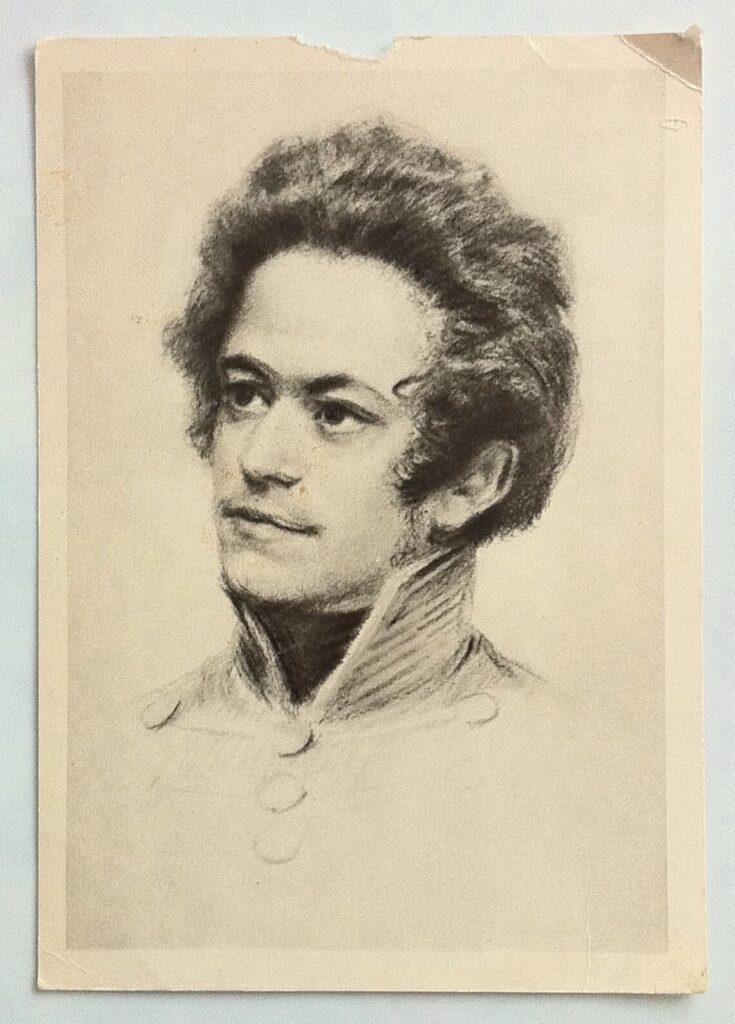
Today is May 5, Karl Marx’s 208th birthday. Last night, celebrities got together for the annual display of wealth that is the Met Gala, this year with the billionaire Bezos family as honorary chairs. Could there be a more appropriate anticipation of Marx’s birthday? Protestors should have set up cake stands outside. And guillotines.
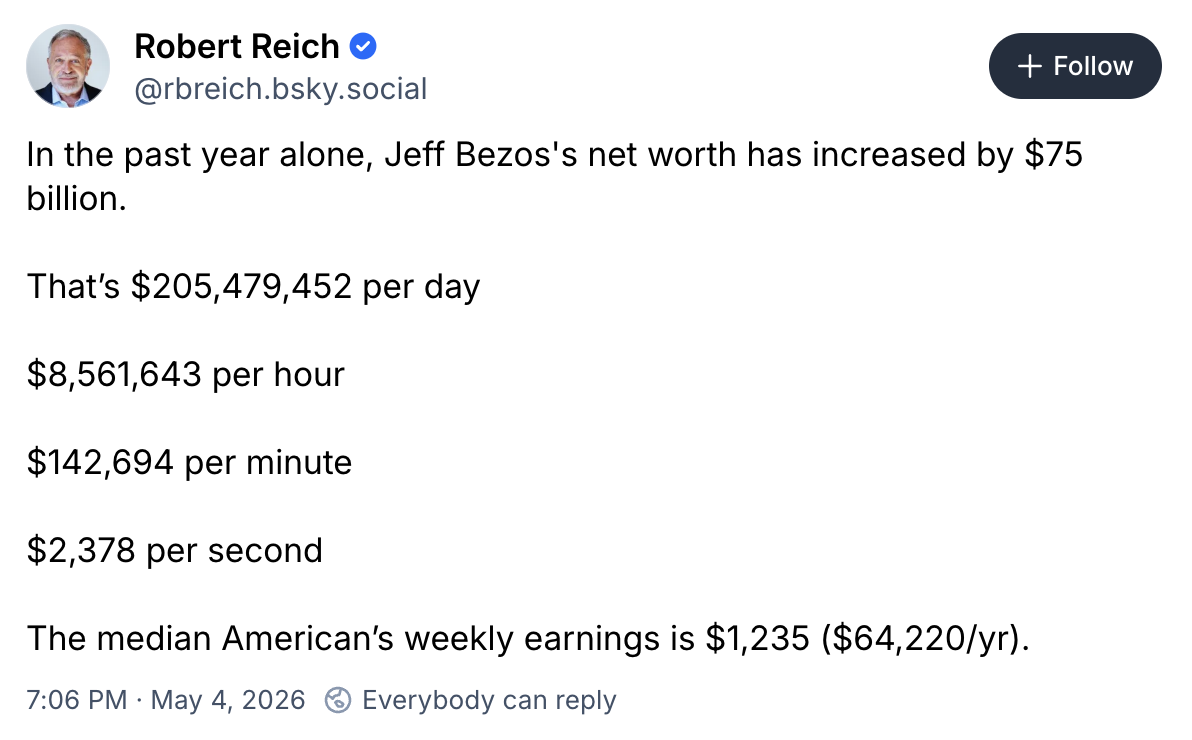
Before moving to Marx, let’s just refresh our knowledge of where things stand, here nicely summarized by former U.S. Secretary of Labor Robert Reich on Bluesky:
Is it any wonder that I’ve been reading more Marx than usual recently? We all should!
Here, then, a few quick notes on the sorts of Marxist and Marxish things I’ve been reading lately, with the hope that something here might pique your interest…
Biographies
First, inspired by someone on social media somewhere (I’m thinking it was Corey Robin, but I can find no trace of it, so maybe I’m hallucinating) saying that they were reading multiple Marx biographies at once, since in English there just isn’t any fully satisfying bio, I’ve been reading four biographies. Slowly, as I’m a slow reader anyway, but also because these books are pretty dense. I’m pretty sure Robin pointed to David McLellan’s 1973 biography as being particularly good, and he (or whoever it was) is correct — even with the opening of various archives after the fall of the Soviet Union in 1989, none of the English-language biographies so coherently weave life and thought together. It’s really an extraordinary accomplishment just as a piece of writing. There are updated editions, but as far as I can tell the updates are not substantial, so there’s no real need to get the expensive, more recent edition.
The other essential English-language biography is A World to Win: The Life and Works of Karl Marx by Sven-Eric Liedman (translated by Jeff Skinner), which is informed by post-Soviet scholarship. Reading McLellan and Liedman together has clarified a lot about Marx that I’ve either not known or not understood before. I’m now reading the McLellan and Liedman chapters on Capital, which is very slow going for my economics-challenged brain, but I’m seeing a lot I missed in my earlier attempts to make sense of that book (via the Oxford World’s Classics paperback edited and annotated by McLellan, which is good, and I think I understood the major points, but even with McLellan’s annotations there’s a ton I missed, most likely because I was often bored by material. The new reading is only helping to make Capital slightly less boring. I’m certainly not going to rush out to reread the whole damn thing, but I appreciate having a better sense of what’s there).
Additionally, I’ve been reading around in Karl Marx: A 19th Century Life by Jonathan Sperber (2013) and Karl Marx: Greatness and Illusion by Gareth Stedman Jones (2016). These are both flawed in noticeable ways, but they also have certain strengths. Sperber’s strength is also his weakness: he is a historian of 19th century European politics and very much not a philosopher or economist. For me, this has made his book almost as enjoyable and readable as McLellan’s, because I have limited patience with philosophy and little understanding of economics. Sperber loves a lot of the stuff I love, for instance the details of how journalism worked in the mid-19th century. I’ve never read another book that makes Marx’s everyday life as a writer so vivid. Great stuff! Marxist critics have understandably taken umbrage at Sperber’s dismissal of the importance of Marx for later centuries — Sperber makes this case particularly in his introduction, where, among other things, he writes, “The view of Marx as a contemporary whose ideas are shaping the modern world has run its course and it is time for a new understanding of him as a figure of a past historical epoch, one increasingly distant from our own: the age of the French Revolution, of Hegel’s philosophy, of the early years of English industrialization and the political economy stemming from it.” This is is gobsmackingly strange statement, and I am entirely in sympathy with the critics who have pointed out how flagrantly misguided it is, but I also have not found that Sperber’s urge to be ostentatiously trivializing of Marx’s ideas has affected his presentation of the history; indeed, if anything, it has led him more toward the history than has been the case with other biographers. But you can see how such a bias would affect Sperber’s understanding and presentation of things that are not matters of history. I take seriously the criticisms of people who understand philosophy better than I that Sperber is not a good guide to Hegel and other philosophers important for Marx, and in fact misunderstands and misrepresents some important influences on and insights from Marx. McLellan, Liedman, and others are far more trustworthy on those topics.
Liedman spends a few pages of his preface discussing Gareth Stedman Jones’s biography, which really should have been the greatest biography of Marx in English — Stedman Jones’s life has been spent studying 19th century workers movements, he edited the Penguin Classics edition of The Communist Manifesto, he’s on the advisory board of the International Marx-Engels Foundation… “Word of Stedman Jones’s plans to write a Marx biography has been out for at least the past decade and the finished book has been eagerly anticipated,” Sperber wrote in a review. “It has now appeared and is an admirable work of scholarship, combining profound insights with compelling arguments. The book is also, in spite of its considerable length, at times peculiarly fragmentary and incomplete.” Liedman notes that Stedman Jones’s book is has a lot of useful information up through about 1848 (the year of the Manifesto), and Stedman Jones is skilled at delineating the ins and outs of various political groups that often cause historians to scream in dizzied desperation and defeat. But Liedman is not alone in pointing out how strangely out of date Stedman Jones’s sense of the scholarship is, particularly in the second half of Marx’s life, which has been the subject of a lot of interest and excellent scholarship over the last couple of decades. “It is striking,” Liedman writes, “how names such as Hans-Georg Backhaus, Michael Heinrich, and Andrew Kliman are conspicuous by their absence in Stedman Jones’s work.”
Interestingly, David McLellan reviewed both the Sperber and Liedman books for the Marx & Philosophy Review of Books, and proves himself to be, as one would suspect from his own biography of Marx, eminently judicious and even-handed in his thinking — for instance, in considering Stedman Jones alongside Liedman, who is so critical of him, McLellan writes: “Liedman’s view is, I think, correct though rather harshly expressed: Stedman-Jones is excellent on Marx’s politics but less so on Marx’s achievements as an empirical researcher and thinker, particularly in the last decade of his life. As I shall try to show below, Liedman’s book is the reverse: he is weak on Marx’s politics, but insightful on the later Marx’s researches into political economy in the broadest sense. Thus they tend to complement each other.” Or his encapsulation of Sperber: “This biography is definitely, as the subtitle says, a nineteenth century life. As such – but only as such – this book is the best there is.” (For more on all of this, see the reviews of Gareth Stedman Jones’s biography at M&P Review of Books by Terrell Carver and Christian Fuchs, two important scholars.)
At this point it seems unlikely that a new, one-volume biography will surpass McLellan’s in balancing both the life and thought. It’s just not possible with such a rich and thought-filled life as Marx’s, especially given all the archival material that has become available in recent decades. I’ve recently gotten a copy of the first volume of Michael Heinrich’s ongoing biography (the second volume of which is due to be published in German this summer), but, as much as I respect Heinrich’s scholarship and extraordinary achievement, I just don’t care enough about the first couple decades of Marx’s life to read a whole book about it. Volume 2 covers an even shorter amount of time: 1841-1845. An important moment in Marx’s life, but Heinrich’s now two volumes in and is still a few years away from 1848! (I worry there will be multiple volumes devoted just to that year.) He laid out his philosophy of biography in a useful essay from 2020 for the Chicago Review, and his all-inclusive approach has real scholarly merit, but he might need to read Borges’s “On Exactitude in Science”…
Finally, we should not ignore Love and Capital: Karl and Jenny Marx and the Birth of a Revolution by Mary Gabriel, Eleanor Marx: A Biography by Yvonne Kapp, and Eleanor Marx: A Life by Rachel Holmes. Gabriel’s book on Karl’s wife Jenny got mixed reviews from Marxists when it came out over a decade ago, mostly because some Marxists scholars were disappointed that it did not include much information that they didn’t already know, but Terrell Carver made an important point about the book in an essay on Marx, Engels, gender, and intellectual biography: “By adopting a Jenny-centered perspective, Gabriel’s chronological, diary-like chapters begin to do something different [from standard intellectual biographies]. The point of view has shifted, and not just because it is Jenny’s view of Marx. Rather we get a view of his associates and the ongoing political projects conducted collectively by women and men, as we see from correspondence and memoir. What has happened is that what were in conventional biographies briefly recounted and supposedly uninteresting events and episodes suddenly come to life and occupy much more narrative time and page space….”
Eleanor Marx (1855-1898) was Karl and Jenny’s youngest daughter, and she was a remarkable human being. I’ve only managed to glance at Kapp’s pathbreaking biography from the mid-’70s and Holmes’s from 2014, but I hope to read them soon. Eleanor Marx assisted her father and worked herself as a translator, editor, activist, organizer, actor in theatre, and more. Her life ended in tragedy by her own hand, but it was, despite its many hardships, a life lived fully, one deserving of honor and study.
By Marx
I’m a sucker for a biography, but arguably a reader should just read Marx. Maybe don’t jump right into Capital, though. (Sure, okay, read the first chapter of volume 1. Important stuff there. The new translation from Princeton University Press is well done.) Nor would I recommend doing as I tried to do in college: picking up the Grundrisse and reading it as if it’s a novel. I wish the Marxists Internet Archive had been available then — their “What Is Marxism” FAQ answer has links to good places to begin, and their guides to selected works are also useful.
But I’m not here to give a comprehensive overview of how or why to read Marx. Rather, I wanted to point to some recent(ish) books that I’ve found interesting to at least page through.
Absolutely fascinating is Andrew Zimmerman’s updated edition of The Civil War in the United States by Marx and Engels. This is the same title as an earlier, less comprehensive volume, and Zimmerman’s introduction is illuminating. (The downside of the book is that the interior is terribly designed — all the paragraphs are without indentation, just a narrow space in between. It’s godawful, but the content is good enough that it’s worth putting up with the crime against book design.)
Marx’s decade (1852-1862) of writings for the New York Tribune have not received as much attention as they deserve, though that work provided Marx with the steadiest income of any of his writing. (Engels also wrote quite a few of the pieces.) Penguin Classics released a selection edited by James Ledbetter in 2007, titled Dispatches for the New York Tribune: Selected Journalism of Karl Marx, which grouped the articles by topic: China; War, Revolution, and Counterrevolution in Europe; British Politics & Society; Economics & Finance; India & Imperialism; America & Slavery. The Penguin collection does not overlap much with the earlier collection The American Journalism of Marx & Engels edited by Harry M. Christman (New American Library, 1966), which is long out of print but worth seeking out in a library. Quite a few pieces are also available at the Marxists Internet Archive.
Reading Marx & Engels’s journalism allows us to see their ideas developing in the moment on topics such as imperialism. Many of the articles are not the most exciting reading today, and I was astonished at how detailed and impenetrable some of the writing on, for instance, the British economy was — it’s shocking to remember that these were newspaper articles!
I also recently enjoyed exploring The Adventures of the Communist Manifesto by Hal Draper, a large-format book that explores the ways the Manifesto has been translated since its first publication, presenting side by side the German text, the first English translation by Scottish activist Helen Macfarlane of 1850, the famous authorized translation of 1888 which Engels himself completed in a week or so (he hoped and expected that it would be revised), and a new translation by Hal Draper intended as a supplement to the authorized translation. This is all followed by extensive annotations. If you want to wrestle with the Manifesto in word-by-word detail, this is the book for you. (I’m not committed enough to the Manifesto myself to read every page of Draper’s book — it’s one of my least favorite of any of Marx’s writings — but I am fascinated by Draper’s scholarship and thoroughness, so I like to flip through it.)
The German Ideology (attributed to both Marx and Engels, but Engels himself said Marx wrote almost all of it) has been a book I’ve struggled with for decades, because until recently it existed in only two editions: a highly edited one, which is the most commonly available, and the full beast itself. The old abridged edition is okay, but it’s not very user friendly, and the unedited book is … a lot. This is, after all, less a book than a collection of manuscripts Marx never managed to get organized, written, as so much of his work was, out of blazing (if perhaps momentary) anger at the writings (and existence) of somebody else, in this case Max Stirner. (For a deep dive into how the manuscripts got turned into books, for better or worse, see A Political History of the Editions of Marx and Engels’s “German Ideology” Manuscripts by Terrell Carver and Daniel Blank.)
In 2022, Repeater Books published a new abridgement by Tom Whyman that is really well done. Whyman has used The German Ideology in classes he’s taught, and it shows in his approach to the abridgement and annotations. Finally, The German Ideology feels approachable. And it’s not abridged in the way one might expect (and the way C.J. Arthur did in the most familiar version) — received opinion is that the hundreds of pages of critique of Stirner is the book’s weakness, but Whyman makes a compelling case that the Stirner critique is essential to any understanding of the material.
I just got a copy of the recent PM Press edition of Critique of the Gotha Program, an important late essay here newly translated and annotated by Kevin B. Anderson and Karel Ludenhoff, with additional writing by Peter Hudis and Peter Linebaugh. I like Anderson’s writings on late Marx, so I’m excited to plunge into this when I get a chance, as a fresh translation is most welcome and the annotations look quite thorough.
About Marx
We are living in an exciting time of Marxist scholarship. The ongoing progress of the Marx-Engels-Gesamtausgabe (MEGA) — a scholarly feat rivalling the creation of the Oxford English Dictionary — has brought new attention especially to Marx’s writings after Capital. My German reading ability is not up to making sense of abstruse philosophy and economics, alas, but plenty of wonderful work has been published in English.
Most recently, I’ve been devouring Andrew Hartman’s Karl Marx in America, a detailed but not overwhelming history of how Marx has been read (or not read), studied, interpreted, villified, and imagined in the United States. It’s great stuff, reminding us of the noble history of American labor activism and the grotesque, cruel, and even murderous history of anti-communism.
I first learned of the wealth of new material by and about Marx in his post-Capital years from The Last Years of Karl Marx by Marcello Musto, a short but dense book that brought me back to Marx during the strange summer of 2020. I had not read much Marx for years at that point, and had no knowledge of new research and scholarship, but Musto’s lively presentation ignited my imagination and hunger. Marx felt relevant in a way he never had for me before. I had previously mostly engaged with Marx via two of my intellectual lodestars, C.L.R. James and Stuart Hall, but that mostly led me back to thinkers like Rosa Luxemburg and Antonio Gramsci, always keeping Marx & Engels at at least one degree of separation from me. Luxemburg, Gramsci, James, Hall (and John Berger; always John Berger!) — these felt like people thinking their way through problems of society, economy, and culture that mattered in a way Marx had never mattered for me.
It was probably via Musto that I discovered Kohei Saito and Karl Marx’s Ecosocialism. Saito has been one of the leading cheerleaders for later Marx, and particularly for understanding Marx as an ecological philosopher. John Bellamy Foster has been ringing that bell for decades — I remember seeing a lecture he gave on Marx and nature back when I was in New York in the 1990s — but to be honest I’ve never found his interpretation all that convincing, perhaps because I have always wanted a more radical approach to the environment than he has seemed to offer. But I may be unfair to him, I don’t know.
In any case, Saito’s work thrilled me. His 2023 book Marx in the Anthropocene: Towards the Idea of Degrowth Communism was a revelation, and it was followed (in English; in Japan the order is reversed) by the less overtly scholarly, more popular Slow Down: The Degrowth Manifesto. As controversial — inside and outside Marxist circles — as the concept of degrowth communism is, it seems to me the only possible way to move forward as a species on this planet. I’ve come to believe that degrowth without communism is barbaric; communism without degrowth is hopeless.
After Musto and Saito rekindled my interest in Marx and I started reading around in the literature, China Miéville helpfully published A Spectre, Haunting, his masterful study of The Communist Manifesto. (I think it was from Miéville that I learned of Hal Draper’s book, noted above.) I have never liked the Manifesto. It seems bombastic, vague, arrogant, authoritarian, useless. I can’t say that A Spectre, Haunting has entirely convinced me otherwise, but at least now I feel that I understand what other people value in it. And that I read an entire book about The Communist Manifesto alone speaks quite highly to Miéville’s achievement with the book.
Kevin B. Anderson’s Marx at the Margins: On Nationalism, Ethnicity, and Non-Western Societies and The Late Marx’s Revolutionary Roads: Colonialism, Gender, and Indigenous Communism work well together as a pair, providing new insights on Marx’s thinking about topics that are of great relevance today.
Citizen Marx: Republicanism and the Formation of Karl Marx’s Social and Political Thought by Bruno Leipold has gotten a lot of attention recently, and I’m slowly making my way through it. The focus on republicanism is fascinating, though I’m not sure yet if it doesn’t make Marx seem less radical than he actually was. In Leipold’s telling — and I’m not at all saying he’s wrong — Marx saw, for instance, universal suffrage as the key to all progress. (By “universal suffrage”, he and others of the era generally meant male suffrage, but unlike a lot of men of the time, Marx was not at all opposed to women voting — a good thing, too, given how many women he lived with! But he couldn’t quite wrap his head around the idea.) Much of what Marx advocated for in the 19th century — and this is, in a different way, Sperber’s point — is now not all that controversial. We’re so used to seeing Marx through the distorting lens of the distortions of Leninism, Stalinism, and the USSR that it’s shocking to be reminded of just how ordinary a lot of his actual ideas now seem. It’s inspiring, too, to see how committed Marx was (in Leipold’s telling) to ideas of democracy and non-domination. The caricature of Marx as an authoritarian — which he himself did much to promulgate through the force of his literary style and some of the ideas he advocated for — is systematically undermined by Leipold’s careful piecing together of evidence for Marx as, throughout his mature life, at least sympathetic to democratic republicanism.
Marx’s Literary Style by Ludovico Silva was published in Italy in 1975 but not brought into English (in Paco Brito Nuñez’s translation) until 2023. It’s a very short book, barely 100 pages, but it is full of insights, particularly on Marx’s use of metaphor, his use of irony, and the importance of seeing his writing style as part of his method of argumentation. For instance: “If Marx is a materialist, it is because he always sought to discover, by going beyond or beneath the ideological appearance of historical events (state, law, religion, morality, metaphysics), their underlying material structures. This is why his stylistic ironies always play a key role: that of denunciation, of the illumination of reality. …the irony which is always at play in Marx is not a mere detail but one of the keys to understanding his conception of history” (94-95).
I should finish this up while it’s still Marx’s birthday. Thus, a glance at two books I have only glanced at but am excited to read: Free Gifts: Capitalism and the Politics of Nature by Alyssa Battistoni and Marx’s Ethical Vision by Vanessa Christina Wills. These are both building off of recent trends in Marxist scholarship and showing the immediate relevance of Marx’s ideas to our current situation of ecocidal fascism.
208 years old and the guy’s still got something to say that’s worth listening to.
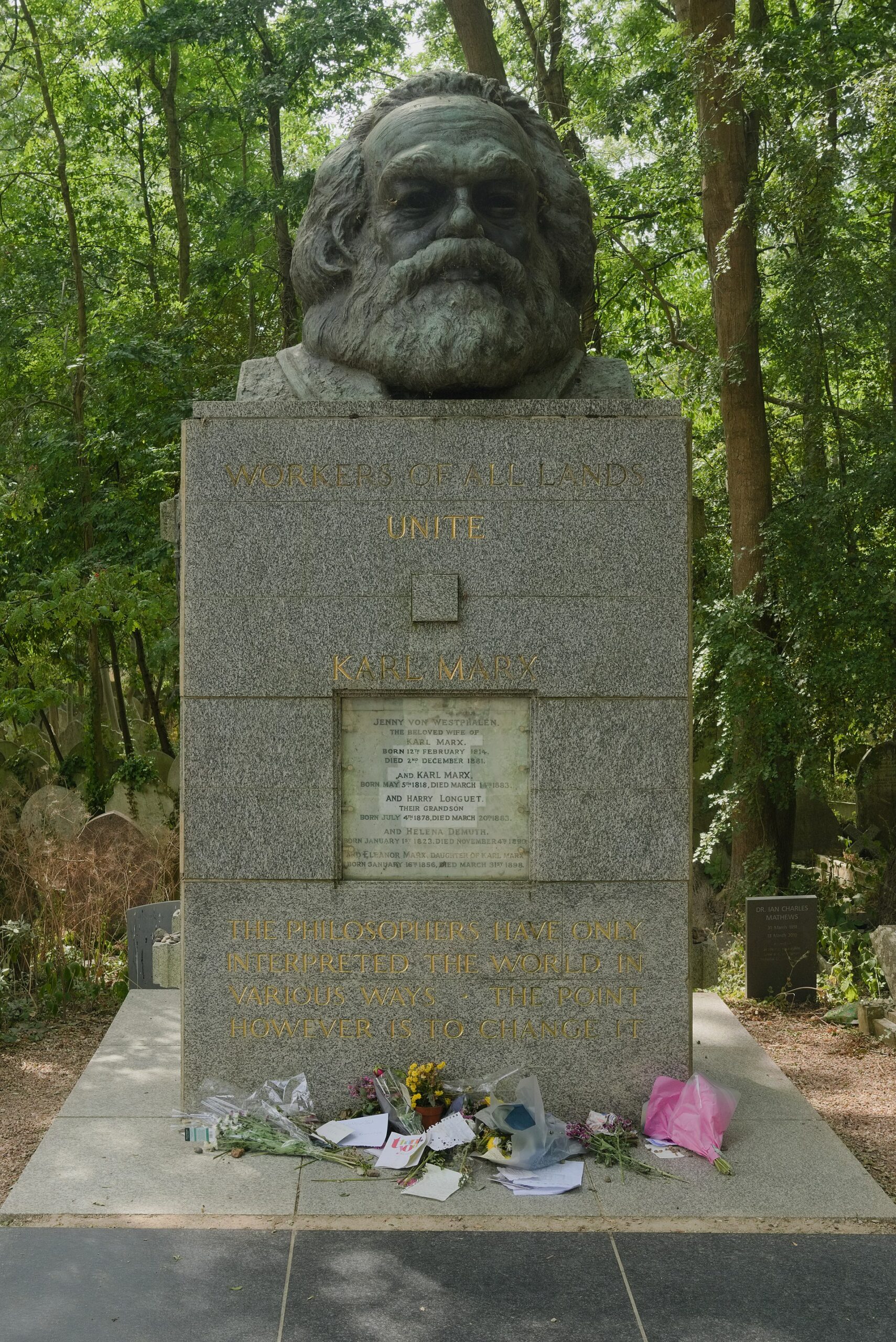
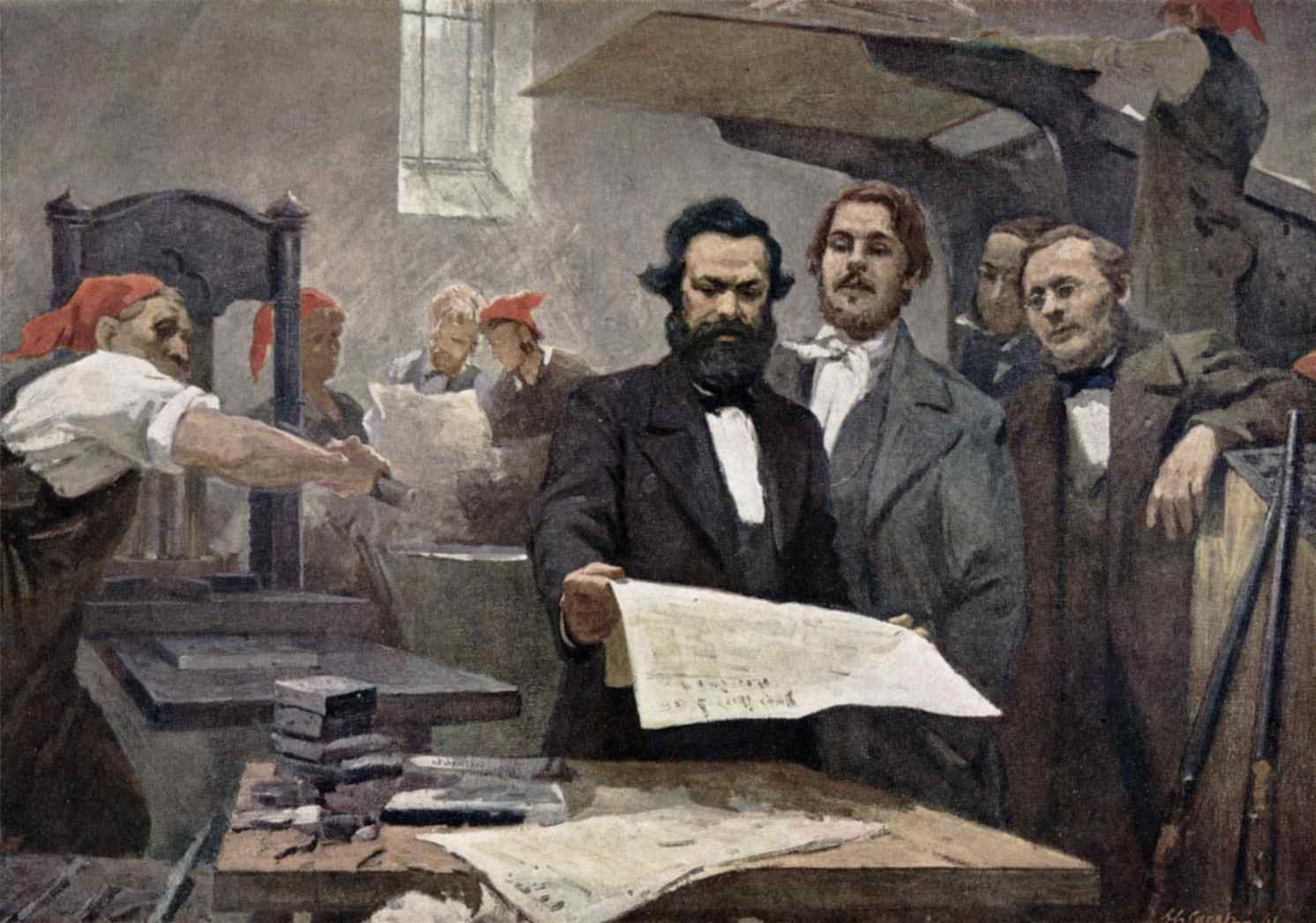
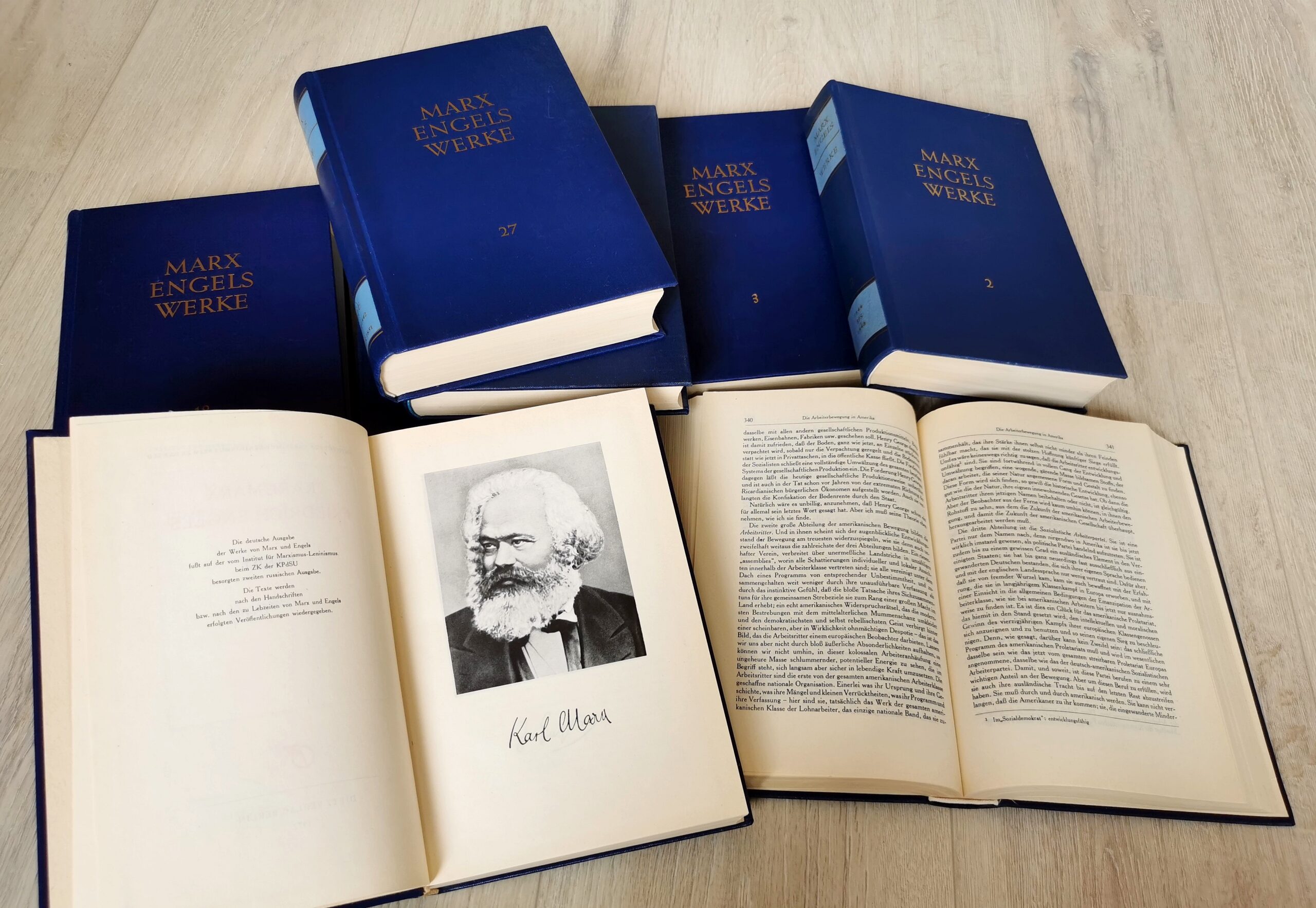
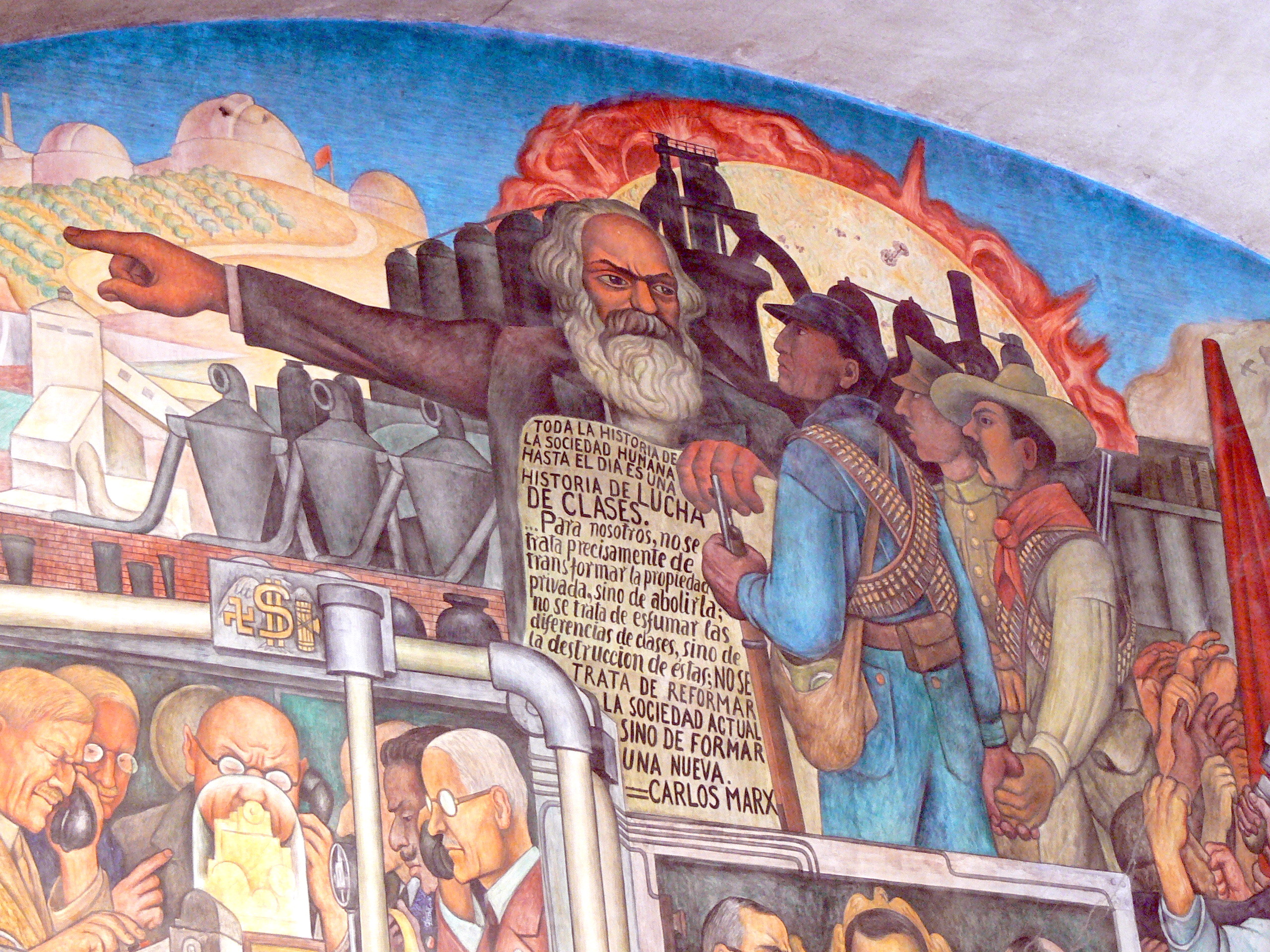
images: 1. Young Karl Marx via Wikimedia Commons; 2. Karl Marx and Engels in the printing house of the “Neue Rheinische Zeitung”, painting by E. Capiro; 3. volumes of Marx & Engels Collected Works in German via Wikimedia Commons; 4. detail of mural by Diego Rivera, Palacio Nacional, Mexico City via Wikimedia Commons; 5. tomb of Karl Marx in Highgate Cemetery via Wikipedia
Discover more from Matthew Cheney
Subscribe to get the latest posts sent to your email.


