Today is Bob Dylan’s 85th birthday. I expect he finds that number at least as weird as the rest of us do — how did Bob Dylan manage to survive to be 85 years old? But also: how was Bob Dylan ever less than 85 years old?
In 2021, I wrote up some notes for Dylan’s 80th birthday, and I’m just going to add a few things here, as my opinions on Dylan haven’t really changed since then.
Since 2021, Dylan has stayed busy. He’s still touring, as always, and though I can’t say I’m a huge fan of Dylan concerts of the last 10 years or so, now and then something comes out that’s truly impressive. For instance, his performance last year in San Diego of Rick(y) Nelson’s song “Garden Party”, which he’d never performed before, and which I think is probably the first time he ever sang a song with a reference to himself in it: “Mr. Hughes hid in Dylan’s shoes, wearing his disguise.” (“Mr. Hughes” was reputedly a pseudonym George Harrison used for traveling incognito.) (As Peter Gabriel once sang: “And it feels so unnatural to sing your own name.”) It’s just a good, fun performance. At some concerts, even die hard fans can begin to wonder if Dylan knows how to sing anymore. “Garden Party” shows he’s still got it.
The 2024 biopic A Complete Unknown brought new attention to Dylan, with an impressive performance by Timothée Chalamet as Dylan, and in many ways even more impressive impersonations by Edward Norton as Pete Seeger and Monica Barbaro as Joan Baez. I went in with low expectations, because biopics are usually terrible and Dylan is especially resistant to that kind of treatment, given how much “Dylan” is a mask over an enigma that may just be a void. But I found the film strangely moving, less because of anything having to do with Dylan than with its sensitive evocation of the era, one that is (and very much feels) more and more distant from our own, and one which I associate with my parents and their generation. (Call it nostalgia for a world I never lived in.)
A Complete Unknown was loosely based on one of my favorite books about Dylan, which is also among my favorite books about music and about the ’60s: Dylan Goes Electric! by Elijah Wald. It’s that rarest of things: a book about Dylan that I never hesitate to recommend to people who don’t care about Dylan, because it uses the topic of Dylan as a lens through which to view a whole moment and to explore a pivot point in American popular culture. You don’t have to know or care a thing about Bob Dylan to find the book interesting and engaging. (The other book I tend to recommend to people regardless of their interest in or knowledge of Dylan is Grown-Up Anger: The Connected Mysteries of Bob Dylan, Woody Guthrie, and the Calumet Massacre of 1913 by Daniel Wolff. Just a great work of historical writing.)
Wald himself had the best quick opinion on the film I’ve seen: “I liked it a lot. …My book isn’t fiction; the movie is. It’s not historically accurate, but it’s poetically accurate.” Poetically accurate is what you want from a Dylan representation. It’s why I’m Not There is the perfect Dylan biopic — it embraces and foregrounds the way appropriating and fictionalizing the shards of shattered culture (and life) becomes meaningful in Dylan’s work.
Since 2021, Dylan has released one new studio album, the lovely Shadow Kingdom, a collection of new interpretations of some of his early songs. His version of “Queen Jane Approximately” there is particularly affecting. Guitarist Tim Pierce tells some great stories of how the record was made.
The Official Bootleg Series has continued to offer revelations since 2021. Spingtime in New York (1980-1985) bravely explored Dylan’s most maligned years, the years when he released unquestionably some of his worst albums. There’s good stuff, especially the Infidels outtakes, but nothing essential that wasn’t already available on the first Bootleg Series release. (And I’m kind of annoyed at them for not including all the songs from Dylan’s astonishing performance on the David Letterman show. They include “License to Kill”, which is good, but not “Don’t Start Me Talkin'” and “Jokerman”, the latter of which seems to me, in all its roughness and ferocity, one of Dylan’s great performances of the decade. The story of how the this performance with a basically unknown L.A. punk band happened — and why, in an era when Dylan was lacking energy or purpose most of the time, it’s so good — is pretty amazing, too.)
In 2023 we got Fragments – Time Out of Mind Sessions (1996–1997), which chronicles Dylan’s astonishing rebirth.
There’s a pile of material they could have included from a few years earlier. Maybe they’re saving it for future releases — I certainly hope so, as I dream of official editions of the 1990 Toad’s Place concert (the longest Dylan ever performed), the 1992/92 Bromberg Sessions, the 1993 Supper Club performances, the 1994 Roseland concert… But still, Fragments is great, and combined with The Bootleg Series, Vol 8: Tell Tale Signs from 2008, it gives a good view of Dylan’s rediscovery of his talent.
The Complete Budokan concert came out in 2023. I don’t hate the original Budokan release, and in fact sometimes really enjoy its more jaunty reimaginings of his songs, but I can’t say I wanted … more.
The 1974 Live Recordings, released in 2024, are pretty amazing, however. I mean, it’s all too much, but wonderfully so — 27 CDs! My friends at Third Man Records did a limited edition vinyl selection that does a great job of selecting from what may otherwise feel like an ocean of Bob (and The Band) — though the record itself is sold out, the track listing is useful. Also useful is Ray Padgett’s exploration of the set.
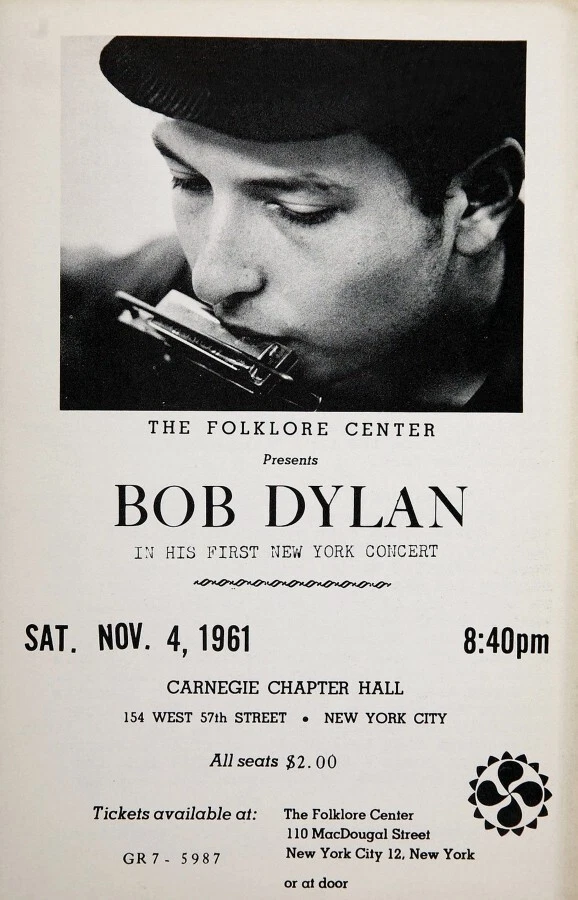
This past fall, probably to build off the success of A Complete Unknown, we got The Bootleg Series Vol. 18: Through The Open Window, 1956-1963 which, like the film, is much better than I expected it to be. In fact, this is a release where I recommend getting the “deluxe edition” if you can afford it, because the ancillary materials are excellent and the real joy of this set is listening to Robert Zimmerman become Bob Dylan. Also, it’s marvelous to have the full Carnegie Hall concert. The 2-CD highlights version is fine, but it’s not much more than you could get from a lot else that’s out there. This era is the one that’s most fully chronicled, most fully analyzed, most fully chewed over. We haven’t lacked for releases of Dylan’s ’60s material. What’s new and exciting here is the detail, scope, and wonder across all 8 discs of the full version. (Once again, Ray Padgett goes into the details really well.)
And then there are the books. There’s a huge number of Dylan books published every year, but they tend to be … disappointing. Even otherwise good writers can become quite bad when they write about Dylan — we saw this in Ron Rosenbaum’s Bob Dylan: Things Have Changed, a book that desperately needed an editor (and proofreader) to try to contain its rambling self-indulgence. A truly embarrassing book to be published by a professional writer. Robert Polito’s After the Flood: Inside Bob Dylan’s Memory Palace is somewhat better; also self-indulgent and rambling but at least with some interesting and useful perspective on Dylan since 1991, which is Polito’s focus. It’s hard to escape the feeling that a certain type of aging white guy desperately wants to make sure to publish a book on Dylan before Bob outlives him.
The one really good book on Dylan that I’ve read since 2021 is What Did You Hear: The Music of Bob Dylan by Steven Rings, a professor of music at the University of Chicago. This belongs alongside Timothy Hampton’s essential Bob Dylan’s Poetics, which looks at how Dylan’s lyrics and music work together. What Rings does is provide those of us who are not musicologists with concepts and language that allow us to better understand what we’re responding to in Dylan, and to hear new things that we were otherwise ignorant of. It’s frustrating that so much drivel gets written about Dylan and books like Rings’ and Hampton’s are less known.
But hey, it’s Dylan’s 85th birthday and what we really should be doing is listening to his music. For his 80th, I listed 8 songs to listen to, and so I will do that again, this time with 5 that I’ve been listening to a lot over the recent years. Links are all to YouTube, which seems easiest:
- The Ballad of Hollis Brown (live, Carnegie Hall, 1963)
- Isis (live, 1975)
- Polly Vaughn (live, 1992)
- Lone Pilgrim (World Gone Wrong, 1993)
- A Hard Rain’s A-Gonna Fall (live, Japan, 1994)
Discover more from Matthew Cheney
Subscribe to get the latest posts sent to your email.
