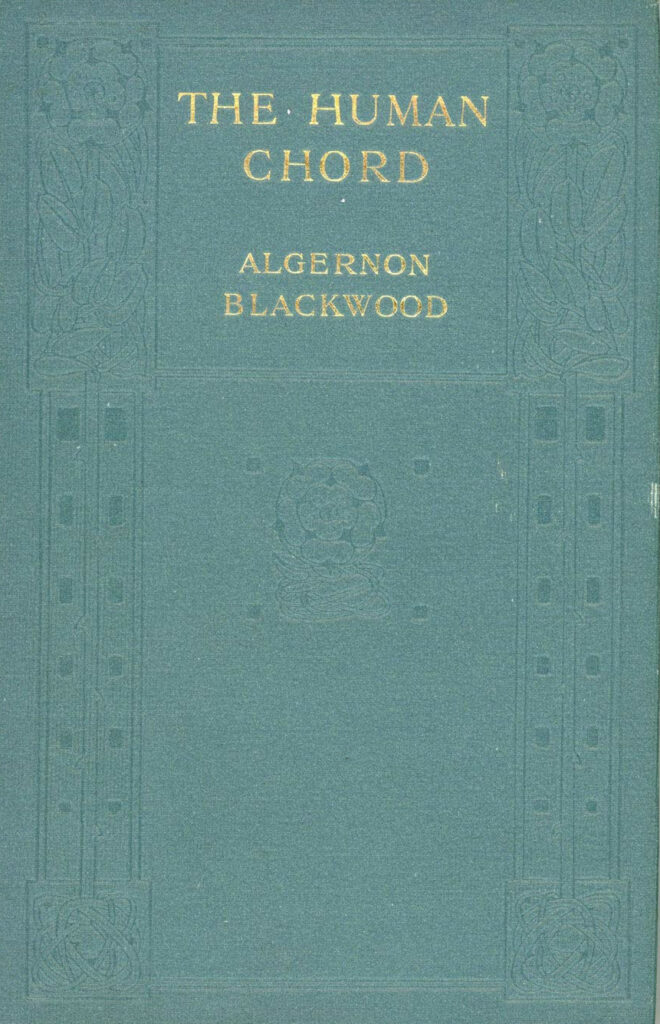
Published in 1910, Algernon Blackwood’s The Human Chord is not, by any stretch of the imagination, a good novel. But it is a strange and intermittently interesting one, and historically important in that it attempts to give fictional life to some of the key ideas of the Hermetic Order of the Golden Dawn, a group that had an outsize influence on 20th century culture. Blackwood was a member of the Golden Dawn for a while, and a fellow traveler of other occult and parapsychological groups, which makes his work particularly valuable for tracing the echoes of mystical thought into intellectual and social culture from the Decadent 1890s through 1945 or so, an influence that seems to me as meaningful and pervasive as that of Freud, but considerably less studied.
(I’ve previously written at some length about a vastly better, more enduring work by Algernon Blackwood in “Blackwood’s Greenwood: The Man Whom the Trees Loved”.)
There is not much story to The Human Chord, making it easy to summarize: A 28-year-old man, Robert Spinrobin, has ended up in various dull jobs. Though he “possessed the mystical vision of the poet”, he lacked “the sense of proportion and the careful balance that adjusts cause and effect”. Since childhood, Spinrobin has been fascinated by the idea of “real names” for things — the hidden, unspoken, powerful names that hide behind reality’s veil. He ends up going to work as a secretary for a mysterious retired clergyman, Philip Skale, who takes him to a remote house in the mountains of Wales. There, Skale slowly reveals his plans: He needs a voice like Spinrobin’s to add to a chorus made up of himself, his housekeeper Mrs. Mawle, and an innocent young woman, Miriam, with whom Spinrobin falls in love at first sight. The novel is then given over to Skale’s many discourses on the nature of sound, vibrations, names, and mystical power, as well as the revelation of his plan ultimately to assemble the true name of God (or Nature or whatever) and thus gain a tremendous power, a power he can glimpse through the experiments he has achieved, experiments that demonstrate the ability of sound and vibration, carefully controlled and mystically known, to alter both emotions and material.
“Sound,” he went on, the whole force of his great personality in the phrase, “was the primordial, creative energy. A sound can call a form into existence. Forms are the Sound-Figures of archetypal forces—the Word made Flesh.”
Such ideas have a long history, but that history culminated in a particular use by Theosophy, the Golden Dawn, and the Society for Psychical Research — all groups Blackwood was familiar or closely associated with — as Justin Sausman points out in a useful essay, “From Vibratory Occultism to Vibratory Modernism: Blackwood, Lawrence, Woolf”, delineating the
three main ways in which vibrations functioned within late nineteenth-century occultism. (1) Vibrations are naturalised as the physical basis of occult forces, through sympathetic vibrations between individuals, vibrations of the ether, or the forces of primal creation and destruction unleashed through vibrating divine names. (2) Vibrations are psychologised: the effect of bodily vibrations is registered within the consciousness of the magician, rather than the external world. (3) Vibrations become a metaphorical resource for exploring the permeable boundaries between science and occultism. (38)
Skale is something of a sorcerer and a mad scientist, and as much as The Human Chord has a story, it’s a familiar one, going back at least to Prometheus and, later, Faust, of hubris and forbidden knowledge. Of course, it doesn’t all go as planned, and Skale is properly punished for his desire to be as a god, while Spinrobin and Miriam escape back to the ordinary world and the cherished purity of their love.
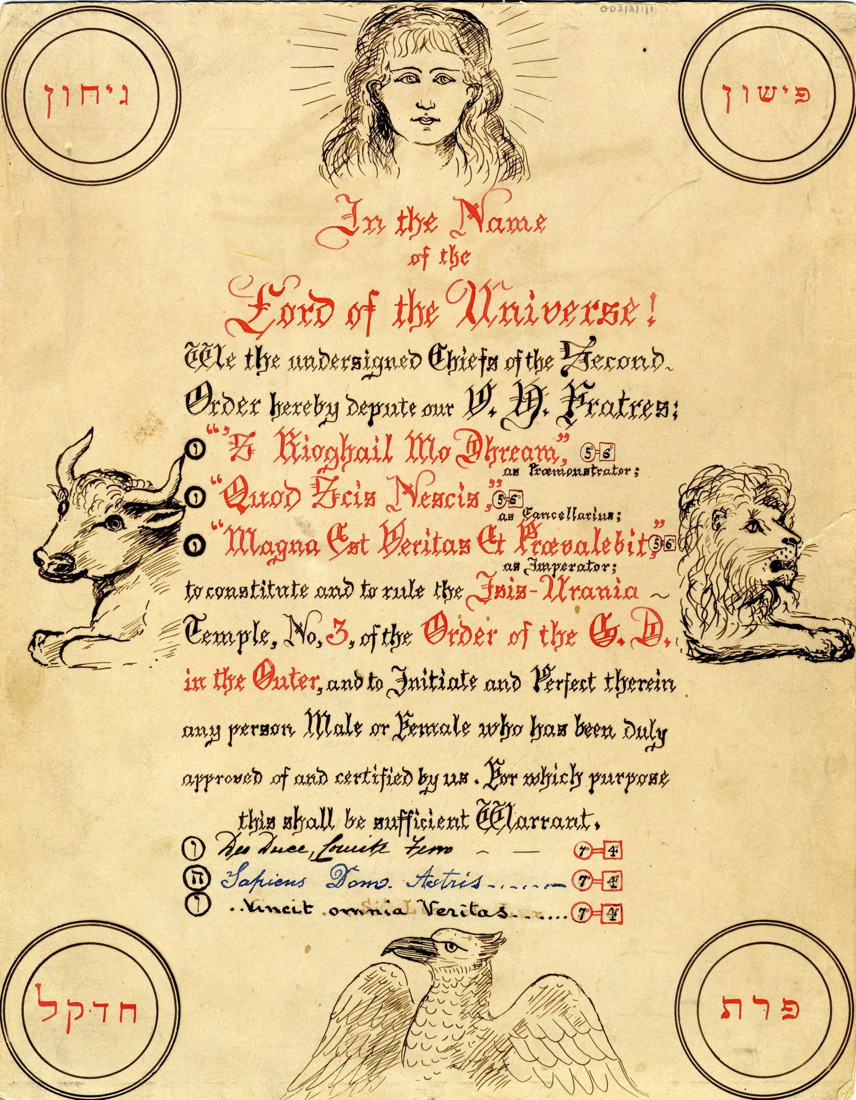
In Talking to the Gods: Occultism in the Work of W. B. Yeats, Arthur Machen, Algernon Blackwood, and Dion Fortune, Susan Johnston Graf notes that it was in this novel that Blackwood
most openly showcases Golden Dawn magic, but it is not exactly a positive depiction of ritual activity. The later occult novels, The Promise of Air, The Centaur, Julius Le Vallon, and The Bright Messenger, present the occult ideal that there are superhuman possibilities for spiritually evolved individuals. The magician in The Human Chord is more of a sorcerer than a magus: He is more concerned with personal power than with spiritual perfection. In contradistinction to the adeptus minor oath, he abused the powers entrusted to him. The story is a cautionary tale, in a sense, because the Faustian sorcerer fails in his attempt, bringing ruin on himself and his household. (85)
There are two great aesthetic problems with the novel: first, it would have been far more effective as a 25-page story, since most of what is in the middle of the book is repetitive and primarily devoted to Skale’s theories and expositions, none of which require pages and pages of explanation. At least as much of a problem is the utter shallowness and silliness of the love story. Miriam is hardly a character at all, she’s just a figure of purity and innocence, though rather than pure and innocent she mostly comes off as dazed and dull-witted. Spinrobin isn’t a whole lot more developed, and their love story is like something a 12-year-old might write. It’s cloying and occasionally unintentionally funny — sometimes laugh-out-loud (such as when they decide to repurpose Spinrobbin’s imaginary childhood friend/monster named Winky to represent their love, a use that makes it difficult not to think that they’re using “Winky” as a nickname for Spinrobin’s penis. Wee Willie Winky runs through the town…)
The novel has very little conflict. It’s mostly premise and concept. The characters all like (and love) each other for the majority of the book’s length, and then the disagreements toward the end aren’t even really acted out, since Spinrobin and Miriam never really confront Skale about their doubts, they just slip away while he thinks they’re going to be performing their part in the summoning of power. Skale and Mrs. Mawle get destroyed and Spinrobin and Miriam live happily ever after, content with knowing each other’s true names.
While The Human Chord is weak in its story and its character development, it is worth attention for some of its other qualities: Blackwood’s typically sensitive descriptions of landscape, which rarely rise to the lyrical (or perhaps purple) heights of some of his contemporaries, but instead are, at their best, vividly grounded and material; his forceful depictions of the effects of Skale’s experiments; and his commitment to the depths of his concept, even if that commitment is also what leads the book often to feel repetitive. Blackwood seems no less committed than Skale to the idea that the universe is made of sounds (vibrations). Like many of Blackwood’s longer stories, The Human Chord is primarily a philosophical narrative, an attempt to tell a story about the ways of the universe. It has a clear didactic purpose: Via the character of Skale, Blackwood is teaching us to rethink our assumptions about how the world works.
In a brief introduction to the Stark House edition of the novel, which pairs it with Blackwood’s next (and stranger) novel The Centaur, Richard Gavin insightfully notes that we might think of the novel as “pulp Gnosticism, mysticism for the masses”, and that seems right to me, even as Gavin points out Blackwood’s clear use of the Gothic. This is a book trying to bring to a general audience some of the insights Blackwood had gleaned through his occult and mystical reading, thinking, and work. It’s a book that has more in common with The Celestine Prophecy or Ishmael than with a novel by, say, Stephen King or another contemporary gothicist.
Though raised in a strongly Christian family, Blackwood’s own beliefs tended toward pantheism and animism. (Vincent Starrett, in Born in a Bookshop, related Arthur Machen saying to him: “Tennyson, you remember, says ‘the cedars sigh for Lebanon’, and that is exquisite poetry; but Blackwood believes the cedars really do sigh for Lebanon and that, Starrett, is damned nonsense!”) The Human Chord expresses such beliefs — which rise to the cosmic — repeatedly and powerfully:
The terrifying beauty of Skale’s ideas; the realization in cold blood that all forms in the world about him were silently a-singing, and might any moment vanish and release their huge bodies into primal sounds; that the stones in the road, the peaked hills, the very earth herself might alter in shape before his eyes: on the other hand, that the viewless forces of life and death might leap into visibility and form with the calling of their names; that himself, and Skale, and Mrs. Mawle, and that pale fairy girl-figure were all enmeshed in the same scheme with plants, insects, animals and planets; and that God’s voice was everywhere too sublimely close—all this, when he was alone, oppressed him with a sense of things that were too intimate and too mighty for daily life.
There’s a brief and subversive comment on Christianity, and specifically Christ himself, by Skale:
“Spinrobin,” said the clergyman at length, in a voice turned soft and tender with compassion, “the name I seek—this awful name we may all eventually utter together, completely formed—is one that no living man has spoken for nigh two thousand years, though all this time the search has been kept alive by a few men in every age and every country of the world. Some few, they say—ah, yes, ‘they say‘—have found it, then instantly forgotten it again; for once pronounced it may not be retained, but goes utterly lost to the memory on the instant. Only once, so far as we may know”—he lowered his voice to a hushed and reverent whisper that thrilled about them in the air like the throbbing of a string—”has it been preserved: the Prophet of Nazareth, purer and simpler than all other men, recovered the correct utterance of the first two syllables, and swiftly—very swiftly—phonetically, too, of necessity,—wrote them down before the wondrous memory had time to fade; then sewed the piece of parchment into his thigh, and hence ‘had Power’ all his life.[“]
Skale here proposes for something a little bit like the idea of Jesus the Magician, and though it denies that Jesus was the son of God, it allows that he was “purer and simpler than all other men” and thus able to bear and wield the name of God. The animistic, occult, vibratory conception of the universe thus can include a kind of Christianity, even encompass that Christianity.

While certainly his occult studies brought Blackwood to his conception of The Human Chord, the novel itself also stands as a critique of the arrogance of ritual magic, putting Blackwood’s tale a bit more in line with W. Somerset Maugham’s The Magician (1908) than occultists might have been comfortable with (and, indeed, Aleister Crowley didn’t have much good to say about Blackwood’s book, also mentioning The Magician, and basically accusing Blackwood of plagiarizing The Garden at No. 19 by Edward Jepson — though as Mike Ashley points out in his Blackwood biography, plagiarism would have been chronologically impossible). Justin Sausman writes that by “the end it becomes difficult to pinpoint which side the novel finally takes in [the] conflict” (41) between the cosmic and mundane, at least in terms of philosophy; it’s pretty clear that the novel is on the side of Spinrobin and Miriam, who choose worldly love over cosmic power.
Blackwood’s novel shows quite clearly the ways that occultism considered itself part of a (quasi-)scientific enterprise, an expression of scientific naturalism. Skale doesn’t sound like a wizard, he sounds like a scientist. Maybe mad, but a scientist nonetheless. The Human Chord represents, then, a type of proto-science fiction like the works published in MIT Press’s excellent Radium Age series. Sylvia Mieszkowski, in a long chapter about The Human Chord in her book Resonant Alterities: Sound, Desire and Anxiety in Non-Realist Fiction, writes that
occultism should be read as a symptom of an epistemological crisis, which happened during the late 19th and early 20th centuries, due to the replacement of religion by science as the dominant discourse. In presenting occultist extensions of scientific discoveries about sound, The Human Chord comments on two effects of this crisis: It refers to the well-founded cultural anxiety (that neither science nor the cosmos which it researches care about human individuality), while giving voice to a collective desire (that science might be wrong, and that there is a place for each individual within the cosmic order). (166)
Egil Asprem and Jason Ānanda Josephson Storm, among others, have done good work to complicate and challenge the religion-replaced-by-science idea, but Mieszkowski characterizes the epistemological thrust of The Human Chord accurately. What, the novel wonders, is to become of individual human emotion — in particular, love — in a vast and powerful cosmos? Blackwood’s answer by the end of the book seems to be: Humans should take care of each other and let the cosmos be, since soon enough death will transform us into whatever cosmic vibration we are going to be next. No need to hurry. The cosmos will always be there — but true love may not.
Discover more from Matthew Cheney
Subscribe to get the latest posts sent to your email.
