I continue, having really hardly stopped for decades now, to read Virginia Woolf’s two Common Reader collections. In the absence of an adequate Selected Essays (the Oxford World’s Classics one is thin and lacking even “The Death of the Moth”), the Common Readers must suffice. (For more of my thoughts on selecting Woolf’s essay, see this post from 2017.)
Today I was browsing through “Jane Eyre and Wuthering Heights“ from the first Common Reader, an essay that incorporates some of a 1916 piece she wrote for the Times Literary Supplement in honor of Charlotte Brontë’s centenary, but which also adds new material and perspective.
What struck me on this reading was a single long paragraph. It’s dense, but worth the effort to make your way through, because there is an entire writing workshop of insight here about how (some) fiction works and why:
For the self-centred and self-limited writers have a power denied the more catholic and broad-minded. Their impressions are close packed and strongly stamped between their narrow walls. Nothing issues from their minds which has not been marked with their own impress. They learn little from other writers, and what they adopt they cannot assimilate. Both Hardy and Charlotte Brontë appear to have founded their styles upon a stiff and decorous journalism. The staple of their prose is awkward and unyielding. But both with labour and the most obstinate integrity by thinking every thought until it has subdued words to itself, have forged for themselves a prose which takes the mould of their minds entire; which has, into the bargain, a beauty, a power, a swiftness of its own. Charlotte Brontë, at least, owed nothing to the reading of many books. She never learnt the smoothness of the professional writer, or acquired his ability to stuff and sway his language as he chooses. “I could never rest in communication with strong, discreet, and refined minds, whether male or female,” she writes, as any leader-writer in a provincial journal might have written; but gathering fire and speed goes on in her own authentic voice “till I had passed the outworks of conventional reserve and crossed the threshold of confidence, and won a place by their hearts’ very hearthstone”. It is there that she takes her seat; it is the red and fitful glow of the heart’s fire which illumines her page. In other words, we read Charlotte Brontë not for exquisite observation of character—her characters are vigorous and elementary; not for comedy—hers is grim and crude; not for a philosophic view of life—hers is that of a country parson’s daughter; but for her poetry. Probably that is so with all writers who have, as she has, an overpowering personality, who, as we should say in real life, have only to open the door to make themselves felt. There is in them some untamed ferocity perpetually at war with the accepted order of things which makes them desire to create instantly rather than to observe patiently. This very ardour, rejecting half shades and other minor impediments, wings its way past the daily conduct of ordinary people and allies itself with their more inarticulate passions. It makes them poets, or, if they choose to write in prose, intolerant of its restrictions. Hence it is that both Emily and Charlotte are always invoking the help of nature. They both feel the need of some more powerful symbol of the vast and slumbering passions in human nature than words or actions can convey. It is with a description of a storm that Charlotte ends her finest novel Villette. “The skies hang full and dark—a wrack sails from the west; the clouds cast themselves into strange forms.” So she calls in nature to describe a state of mind which could not otherwise be expressed. But neither of the sisters observed nature accurately as Dorothy Wordsworth observed it, or painted it minutely as Tennyson painted it. They seized those aspects of the earth which were most akin to what they themselves felt or imputed to their characters, and so their storms, their moors, their lovely spaces of summer weather are not ornaments applied to decorate a dull page or display the writer’s powers of observation—they carry on the emotion and light up the meaning of the book.
Woolf speaks well for herself, so I will not belabor all that is here, but I can’t resist pulling a few pieces out for special attention.
The linking of Charlotte Brontë and Thomas Hardy as “self-centred and self-limited writers” who “have a power denied the more catholic and broad-minded” is one I wish more people would keep in mind, even if they disagree with Woolf’s representation of Brontë and Hardy. (I’m not sure I disagree exactly, though I expect I see more in Hardy, at least, than she did, but I struggle to agree with Woolf that Jane Austen represents the other pole, but that’s my own failure as a reader, since I find Austen’s writing quite unbearable. Woolf would slap me upside the head for thinking that. C’est la vie.) Woolf’s insight here is that we do not need novels to contain the whole world, we do not need them to be photo-realistic baggy monsters — she has no problem with such things, in certain ways (her preference was for the Russians when it came to all-encompassing novels) — but she is going to the barricades to defend powerful writers with narrow subject matter or repeated themes and motifs, writers who perhaps lack a certain eloquence or depth of vision but who make a great virtue of their limitations. Woolf was notoriously tough on her contemporaries. There were hardly any whose fiction she really embraced, but Hardy was an exception, perhaps because he wasn’t an exact contemporary. Her father had been important to Hardy’s career and she had tea with him late in his life — I’m lazy and not looking up the reference in her diary at the moment, but it’s quite a fun entry, because she clearly went as a fan and had what she knew was an unreasonable expectation that the great writer would share sage wisdom and perhaps nudge her toward enlightenment, but he just wanted to talk about mundane things and had little or nothing to say about writing or literature. It reminded her that the best authors are much less interesting than their writing.
“Nothing issues from their minds which has not been marked with their own impress.” This (this, I say!) is the core matter too often lost by ambitious writers today (and, for that matter, in the past). Let us grant, for the moment, Woolf’s opinion that Charlotte Brontë and Thomas Hardy were limited writers who exploited their limitations brilliantly. What made their work brilliant was that it could only ever be their own work. It bears the force of the writer’s personality, which is to say its odd moments, awkward turns of phrase, strange structures, obsessive repetition of ideas and themes and character types and images, etc. etc. — all of this is singular to that writer. We know (and Woolf knew) from their biographies that sometimes they were, in fact, trying to write in conventional ways. But their commitment to their own vision, and the strength of their personal oddities, overcame any ambition to be conventional. Indeed, we might even suggest that the weakest moments in their books are the most conventional ones, the times when they were trying, either from desire or haste, to write like everybody else.
Without saying so, Woolf positions Charlotte Brontë and Thomas Hardy as cousins to dime novelists, pulp writers, and lovers of melodrama: “There is in them some untamed ferocity perpetually at war with the accepted order of things which makes them desire to create instantly rather than to observe patiently. This very ardour, rejecting half shades and other minor impediments, wings its way past the daily conduct of ordinary people and allies itself with their more inarticulate passions.” I’ve long thought there is much to learn about the value and power of melodrama from Charlotte (and Emily) Brontë and Thomas Hardy. Woolf is clear about this. Theirs are books full of passion and drama, heightened because ordinary language is inadequate to the greatest human feelings. If you have ever been overwhelmed by love or terror, grief or bliss, you know that melodrama is the most emotionally realistic mode. Woolf, who struggled all her life not to be undone by her emotions, knew this viscerally.
That power is why such writers turn to nature. (Woolf’s essay is about the Brontës, so she leaves Hardy behind, but her insights apply equally to his work.) “…their storms, their moors, their lovely spaces of summer weather are not ornaments applied to decorate a dull page or display the writer’s powers of observation—they carry on the emotion and light up the meaning of the book.” This is the kind of insight that makes me want to stand up and cheer.
Depictions of nature that are not ornamental but instead are essential to the purpose and meaning of the writing. Too often, writers think of description or setting as separate from other elements, but in the best writing no elements are separate. Literary analysts may be forced to pull elements apart to look at them, but even as we do so we know what we do is artificial and possibly a kind of violence against the beauty and wonder of the unified whole. Summary and analysis will never do justice to great writing because great writing can only be expressed as what it is.
In any case, you don’t need me to explain it all to you. Just reread the paragraph and keep reading the essay and let Woolf be your guide.
—–
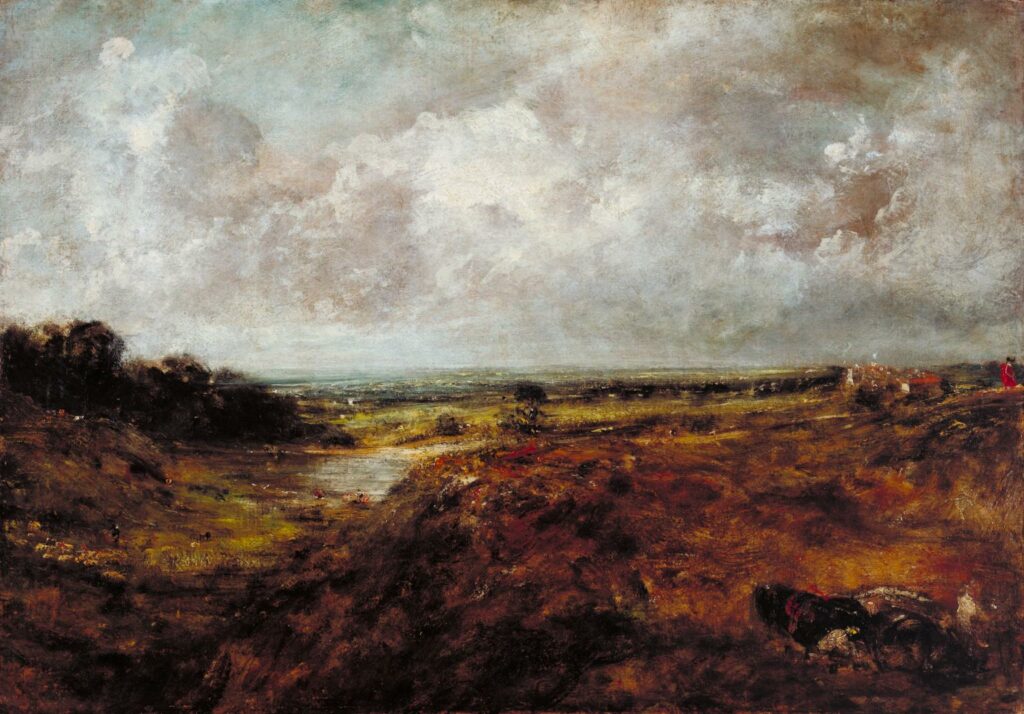
image: John Constable, “Branch Hill Pond, Hampstead Heath, with a Cart and Carters”, c. 1825
Discover more from Matthew Cheney
Subscribe to get the latest posts sent to your email.
