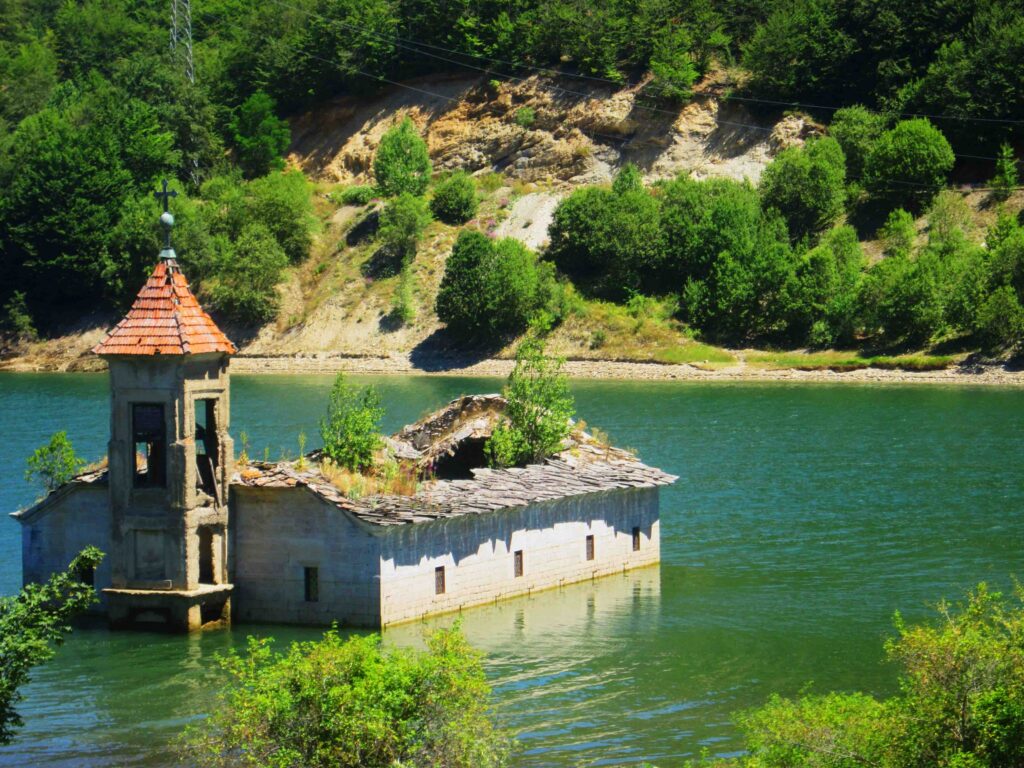
1. Submersible
Edgar Allan Poe was a trickster, a hoaxster; were he peering over our shoulders as we stare at pages of his words and, with the omniscience of a ghost, reading our thoughts, I have no doubt he would repeatedly whisper, like a dusty and demented raven, or a prematurely buried man, “That is not what I meant at all. That is not it, at all.”
Do you remember the first time you read “The Purloined Letter”? For me, it was childhood, having saved money for weeks, maybe months, to buy The Portable Poe edited by Philip Van Doren Stern, which I remember finding in a little basement bookstore in town, and I was always afraid somebody else would buy it before I had scrounged enough cash from whatever errands and tasks I performed for family and friends in those days to get spending money.1The book cost an unfathomable $8.95, a price that astonished me for a paperback in the days when Stephen King’s newest mass market edition, the 1,093-page It, was selling for $4.95. (Holding the Poe collection now, I note its last page is numbered with the demonic 666…) There were less expensive Poe paperbacks at that little basement bookstore, but The Portable Poe was obviously the best, containing the most famous stories and poems as well as a selection of his nonfiction and of letters he wrote. I remember holding it, my heart heavy as I stared at the price, and my father counseled me that it was not worth spending a few less dollars on notably inferior books. (A good lesson!) I had been entranced by one of my elementary school teachers reading Poe stories and poems to us, I had read a bit by and about old Edgar in library books, and I was ready to take the plunge. I expect I had accumulated $10 to my name and that day spent $8.95 of my wealth on that book. It was a good decision and a book I still own.
I don’t remember, though, when I got to “The Purloined Letter”. I was less interested in the stories Philip Van Doren Stern categorized as “Of Mystery and Ratiocination” than I was in the stories he categorized as “Of Terror”, “Of Death”, and “Of Revenge and Murder”. I read those stories over and over again. A completist even in those green and golden days, I would not have completely skipped the mystery stories, but they held little interest.
I remember first reading “The Purloined Letter” because of the profound sense of disappointment I felt at its conclusion, not only because the story lacked murder or even a drop of blood, but because the revelation of the mystery made the whole hardly seem to be much of a mystery at all. It felt anticlimactic and trivial.
Poe’s story was quite popular when first published, which is evidence that the original readers were impressed even on a first reading, but I wonder if that is still true today, when complex and clever mystery stories are common throughout the culture. I would not at all be surprised if my initial reaction was a common one now.
Of course, “The Purloined Letter” is not the least bit trivial or even anticlimactic — it is one of the most dastardly tricksy stories ever written. As late as 2017, the venerable journal Poe Studies published an article by Russell Reising, “Who Wrote the Purloined Letter?”, arguing that readers are still ignoring clues and missing the truth of which character actually wrote the stolen letter in the story.2I think Reising has too much confidence in his own detective skills; his conclusion is certainly a possible and even logical reading of the story, but it is hardly the only possible or logical reading — if it were, Poe’s story would be much more minor and of primarily historical interest. The most famous readings of “The Purloined Letter”, for better or worse, are those of the psychoanalyst Jacques Lacan and the philosopher Jacques Derrida. The two Jacques’ approaches (with Derrida’s a response to Lacan’s) were so popular among a certain set that they were subject of an entire book, The Purloined Poe: Lacan, Derrida & Psychoanalytic Reading (1988). In Studies in English in 1990, Peter Muckley wrote: “Jacques Lacan’s reading of Marie Bonaparte’s reading of Baudelaire’s, apparent, misreading of the text became part of a campaign to effect a coup in the palace of French psychoanalysis.”
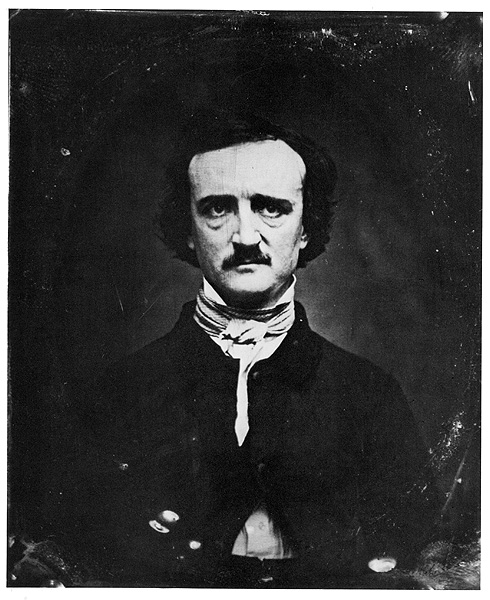
In his essay “The House of Poe”, Richard Wilbur — one of the finest readers Poe has had — proposes that Poe always invited the reader to “play detective” and therefore we must read him “with an eye for submerged meaning”.3First presented as a lecture at the Library of Congress in 1959, and published by the Library in the pamphlet Anniversary Lectures 1959, this essay is currently most easily available in the Norton Critical Edition of The Selected Writings of Edgar Allan Poe edited by G.R. Thompson. A few years later, in a survey of Poe’s life and career written for a textbook, Wilbur noted:
“The Purloined Letter”, despite its adequacy as a detective tale, and as a vindication of pure intuition, is also an allegory of conflict within a single soul. As allegory, it belongs to a class of tales — “The Man of the Crowd”, “Murders in the Rue Morgue”, —in which the soul of a poet “detects” and confronts the evil or brutal principle in itself. By hint upon hint, Poe invites the reader to play detective himself, and to discover that the Minister D— is the worldly, unprincipled “brother” or double of Auguste Dupin.4The essay first appeared in Major Writers of America (1962) edited by Perry Miller, and was reprinted in Wilbur’s collection Responses: Prose Pieces: 1953-1976. It remains an excellent guide to Poe’s life and work, although I may be biased — Miller’s 2-volume textbook was one my mother owned from when she was in school. It lived on the bookshelves in our house when I was growing up, and I read it like a sacred text, so I’m sure my early exposure to Wilbur’s approach to Poe affected my understanding of Poe’s work forever after.
Poe was famously obsessed with doubles and doppelgangers — the critical literature on that topic alone could keep you reading for a good long while. In a later essay, “Poe and the Art of Suggestion”, Wilbur explores the doubling in more detail, writing that there is no way for the detective, Dupin, to know, as he claims he does, what the Minister D— looks like when alone: “Dupin could possess such knowledge only if he were the Minister D—. Well, perhaps he is.” Wilbur then makes a long list of the ways that Dupin and the Minister D— are alike or are direct opposites, with Dupin a kind of positive force of the day and Minister D— a negative force of the night.
This barrage of suggestion forces one to divine a “mystic” dimension of the story in which, as at the close of “William Wilson”, the good and evil sides of one person are in conflict over a woman’s honor and what it symbolizes. The absurdity to which I called your attention — Dupin’s assertion that he knows what the Minister looks like “when nobody sees him” — is not, then, a slip of the pen but one brilliant and challenging hint in a narrative full of pokes and nudges.
Here we begin to see the submerged meaning of “The Purloined Letter”. Poe’s apparently clever but not especially satisfying story is revealed to be a very different sort of puzzle from what we take it to be on an initial reading. We must approach the story as, ourselves, detectives; Dupin may be a most unreliable narrator — may even be, for all we know, the villain of the story.
And so we discover that “The Purloined Letter” is less a story than a provocation toward imagination. Not only is the meaning submerged, but much of the narrative is. We can, and probably must, extrapolate a different tale by digging beneath the words and toward what they side-step, suggest, imply. We must make some choices about which words to believe and which to be skeptical of, perhaps even to discard as entirely false. “The Purloined Letter” is not just a mystery story — it is also itself a mystery, one no reader will ever be able fully to solve, but which offers enough material and information for us to arrive at satisfying conclusions of our own.
2. A Place on the Plateau
Submerged meaning allows art to weave around hostile audiences able only to perceive the surface; censors, for instance. When Víctor Erice’s film The Spirit of the Beehive was made, it had to gain the approval of the censors in the government of General Francisco Franco, who had been dictator of Spain since 1939, when his Nationalist forces defeated the various groups defending the Republic. While Franco was old and ailing at this point (he would die on 20 November 1975), and film censorship was not as strictly or consistently enforced as in the early decades of Franco’s rule, but some subjects had to be handled with great care — for instance, any mention of the Spanish Civil War years.
After the opening credits, The Spirit of the Beehive begins with two items of text on the screen:
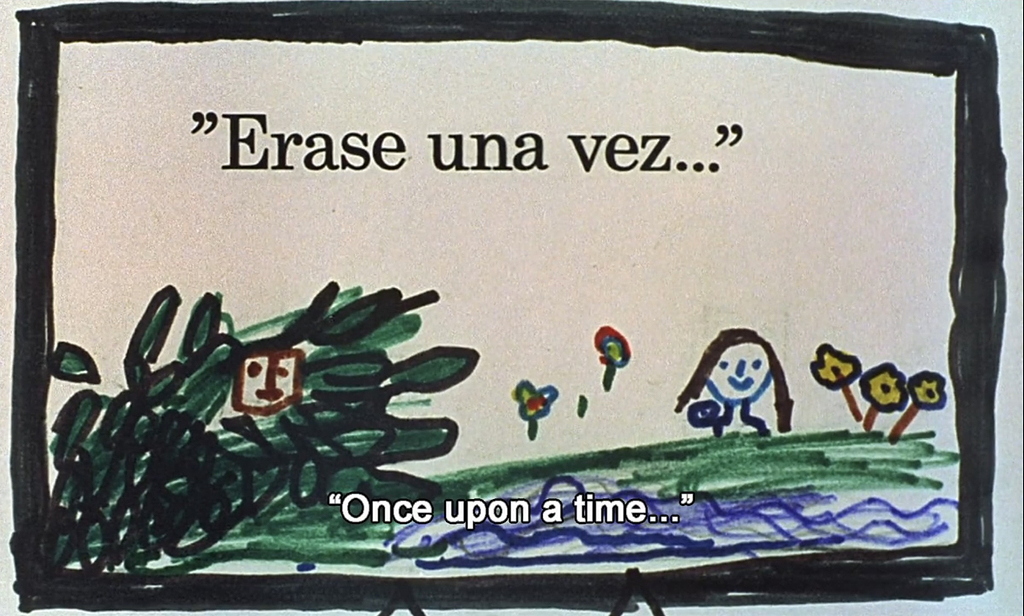
“Once upon a time…”
and
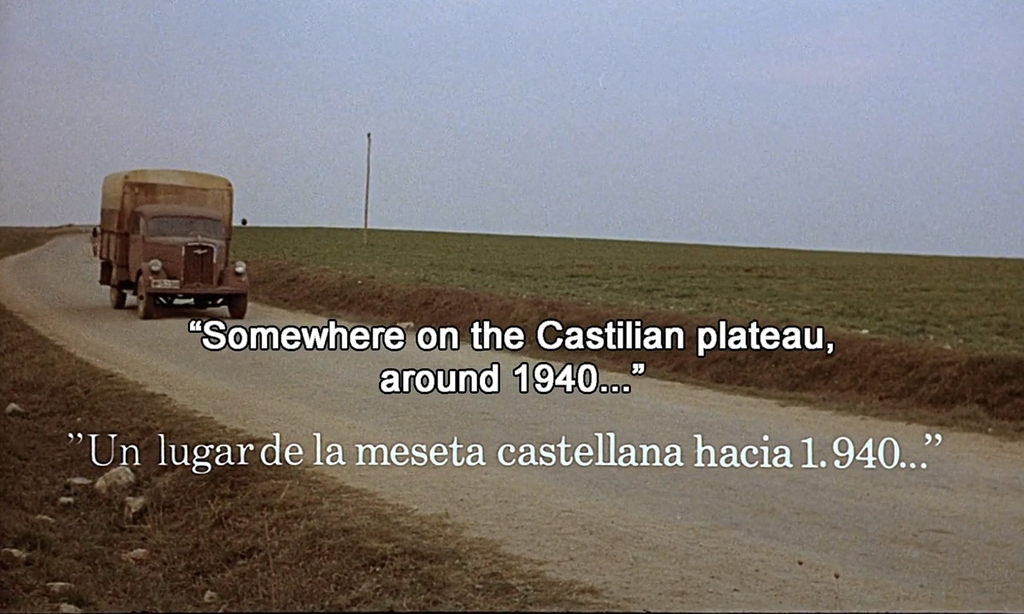
“Somewhere on the Castilian plateau, around 1940…”
As various critics have pointed out, these two statements are in different modes: the first, mythic (the language of a fairy tale), the second, straightforward and historical. This is equally true of the images beneath the text on the screen. The first text appears over a child’s drawing of a moment in the 1931 film Frankenstein that will prove important to this film itself; the second appears over an image of a truck driving on a road on that Castilian plateau (a truck carrying the film reels of Frankenstein that will soon be shown in town).
Like “The Purloined Letter”, The Spirit of the Beehive may not seem like much on a first encounter. I first saw it in college and all I remember is being bored and drifting in and out of sleep. (Being sleepy isn’t a terrible way to experience this movie — it is a dream as much as it is a story.) Especially if you don’t know anything about the history of 20th century Spain, the film can feel slow, thin, empty. It makes no attempt to connect its own dots. Viewers must approach it as they would a pointillist painting, finding just the right distance so that the dots begin to blur together into shape and scene. Then, suddenly, the richness reveals itself.
In an insightful analysis of the film, Dominique Russell identifies three types of ambiguity it employs: 1. oblique references that would, if presented more straightforwardly, invite censorship; 2. the ambiguities common to the international art cinema mode of the 1960s (including, importantly, the film’s constant tension between reality and myth — a tension exemplified, as Russell points out, in the differences between “Once upon a time…” and “Somewhere on the Castilian plateau, around 1940…”); and, 3. the ambiguity of the monstrous: “Monsters are by nature polysemic, and however much they are corralled into singular signification, they inevitably escape their creators’ designs, meaning more, and often contradictory, things.”
The basic references are easily enough elucidated, as Paul Julian Smith does well in his essay for the Criterion Collection edition from 2006:
The village may be a playground for heedless children, but its unpaved streets and ruinous buildings are scarred by conflict and deprivation. The father, Fernando, listens in secret to a shortwave radio (surely it is to the BBC, forbidden by the regime), while his wife, Teresa (Teresa Gimpera), writes letters to an absent loved one (an envelope is addressed to a Red Cross camp in France, where Spanish refugees were interned). The character known only as “the fugitive,” whom Ana visits in an abandoned barn, is presumably a member of the maquis, or anti-Francoist resistance. More generally, the insistent melancholia, approaching catatonia, of the household marks it out as one inhabited by members of the losing side in the war. As the innocent Ana leafs through the family photo album, we glimpse her father in a snapshot with Miguel de Unamuno, the famous intellectual who was a brave critic of Franco’s rebellion.
That gives a first-time viewer most of what they need to know to begin an appreciation of what the film is up to. (Though I would add that Unamuno is most famous for having written The Tragic Sense of Life, the title of which adds some nuance to Fernando and Teresa’s dispirited miens — they are not in any simple way depressed or catatonic; their lives are encased in tragic amber.)
Russell’s insight that Spirit of the Beehive uses the tools of art cinema is useful because it suggests one of the key areas for meaning-making in the film: montage. Editing in art cinema often draws from ideas similar to those of Eisenstein, Vertov, and other Russian film theorists, with important meaning coming from the juxtaposition of seemingly unrelated images and the ability of the viewer to assemble a coherent meaning in their mind. What could be called paratactic editing over hypotactic editing. Thus, early in the film, Fernando is associated with Frankenstein’s creature via both images and sounds. It’s one of the most insistent and least subtle juxtapositions in the entire movie, but it teaches us how we are to find meaning through the rest of the narrative.
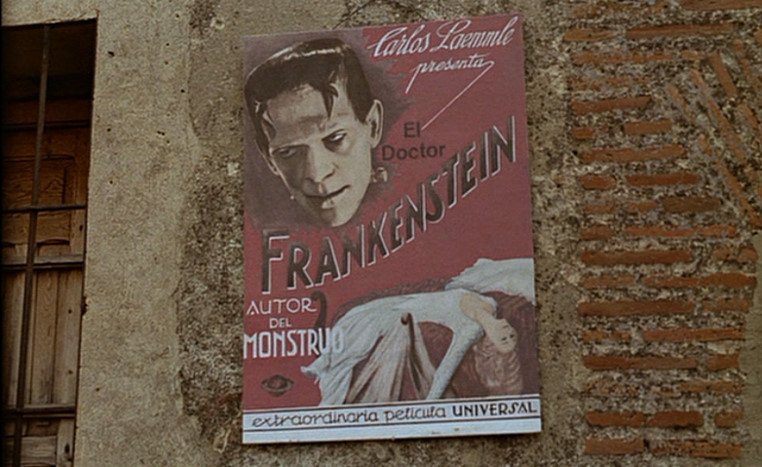
What The Spirit of the Beehive and “The Purloined Letter” both create, in their very different ways, are implied narratives. Shadow stories. A fuller, richer story is buried between the lines, between the shots, in the interstices.
Perhaps there are stories that work as perfect puzzles, where if you figure out some of the clues you find a hidden story that is incontrovertibly one narrative — that would actually be kind of fun, like an optical illusion, but it would be more trick than art. The stories that I am thinking of not only imply most of what matters to their narrative, but also thrive on the ambiguity that implication inevitably raises. The impossibility of knowing for sure what the whole story is becomes itself a central force within the story’s meaning.
And not just meaning. There is an affectual element, too, which is at least as important. The Spirit of the Beehive is not simply a movie that covers most of its narrative in gaps and silence; it is a movie that defies summary and even language itself. There is much that can (and has been) said about the film, but its deepest meanings are conveyed through the viewer’s intuition and feelings: glancing perceptions, sensed knowledge, inchoate apprehensions. “The Purloined Letter” is more purely intellectual, but even there the effect of the ambiguities and implications is to create a feeling of unsettling uncertainty, a sense of evil lurking in the shadows cast by the mostly trivial events, a shiny palimpsest that fails to obliterate the darkness underneath.
3. Lost Zembla
Vladimir Nabokov admitted that Edgar Allan Poe was his favorite writer during his childhood, but he downplayed any influence later in life, though that influence was obvious, especially in his most famous novel, Lolita. Nabokov and Poe shared at least two primary interests (preoccupations, obsessions): doubles and hoaxes — the latter generally, but not exclusively, literary hoaxes — as well as a tendency to write about ghostly figures.
I do not know to what extent Nabokov thought about or drew from “The Purloined Letter”, but his 1962 novel Pale Fire stands as a perfect example of a submerged or implied narrative — indeed, of many such narratives, a few of which can clearly be limned, many others of which are, to some extent or another, speculative.
The submerged narrative I find most moving and beguiling in Pale Fire is one explored best, to my knowledge, by Andrea Pitzer in The Secret History of Vladimir Nabokov. While many scholars have shown recurring themes and motifs in Nabokov’s work, Pitzer draws out one curiously missing from most previous scholarship: “There is hardly a novel in Nabokov’s mature repertoire,” she writes, “that does not have a major character shattered by his own imprisonment or haunted by memories of those who perished in the camps.”
This is true for Pale Fire‘s strange annotator, Charles Kinbote, almost certainly the pseudonym (or fantasized name) of a Russian emigré academic in the book, V. Botkin. Kinbote claims to be the exiled King Charles II of a land called Zembla, a place name (and idea) that has launched a thousand theses. But despite the close attention of obsessive scholars to Nabokov’s text and to the Kingdom of Zembla, what should have been a relatively obvious reference seems mostly to have been missed until Steven Belleto’s 2006 article “The Zemblan Who Came in from the Cold, or Nabokov’s Pale Fire, Chance, and the Cold War”, an essay that Pitzer acknowledges and extends.
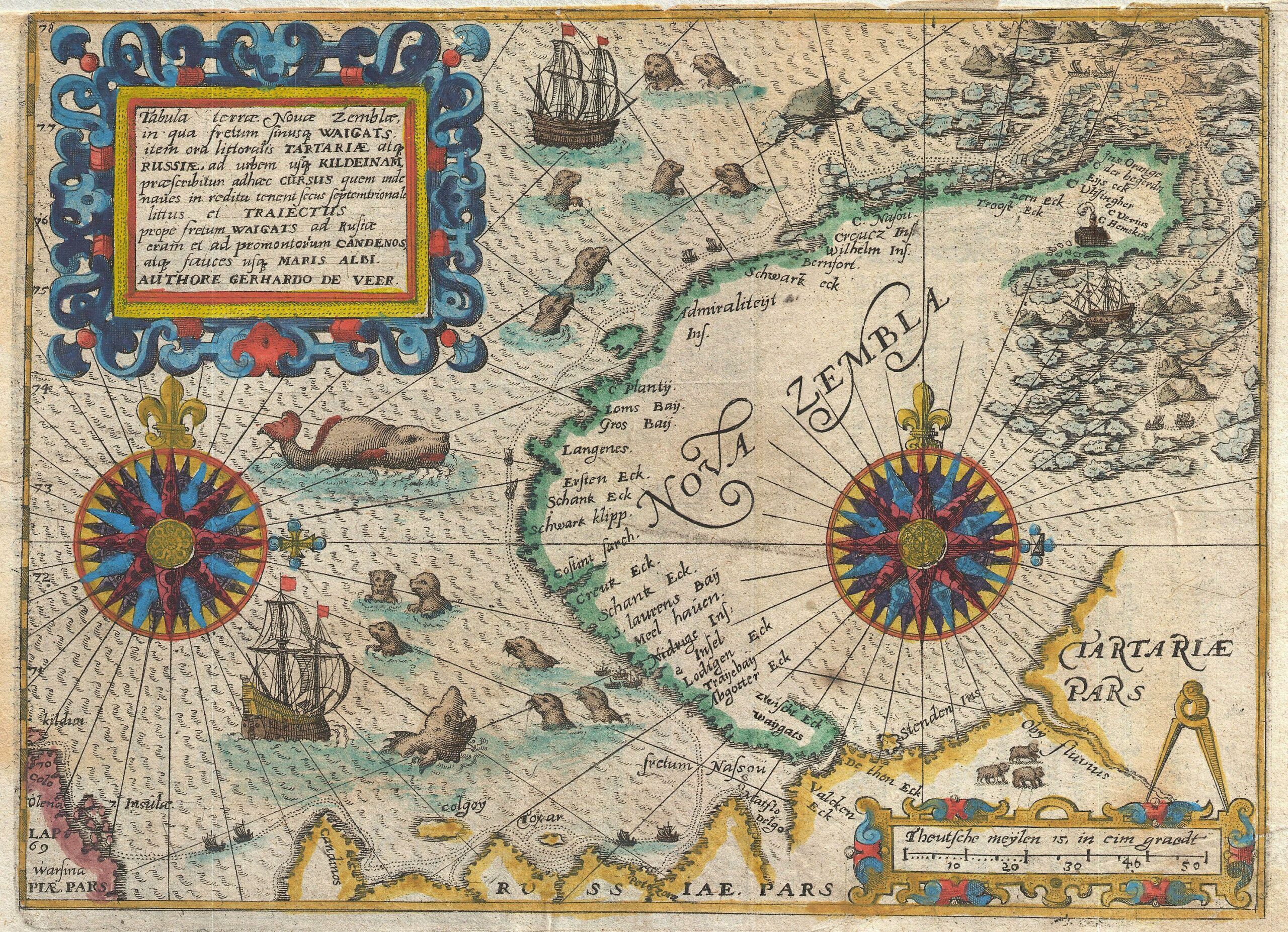
From the mid-1950s through the early 1960s — the exact time when Nabokov was writing Pale Fire — the far northern Russian archipelago of Novaya Zemlya (aka Nova Zembla) was frequently in the news as a primary site of Soviet nuclear testing. A representative example is the front-page New York Times article from November 8, 1958 headlined “New Soviet Tests of Atom Weapons Disclosed by U. S.”, which states: “The Soviet Union has conducted fourteen tests since Sept. 30. Until the last two tests, the Soviet explosions had been conducted at the Novaya Zemlya test site, north of the Arctic Circle, and had included the detonation of several hydrogen bombs.” Pitzer writes that while he was working on the novel, Nabokov “was inundated with nuclear news from Nova Zembla. During his daily reading of the New York Herald Tribune in Switzerland, he would have seen more than a dozen front-page stories mentioning Nova Zembla. Nova Zembla appeared on maps in newspapers around the globe, with fall-out patterns noted.”
While he was at work on Pale Fire, and had already settled on some sort of Nova Zembla connection in it5Nova Zembla is mentioned in a summary of his idea for the book in a 1957 letter to his editor quoted in Brian Boyd’s Vladimir Nabokov: The American Years pp.306-307, Nabokov learned, quite coincidentally, of a family connection to the place. Brian Boyd writes in Vladimir Nabokov: The Russian Years:
In 1959 Vladimir Nabokov would experience an eerie shiver of delight when he was informed that this ancestor had been an explorer. Two years earlier he had begun to outline Pale Fire, which in this inchoate form was to open with a palace intrigue on Ultima Thule that with covert assistance from Nova Zembla would slide toward revolution. Now his cousin Sergey passed on to him his recent discovery that their great-grandfather had apparently participated in a cartographic expedition to Russia’s arctic islands of Nova Zembla, for a river there bore his name. Nabokov was flabbergasted: “When I think that my son Dmitri is an alpinist (and has climbed an unclimbed peak in British Columbia) and that I myself have discovered and named a number of butterflies (and a few— an Alaskan rarity, a Utah moth etc. have been named after me), the Nabokov River in Nova Zembla acquires an almost mystical significance.” Always reluctant to mention unfinished work, he did not add that another Nova Zembla was already being mapped out in his own mind.
Pitzer points out that Nabokov almost certainly knew of something else about Nova Zembla: that, from the early years of the Soviet Union, it was a particularly horrible prison camp, a place of no return.
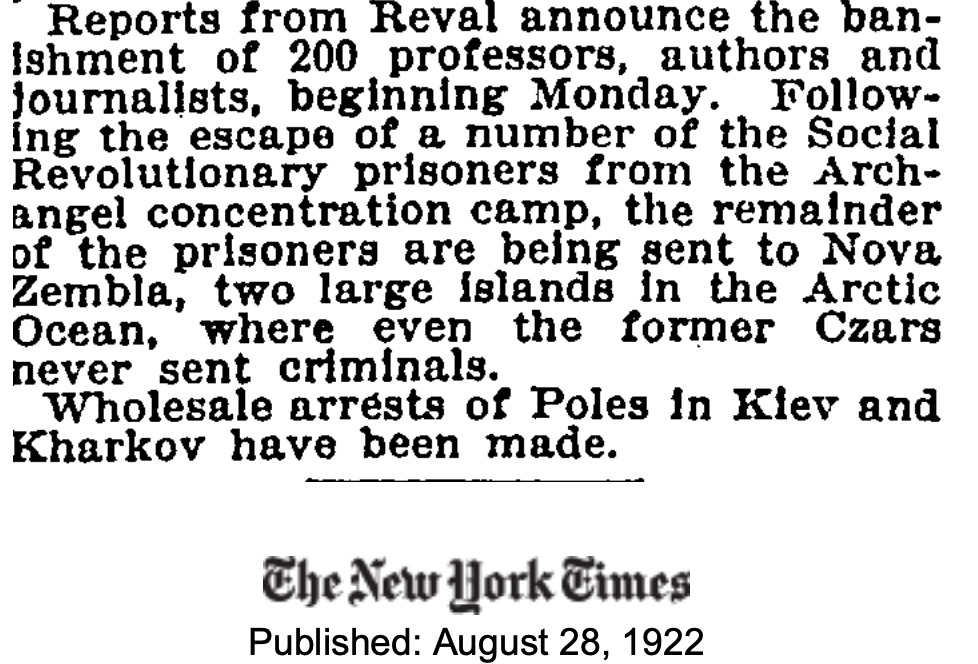
A brief New York Times article from August 28, 1922 bears the headline and subhead: “EXILED RUSSIANS TO LEAVE THIS WEEK; Some Social Revolutionists Sent to Nova Zembla–Those Recently Tried Have Disappeared”. The text includes this penultimate paragraph:
Reports from Reval announce the banishment of 200 professors, authors and journalists, beginning Monday. Following the escape of a number of the Social Revolutionary prisoners from the Archangel concentration camp, the remainder of the prisoners are being sent to Nova Zembla, two large islands in the Arctic Ocean, where even the former Czars never sent criminals.
Pitzer writes that “inside Russia, and across Europe and America, Nova Zembla had been feared as the cruelest outpost in the camp system, a place of terror for all of Vladimir Nabokov’s adult life.”
Nabokov may also have known an earlier history for Nova Zembla, one that Pitzer tells briefly in The Secret History of Vladimir Nabokov and at far greater length in her third book, Icebound: Shipwrecked at the Edge of the World (her second book, One Long Night, is an acclaimed global history of concentration camps). This is the history of the voyages, particularly the third voyage, of Dutch explorer Willem Barentsz (or Barents, c. 1550–1597), who was determined to find a Northeast passage to China. During the fatal third voyage, while stuck in ice, the men of Barentsz’s ship celebrated Twelfth Night on January 5th, 1597. Keeping to tradition, they drew lots to see who would be the monarch of Twelfth Night, when all social roles go topsy-turvy. Pitzer writes that the gunner drew the winning lot “and reigned as the first king of Nova Zembla, an imaginary monarch in a land of ice and death, a ruler over hope and despair, a king of nothing.”
What does all of this add up to? Pitzer summarizes: “Pale Fire’s Charles Kinbote, imaginary king of an Arctic wasteland, stands tribute to the dead exiles and prisoners of the soviet camps. A fictional escapee who longs to bear witness to what he has seen, he is too insane to tell his tale.” Steven Bellotto’s earlier exploration of Pale Fire and Cold War politics focused less on the nuclear history of Nova Zembla than Pitzer did, and instead gives most of its length to an exploration of Kinbote’s homosexuality in relationship to Nabokov’s brother Sergey (who was gay and died in a German concentration camp in 1943), the Lavender Scare, Freudian psychology (which Nabokov loathed), and Cold War narratives of queer menace. Bellotto concludes that “the whole of Pale Fire amounts to a denunciation of the cultural circumstances which made Kinbote’s Zembla narrative not only possible but a necessary strategy for survival.”
Were Pale Fire a straightforward portrait of a deluded, paranoid refugee, it would still be an interesting novel, but it would be diminished and in many ways more noxious, because we would be trapped in a character study of Kinbote rather than getting to exercise our imagination and attention on bringing some sort of submerged narrative into our minds. Even without knowing anything about the history of Novaya Zemlya — as probably the majority fo the novel’s readers have not — we can still bring other frames of reference in and find our way through the labyrinths the book creates.
In a 2013 review of Pitzer’s book and some other works by and about Nabokov, Mark Ford writes:
Why did Nabokov filter in the allusions that furnish Pitzer with her readings of Lolita and Pale Fire in a manner so nuanced as to make them almost invisible? The answer, I suppose, would be that, in both cases, Pitzer’s interpretation makes Humbert [from Lolita] and Kinbote rather less interesting as characters, easier to place, more comprehensible, and in turn pushes the novels in which they feature too close for their creator’s comfort to the realm of “topical trash” excoriated in the afterword to Lolita. A “secret history” implies a history that can be uncovered and then understood; Nabokov, for all his teasing and games-playing and breathtaking ingenuity, wanted more, much more, from his art than that.
The idea that Nabokov’s great novels can be “solved” like a puzzle is a tremendous mistake, and Ford is right to call it out, but we are only tempted to see the books as solved if we see the kinds of details and history Pitzer and Bellotto provide as definitive rather than informative. If Nabokov’s works are labyrinths, they have many entrances and exits.
For me, the idea of Charles Kinbote as a man who lost his mind after an arduous escape from the Soviets while living in a murderously homophobic society is powerful. It is a painful fact of existence that suffering often doesn’t enoble people, and mental illness rarely makes them easily loveable. By the time we glimpse Kinbote/Botkin’s life, he is a man with a ruined mind, trapped into delusional solipsism by the damage he’s suffered, now damaging others. The novel requires us to piece together some idea of how he got to be this way, the story of a life. That’s the submerged narrative — and not the only one, because we also must come to terms somehow with an idea of the life and fate of poet John Shade and Shade’s daughter, Hazel. We can delight in all the wild language and situations, but alongside that delight Nabokov’s text provides us with a slantwise experience of the pain of exile, oppression, and unrealized dreams. As in The Spirit of the Beehive, the experience is too big for straightforward language or imagery. The emotional force is refracted through the many lenses of wordplay, allusions, and legerdemain, but once we begin to perceive the other realities behind the rococo flourishes and Kinbote’s delusions, the force of pathos gets focused, and the other reality flits and flutters in shadows through our imagination.
4. Silent Hills
Submerged narratives might be considered a form of allegory, the surface providing symbols corresponding to the reality below. Solve the symbols, unpuzzle the truth, QED. This is the least satisfying, most shallow sort of narrative trick, and one of the things Edmund White complains about in his oddly testy review of The Stories of Vladimir Nabokov for The New Republic: “There was always something of the whiz kid about Nabokov…”6I say “oddly testy” because White and Nabokov had been mutual admirers — White was one of the few American writers, living or dead, for whom Nabokov had praise — and White wrote well and appreciately about Nabokov elsewhere, such as a 1984 NYRB essay on Nabokov, passion, and parody and in a lively 2016 essay for the TLS on Pale Fire as a great gay comic novel. It seems that what White so appreciated in Nabokov’s novels caused him to miss many of the best qualities of Nabokov’s short stories. There was, indeed, a whiff of whizkidding to Nabokov, but it was dispersed by the richer, more beguiling fragrances of the texts.
Horror stories easily kerplunk into simple allegory, undoing their wonders. The Silent Hill movies directed by Christophe Gans are particularly interesting examples of horror stories that avoid this danger by preserving an essential sense of mystery.7There may be some solutions within the Silent Hill video games, but as I have no familiarity with them at all, my concern here is strictly with Gans’s two movies. Silent Hill (2006) only occasionally relies on allegory, ending with a strong but unresolved implication of a submerged narrative. Return to Silent Hill (2026) gets much closer to simplistic one-to-one relationships between the imagery of the film and the idea that it’s all an extension of the protagonist’s trauma (a word, concept, and narrative choice that’s now utterly exhausted in horror), but Gans is ultimately too smart for that, and he makes the film like a video game written by Marguerite Duras. The final happy ending is undone by our suspicion that it’s nothing more than the fantasy of a dying man, and this suspicion unravels much of what we’ve assumed about all we’ve seen before. While both Silent Hill and Return to Silent Hill seem, on a superficial level, to add up … they don’t. Trace their details back. It’s all too much. What matters and what doesn’t — what creates the shadow narrative of the story in our imaginations — requires the viewer to make some choices.
I wrote in Modernist Crisis and the Pedagogy of Form about J.M. Coetzee’s invocation of the feeling of allegory in a lot of his fiction — narratives that feel allegorical, but the connection between symbols and the symbolized has been severed. Something similar, though not as drastic, occurs in Silent Hill and Return to Silent Hill.
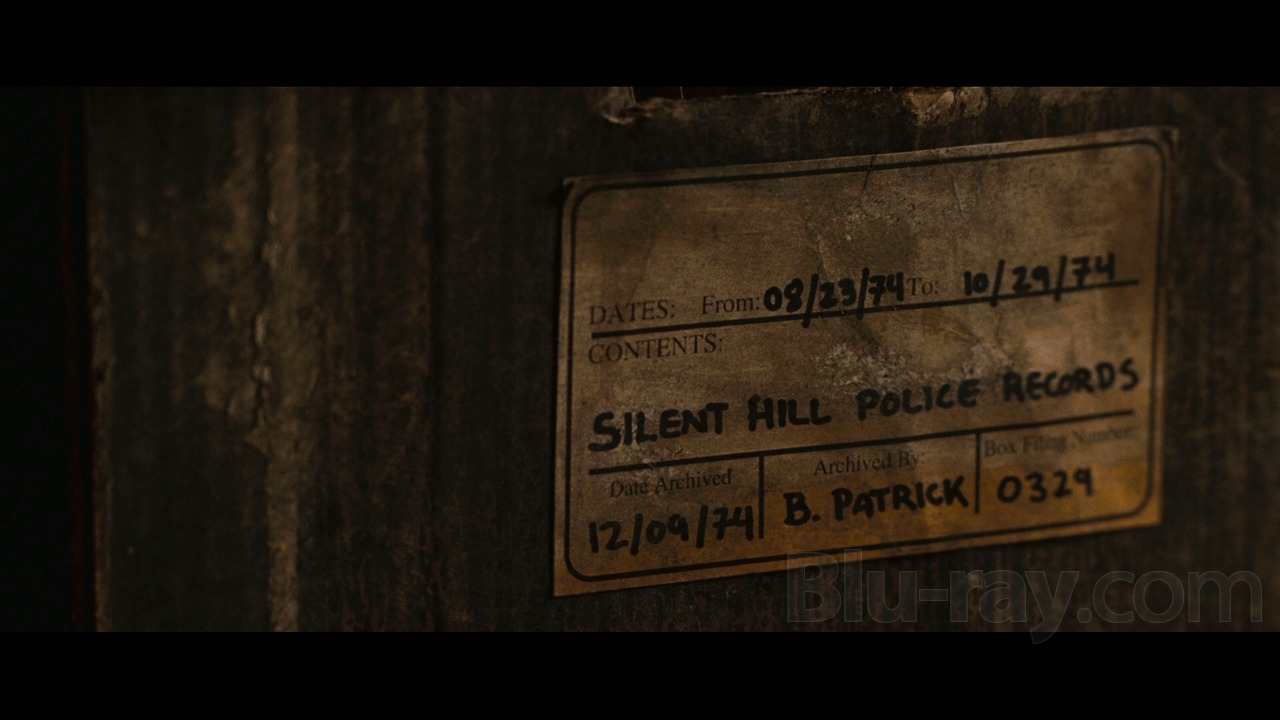
In Silent Hill, there is something going on regarding mothers, fathers, and children in the world outside the fantasy. The film includes various hints that all is not well between Rose (Radha Mitchell), Christopher (Sean Bean), and their daughter Sharon (Jodelle Ferland), but the exact nature of this is not explained. Rose and Christopher are hardly ever on screen together, and soon they quite literally exist in different worlds. Sharon, sleepwalking, is compelled to flee her parents. Cybil (Laurie Holden), a police officer with a compulsive need to protect children chases her on nothing but a hunch that she could be a kidnapper and later explains that “We had a guy come up here two years ago, snatched a little boy from a rest stop, dropped him into a mine vent. I never wanna see anything like that again.” (Later, we learn that Cybil was the first officer on the scene and went down in the mine to help and comfort the boy.) Interestingly, Cybil makes no connection between gender regarding kidnapping/abuse — she sees men and women as equally suspect. But her chief, a man, does make a distinction, saying to Chris, “Ninety percent of the time, when a wife takes a run, she takes the daughter to a place like this, l’d say she’s damn mad at her husband.”
But the majority of the movie is about mothers and daughters, relentlessly so. “Mother is god in the eyes of a child” gets said frequently and insistently enough that it could be the film’s tagline. Whether it’s a good or bad thing for the mother to be god in the eyes of a child is left to us to puzzle out on our own. In the first minutes of the movie, Rose says to Sharon that she’s taking her to Silent Hill. “Daddy’s not coming?” Sharon asks. “No, sweetie. It’s gonna be just you and me.”
What is Silent Hill? It sounds like a cemetery, and in many ways it is. A place of death, a place for the dead — the dead who don’t know that they’re dead. Learning this, we can glimpse a shadow narrative: Rose and Sharon gone together, Christopher left behind. At the end, Rose calls her husband on the phone, but he only hears static as she says, “We’re coming home.” The film is cunningly structured to make us feel a wave of joy and relief as Rose and Sharon make their way, apparently, out of the realm of the dead. But even though the film’s music and colors mostly encourage us to continue feeling this joy and relief, the images contradict it. There is, for whatever reason, no going home to the home that was left behind. Whatever the full story is, we must decide on it for ourselves.
Return to Silent Hill directs our sense of narrative more clearly. It’s essentially “An Occurence at Owl Creek Bridge”, as an alert viewer will suspect fairly quickly, but exactly what happened in the shadow story behind the narrative presented to us is anybody’s guess. The majority of the film is just James (Jeremy Irvine) running in search of his lost girlfriend Mary (Hannah Emily Anderson) and, we begin to suspect, away from himself. But there’s also his therapist, known only as “M” (Nicola Alexis) — an inevitable James Bond association (one strengthened by her saying, to a mystery person on the end of a mystery phone call, “It’s me. Yes. One of my patients has broken protocol. I need a wellness check,” which sounds more like something out of a spy movie than a hospital), and it’s notable that our protagonist is himself a James (not Jim, not Jimmy) and clearly sees himself in the role of a savior, a knight in shining armor, like old-school Agent 007.
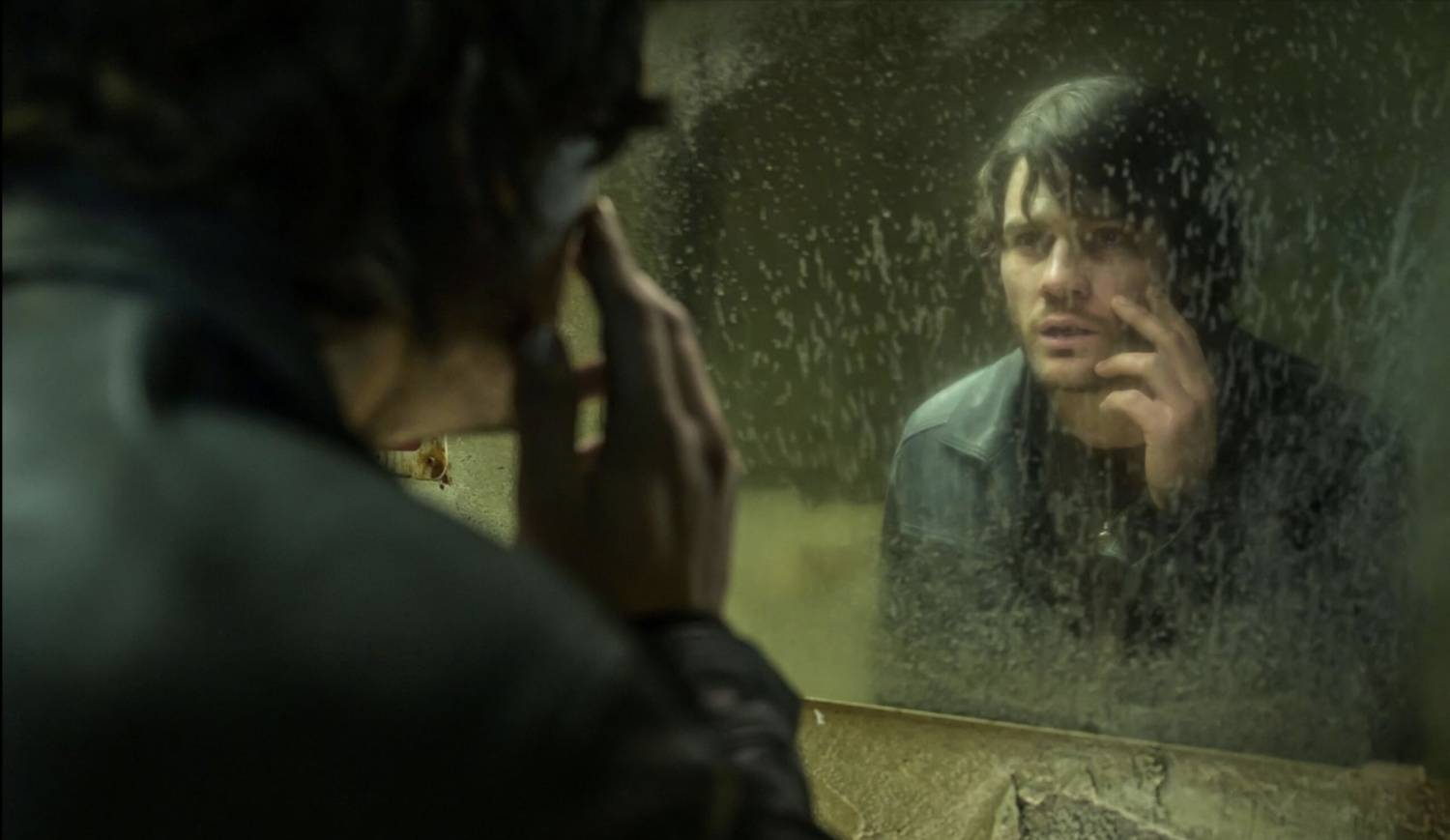
The name M may also hint to us that here is another iteration, somehow, of Mary/Maria/Angela/Laura. The part of Mary that wanted James to get well. But James, apparently, never did get well. That seems to be the story underneath the story. In the narrative structure, James is the self-sacrificing hero. But again and again we are encouraged to be skeptical of this positioning. By the end of the film, one thing we know is that James fails to save anybody. No matter how we resolve our sense of what’s going on beneath the delusions and deceptions, there is no story in which James is actually a savior — except for the last moment, which we are encouraged to see as some sort of fantasy, like the overhappy ending of a Douglas Sirk melodrama.
The closing music is the song “Letter from the Lost Days” by Akira Yamaoka, which includes the refrain, “Soon we will know if it’s for real…”
Will we?
5. Crown Jewels
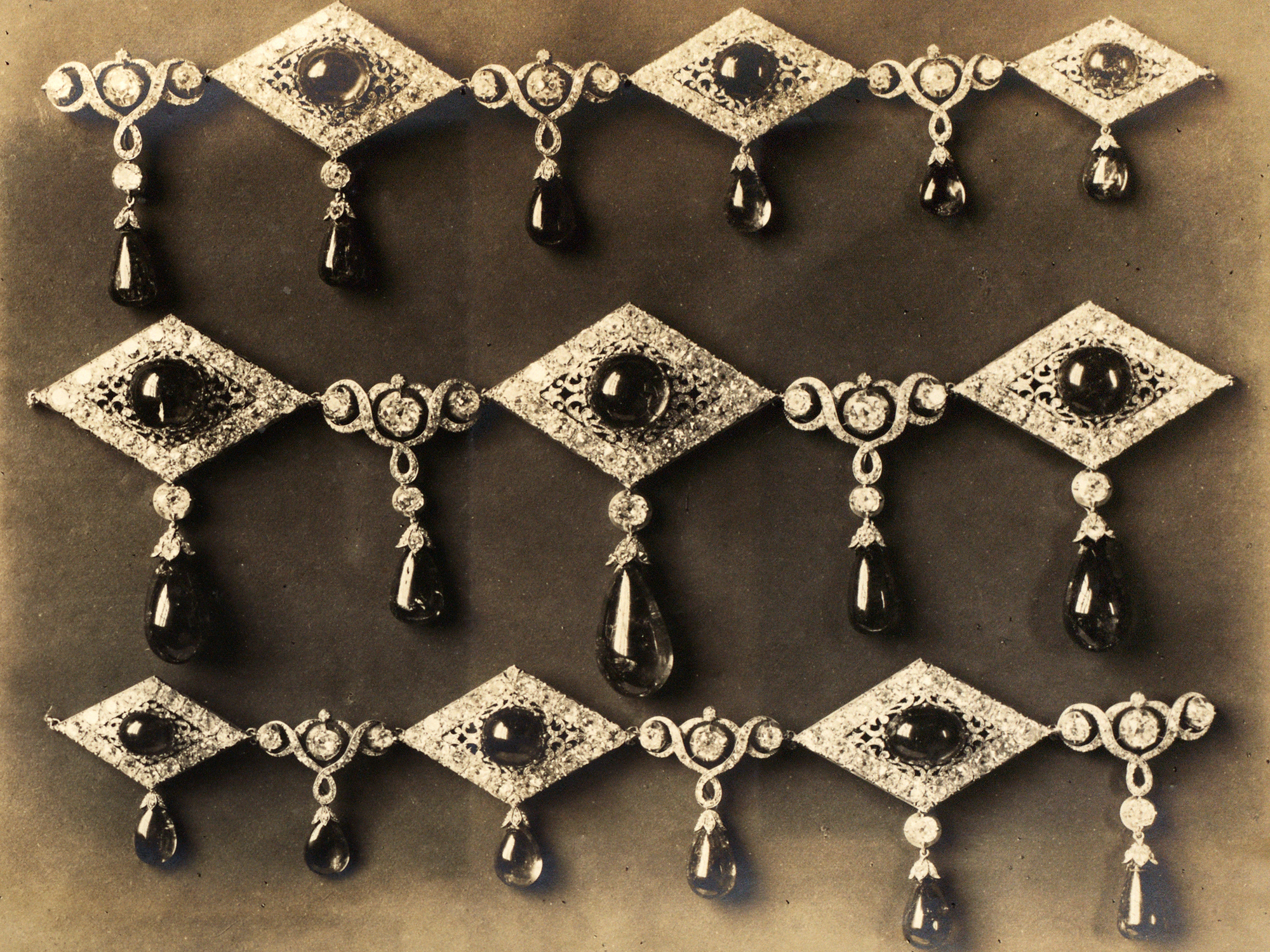
“The story of the missing Russian crown jewels begins, as so many great adventures do, in a library.”
—Corey Flintoff, NPR News
In Charles Kinbote’s tales of Zembla in Pale Fire, the Zemblan crown jewels are sought by the Soviets, but the jewels are too well hidden to be found. In The Secret History of Vladimir Nabokov, Andrea Pitzer notes that the Soviets sought to gather all the Russian crown jewels with great fervor, and this search was chronicled in international newspapers. But Nabokov may have had something else in mind regarding Zembla: “Asked in an interview where the crown jewels were hidden, Nabokov made a reference to the index [in Pale Fire] but also answered directly, explaining that they lay in Zembla ‘in the ruins, sir, of some old barracks.'”
Why would Nabokov point readers in such a direction? Pitzer points toward a September 1, 1922 article from the New York Times titled “Russian Academic Freedom”:
A few days ago we were told how the Bolshevist Government was scrupulously guarding the crown jewels and other priceless treasures, gathered by royal purchase or conquest through centuries from the ends of the earth to make such splendors as no other court or country could boast. In crass and cruel inconsistency this same Government is throwing into the Arctic Sea or over Soviet borders the culture more precious than the wealth of these hoarded jewels. Far better would it be for Russia to sell her crown jewels, and then nourish in her half starved and despondent scholars and scientists, liberated or brought home, that wisdom the price of which is above rubles.
The article concludes: “If [Zinoviev’s] policy continues much longer, the genius of Russia will all be in exile or in prison or in its grave, and the whole land will become as a cheerless shut-away Nova Zembla.”
Pitzer writes: “The real crown jewels of Zembla — of Russia — lay forgotten in the ruins of barracks in not just the distant, mysterious north, but in countless places across the Soviet Union: the dead exiles, the executed prisoners, a beautiful culture, annihilated.”
Nabokov’s elegy for the dead, Pitzer says, was so well buried that it went unnoticed by readers for decades. This may be true in its details — certainly, there seems to be little evidence of readers connecting Nabokov’s Zembla with the history of Novaya Zemlya until Steven Bellotto and Andrea Pitzer drew out the connections for us — but I’m not sure it’s true overall. I can’t imagine how you could read Pale Fire and not sense an implied narrative shadowing the stated one(s). In what we know and what we know we don’t know, there is enough to build a coherent emotional landscape for the novel, even if we can’t pinpoint all the pieces of the puzzle. The impossibility of the puzzle is itself an important fact for readers to grapple with — the fact that not only do we not have all the puzzle pieces, but some of the pieces we do have come from other puzzles! The formal oddities produce narrative implications, and from those implications we can begin to see what is going on with the characters, particularly Kinbote. I am grateful for the information Bellotto and Pitzer pull from the past, but I didn’t need any it to be able to see Kinbote as a man terribly deformed by his experience in his home country and by his exile from that country. The information adds a powerful extra point from which to view the story, but it’s an extra vantage point within an infinity box.
There is, as Emily Dickinson knew, a type of truth that must be told slant. Unslanting it may make the truth legible, but the slant is part of the truth. Oblique references, ambiguous moments, and allegorical monsters may all echo through our texts as through our lives and histories. The resonance of their ringing is as important as any referent we may pin to them (what beauty remains in a dead butterfly on a board?).
Submerged narratives may seem to hide the crown jewels and tempt readers to search for them in armories and archives and Arctic archipelagos, but most quests are more satisfying and meaningful in the act than in the completion. The jewels, in the end, may be fake, or damaged, or not even jewels at all. They may be too well hidden, or nonexistent.
So, too, a surface reality. The best submerged narratives do not replace one reality with another, but rather unsettle our perception of the real. Too many stories make the world and existence seem small, but stories as vastly different as “The Purloined Letter”, The Spirit of the Beehive, Pale Fire, and the Silent Hill movies enlarge our sense of the mystery of existence and stoke our wonder at the great unsolveable tale that is life. And so they render dreams (and nightmares) of our philosophies.
—–
Images:
1.) Submerged church of St. Nicholas (Mavrovo) by Alex Iva, via Wikimedia Commons, cc-by-sa
2.) “Ultima Thule Daguerreotype” of Edgar Allan Poe, 1848
3-5.) screenshots, The Spirit of the Beehive
6.) 1601 De Bry and de Veer Map of Nova Zembla and the Northeast Passage via Wikimedia Commons
7.) excerpt from New York Times, 28 Aug 1922
8-9.) screenshots, Silent Hill and Return to Silent Hill
10.) necklace image from a 1922 album at the USGS library, via NPR
-----
- 1The book cost an unfathomable $8.95, a price that astonished me for a paperback in the days when Stephen King’s newest mass market edition, the 1,093-page It, was selling for $4.95. (Holding the Poe collection now, I note its last page is numbered with the demonic 666…) There were less expensive Poe paperbacks at that little basement bookstore, but The Portable Poe was obviously the best, containing the most famous stories and poems as well as a selection of his nonfiction and of letters he wrote. I remember holding it, my heart heavy as I stared at the price, and my father counseled me that it was not worth spending a few less dollars on notably inferior books. (A good lesson!) I had been entranced by one of my elementary school teachers reading Poe stories and poems to us, I had read a bit by and about old Edgar in library books, and I was ready to take the plunge. I expect I had accumulated $10 to my name and that day spent $8.95 of my wealth on that book. It was a good decision and a book I still own. ↩︎
- 2I think Reising has too much confidence in his own detective skills; his conclusion is certainly a possible and even logical reading of the story, but it is hardly the only possible or logical reading — if it were, Poe’s story would be much more minor and of primarily historical interest. ↩︎
- 3First presented as a lecture at the Library of Congress in 1959, and published by the Library in the pamphlet Anniversary Lectures 1959, this essay is currently most easily available in the Norton Critical Edition of The Selected Writings of Edgar Allan Poe edited by G.R. Thompson. ↩︎
- 4The essay first appeared in Major Writers of America (1962) edited by Perry Miller, and was reprinted in Wilbur’s collection Responses: Prose Pieces: 1953-1976. It remains an excellent guide to Poe’s life and work, although I may be biased — Miller’s 2-volume textbook was one my mother owned from when she was in school. It lived on the bookshelves in our house when I was growing up, and I read it like a sacred text, so I’m sure my early exposure to Wilbur’s approach to Poe affected my understanding of Poe’s work forever after. ↩︎
- 5Nova Zembla is mentioned in a summary of his idea for the book in a 1957 letter to his editor quoted in Brian Boyd’s Vladimir Nabokov: The American Years pp.306-307 ↩︎
- 6I say “oddly testy” because White and Nabokov had been mutual admirers — White was one of the few American writers, living or dead, for whom Nabokov had praise — and White wrote well and appreciately about Nabokov elsewhere, such as a 1984 NYRB essay on Nabokov, passion, and parody and in a lively 2016 essay for the TLS on Pale Fire as a great gay comic novel. It seems that what White so appreciated in Nabokov’s novels caused him to miss many of the best qualities of Nabokov’s short stories. ↩︎
- 7There may be some solutions within the Silent Hill video games, but as I have no familiarity with them at all, my concern here is strictly with Gans’s two movies. ↩︎
Discover more from Matthew Cheney
Subscribe to get the latest posts sent to your email.


