1.
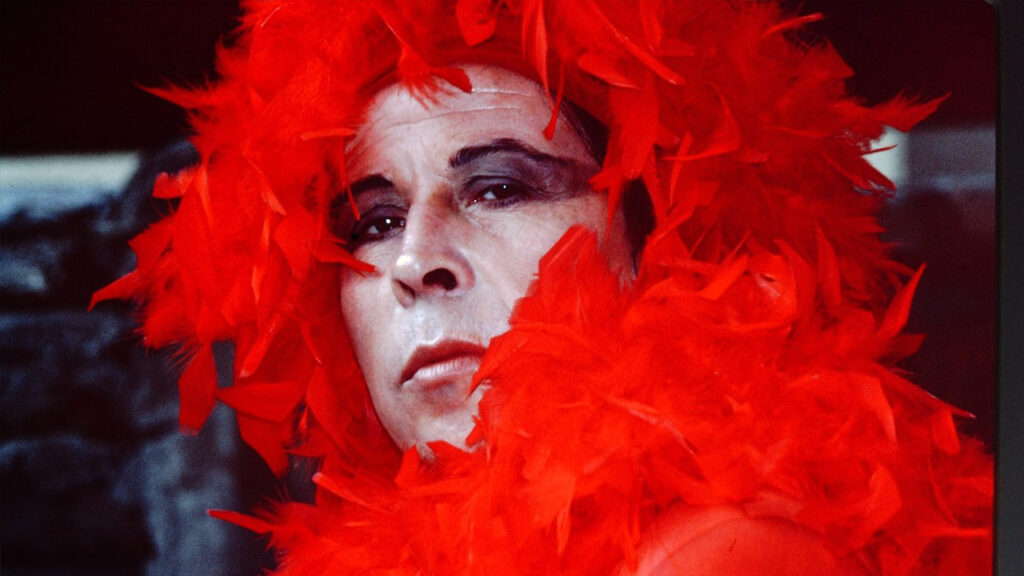
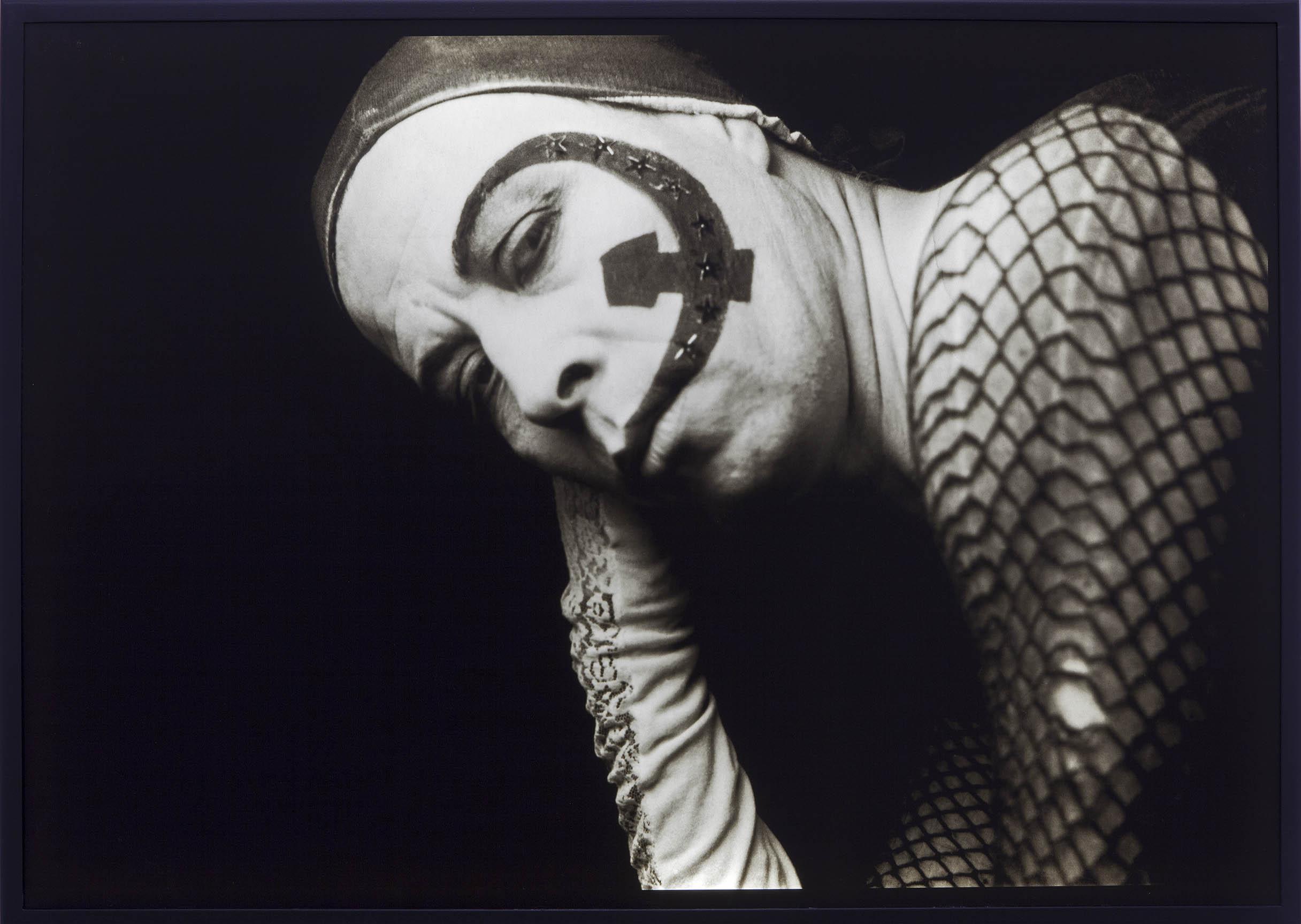
In September 1986, Pedro Lemebel (1952-2015) put on high heels, painted a hammer & sickle over half his face, and walked into a meeting of communists and leftists in Santiago, Chile to speak one of his earliest pieces of writing, a manifesto of being and difference:
I need no mask
Here is my face
I speak from my difference
Defend what I am
I am not so strange
I smell injustice
And mistrust this democratic cueca [dance]
But don’t speak to me about the proletariat
Because being poor and a fag is worse
One must be acid to bear it1The translation is by Gwendolyn Harper from the excellent recent Penguin Classics selection of some of Lemebel’s essays. An earlier translation is available online from Cordite Poetry Review. The original text is variously available, for instance at Altazor.
In the U.S., Lemebel is best known — if he is known at all — for the novel My Tender Matador, a translation of Tengo Miedo Torero, which takes place in Chile in 1986, ending in the days after the September 7 attempted assassination of the dictator Augusto Pinochet, who had been in power since leading the CIA-supported assassination of Chile’s president Salvador Allende on September 11, 1973.
I first read Tengo Miedo Torero ten or so years ago now, when it was one of the texts for my PhD qualifying exams, a text I chose to add to the list because I had read a review and it seemed like Lemebel’s novel might be the perfect embodiment of a few of my examination areas (queer studies and global/postcolonial/world fiction [highly contested terms at the time]). I loved the book and it has influenced a lot of my thinking and my own creative work since — it’s a small but important part of my story “Wild Longing” in The Last Vanishing Man, for instance. I came to Lemebel after having spent some years devouring the work of Roberto Bolaño as it was being translated into English but then feeling a bit Bolaño’d out. I had just read the recently-translated essay collection Between Parentheses, in which Bolaño repeatedly praises Lemebel, a writer he held in something like awe, a writer he called “my hero”. “Lemebel doesn’t need to write poetry to be the best poet of my generation,” Bolaño said. “No one goes deeper than Lemebel. And also, as if that weren’t enough, Lemebel is brave. That is, he understands how to open his eyes in the darkness, in those lands were no one dares to tread. … When everyone who has treated him like dirt is lost in the cesspit or in nothingness, Pedro Lemebel will still be a star.”2In her introduction to A Last Supper of Queer Apostles, Gwendolyn Harper says that in a conversation with Lemebel, Bolaño learned of the literary gatherings that Mariana Callejas held in her house in Lo Curro — a house where her American-born husband, Michael Townley, and other agents of the secret police (DINA), made poisons and bombs, and where at least one person was tortured to death — which would become the inspiration for Bolaño’s great novella By Night in Chile. I have not been able to verify the conversation elsewhere, but it is certainly plausible. Lemebel wrote about Callejas in his 1994 crónica “Black Orchids (or, The DINA’s Cultural Center)”, which Bolaño quotes at the end of one of the essays where he praises Lemebel, “The Corridor with No Apparent Way Out”, first published in 1999. See also Mariano Ben Plotkin’s useful article “Mariana Callejas: Literature and Horror in Pinochet’s Chile”.
My Tender Matador tells the story of the Queen of the Corner, a middle-aged queer person, something of a drag queen, something of a trans person, occasionally a sex worker, best described with Lemebel’s preferred word: loca. (English terms and concepts are inaccurate and distorting for reasons I’ll go into below.) The Queen (La Loca) lets a handsome young college student, Carlos, store some boxes of banned books in her little corner house, and quickly begins to suspect that the boxes contain more than books, but she does not want to know more. She is smitten with Carlos, and she lets him and some fellow students use her house for rather mysterious sessions of studying.
Just as the Queen knows that Carlos’s boxes of contraband are likely guns and ammunition, Carlos knows that the Queen is falling in love with him. It is possible that Carlos first sought out the Queen because a loca would be experienced with keeping away from the clutches of the police and also would not be taken seriously as a security threat — homophobia plus machismo creates all sorts of delusions, and it’s clear from other parts of the novel that while the powers that be may consider locas repulsive and silly, for this reason they think the idea of a loca as a revolutionary is ridiculous. So in some sense, Carlos is very much using the Queen for what she can offer him, and her falling in love with him is useful for the cause. Just as the Queen lets him and his friends use her house not because she has any revolutionary ambitions or is a political person in the least, but because she wants Carlos around as much as possible.
From the beginning to the end of the book, though, both Carlos and the Queen, in their own ways, move closer to the other’s feelings. The genius of the novel is that it never simplifies these feelings. This is not an alternate history story, so we know Pinochet is not going to be killed, which means we know the scope and limits of the political possibilities for the narrative. We also know that whatever love might occur between the Queen and Carlos is ultimately impossible. He’s more committed to politics than to individual people, and in any case he seems quite irredeemably heterosexual. (Despite a provocative story from childhood that he tells the Queen one drunken night.) And Carlos is young and the Queen, while hardly as decrepit as she makes herself out to be, is probably close to twice his age. It’s a novel of contrasts, and, particularly, of the power that contrasts can create.
Contrasted with the Queen and Carlos is the story of the Dictator and his wife. Lemebel presents Pinochet as old, passive, deluded, cowardly, and henpecked by his chatterbox wife. The one time in the whole book where the Dictator actually does anything on his own is when he sees a cadet whom he considers effeminate — the Dictator is fiercely homophobic, and insists the cadet, a nephew of a general, be sent away. The reasons for the Dictator’s homophobia are likely many, with machismo and military culture certainly part of it, but there’s also his annoyance at his wife’s love for and reliance on her beloved and clearly effeminate stylist, Gonzalo (based on an actual person, about whom Lemebel wrote a withering crónica after Gonzalo successfully rebranded himself as a mainstream liberal in the ’90s).3Gonzalo Cáceres, who is, as far as I know, still alive and clearly not a Lemebel fan, having said in a 2023 television interview that Lemebel was in love with him and Cáceres spurned him, which is why Lemebel wrote nasty things about him. This seems unlikely. More likely: Gonzalo is the living embodiment of what Lemebel hated in mainstream gays.
The back and forth between the narrative strands weaves a web of contrasts and connections. We see the loveless marriage of the Dictator and his wife against the impossible and unsexual (but very real) love of the Queen and Carlos, but we also see the richness of the Queen’s community of locas and poor people against the corrupt, forced, lonely, and distrustful community (if it can even be called that) of the Dictator’s military and political world. There are even some similarities. The Dictator’s wife is tremendously hurt by perceived slights from the community of international leaders who seek to distance themselves from the Pinochet regime — because of their ruthlessness and gaucheness, the Pinochets are marginalized outside of Chile, and could learn a few things from the locas about how to make the most of marginalization. But of course they can’t, because there is nothing heroic about the people in power. All the heroism, as the Queen eventually proves, is on the side of the disempowered, the scorned, the forgotten, the ignored. Like many stories of people standing up against authoritarians and bullies, this is a tale of underdogs. Lemebel’s innovation was to make some of them locas.

2.
Everyone in My Tender Matador, it seems, is looking for love. Lemebel wrote about the impossibility and ephemerality of love with great sympathy and subtlety. The yearning for another who never can quite reciprocate is clearly an experience he knew deeply. “Have men ever loved you?” an interviewer once asked. “Maybe,” he replied. “I guess. They just haven’t told me. They just say they want me, but wanting is an obsession that lacks amorous mysticism. That’s why I say I don’t know that thing you call love.”
The great sadness sitting at the heart of Tengo Miedo Torero is a recognition of love’s ephemerality, even — perhaps most — when it is real and powerful. The Queen’s friend and mentor Rana warns her against falling in love with Carlos, but when did such warnings ever work? The Queen thinks the better parts of her life are long past — her youth gone, her looks gone — and yet here’s a lovely young man who enjoys her company. How could she prevent herself from falling in love with him except to banish him, and she’s not willing to do that. All love is doomed (one lover usually dies before the other), it’s just that some love is doomed more quickly than others. A few weeks of real love, as Carlos and the Queen have, is still love, and more than someone like the Dictator ever got, despite his many decades of marriage. The tragedy, of course, is that beautiful moments make us ache for more.
“It had always been the same,” the Queen thinks toward the end of My Tender Matador, “—she sighed with resignation — bread today and hunger tomorrow; right when she thought she had something, life tore it out of her hands.”
We are cursed to yearn, cursed to desire, and the world provides no recompense. “So what was she to do? She was like a scrap of tissue paper withered by the moisture of his breath. What was she to do if all her life the forbidden had always illuminated the constricted tango of the impossible?”
Losses tend to pile up. And yet that curse of yearning (the curse of hope, the curse of dreams) for all the pain it brings, for all the scars and tears, is necessary to carry us through the a life of many other curses. Without the impossible yearning, without the dreams and hopes, the whips and scorns of the dictators and bullies would cast a darker, heavier shadow across our lives. The dictators and bullies always forget, or maybe never even know — can never imagine! — that the wounds they inflict never touch any part of us that really matters, never find the depths so easily plumbed by the people we knew we shouldn’t have loved in the first place, yet still we did, and still we dress brashly, and still we walk haughtily, and still we smile. Bring on the torture devices, bring on the knives, needles, and scalpels. We, the past masters of loss, have scars buried deeper than you’ll ever dream. We turn every wake into a celebration. We know how to let our hearts bleed out.
How much she wanted all the pent-up pain to ooze out in at least one drop of bitterness. Perhaps then it would be easier to go, to leave behind a small puddle of tears, a tiny well of watery sadness that no secret police agent would ever be able to identify. Because a fairy’s tears have no identification, no color, no taste; they have never watered any garden of illusions. The tears of a poor, abandoned fairy like her would never see the light of day, would never be humid worlds that absorbent handkerchiefs would blot off the pages of literature. The tears of a faggot always seem fake: utilitarian tears, clown tears, kinky tears, a cosmetic enhancement to eccentric emotions. The city at her feet lightened suddenly in the backstitch of the timid sun. A golden mesh spread out along the rolling waves of rooftops that housed so much misery, the recent winter rains having washed the tin surfaces that now brightly reflected the golden warmth of the sun. From above, she saw the car as it turned the corner and stopped silently in front of the house. Time to leave, child, she said to herself, blowing a kiss to yesterday that evaporated her good-bye in the wounded oasis of her love.
3.
I’ve been thinking about Lemebel a lot recently. For me, at least, he may be the most essential writer of our age, a writer who lived through aching poverty and atrocious repression, who survived an epidemic that killed many friends and loved ones, and who met the horrors of life head-on, speaking openly and forcefully, creating truly daring performance art, then bestowed on us words of great beauty and ethical power. His writings scorch with scathing fire, but they also sing, yearn, dream. He challenges us as he challenged the communists in September ’86 — to remember the forgotten, to esteem the insulted, to give the most vulnerable new ways to live a dignified life, even, and especially, if they must remain deeply marginalized in a country run either by a military dictatorship or a neoliberal democracy.4The history of neoliberalism in Chile is one that more Americans ought to be aware of, since for over 50 years the country has served as a laboratory for the ideas of the University of Chicago and Milton Friedman. There has been a reciprocal relationship — the policies of the “Chicago Boys” in Chile and other Latin American countries were studied by various policy-makers who sought to implement similar programs in the global north. The ouster of Pinochet brought more freedom to Chile, but as Lemebel repeatedly pointed out, the freedom was unevenly distributed, strong currents of Pinochetismo remained, the country refused to prosecute former government leaders for crimes against humanity (until ultimately forced to do so in the 21st century by prosecutions elsewhere), and the change in leadership did not bring constitutional reforms — those would have to wait until the protests of 2019-2020 and the constitutional referendum in the fall of 2020. Even in a world of nightmares, even as neighbors disappear from the streets and police become indistinguishable from thugs, people will still wake in the morning and sleep in the evening, people still will work, love, dream, yearn.
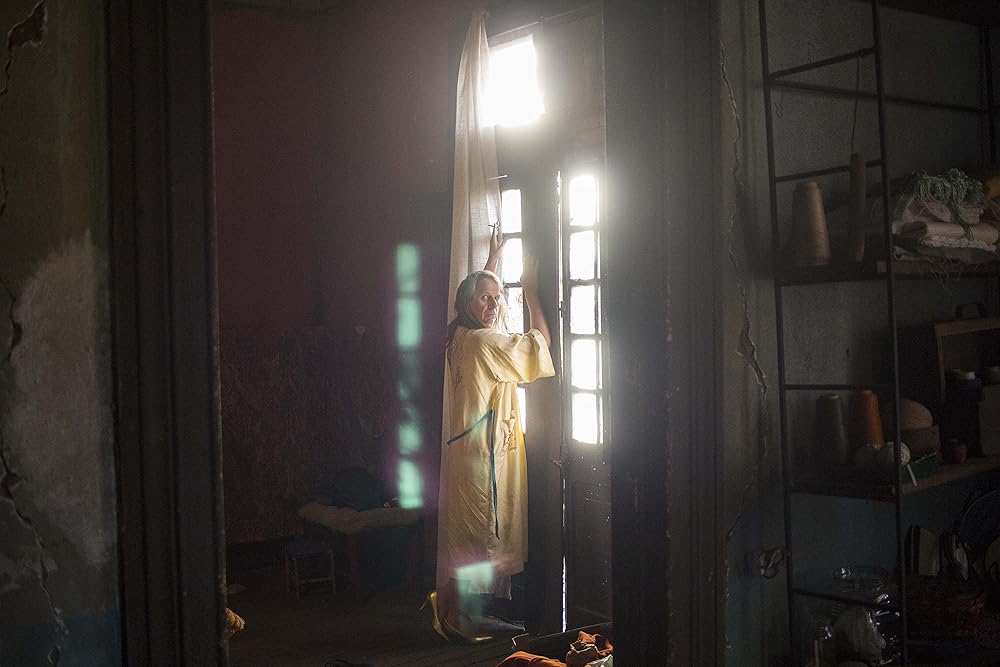
I decided to watch Rodrigo Sepúlveda’s 2020 film adaptation of Tengo Miedo Torero. I remember noting it around the time it first came out, but then forgot about it until a couple weeks ago. I wasn’t sure I wanted to watch it, because a bad adaptation would be painful, and a good one seemed unnecessary, given how vividly the novel lives in my mind. Curiosity got the better of me, though, and so I watched it, and enjoyed it, and, like any good adaptation of a great book, it sent me running back to the original source for even more replenishment.
If you have not read the novel, the film is fine to start with, as long as you keep in mind that, like many films, it lessens important ambiguities — the blunt tool of objective visual drama overcomes the multiplicities of subjectivity offered by text. In some ways, the movie is less an adaptation than an interpretation, and where Lemebel’s narrative offers us, as readers, two or more ways of understanding, the film chooses one, because to depict events with uncertainty it would have to become more avant-garde than the filmmakers wanted it to be. Without the ambiguities, though, all sorts of levels of the novel’s meanings and implications must be stripped away. That is, like translation, the nature of adaptation, and good adaptations balance the loss with visual, aural, and dramatic gains. For the most part, Tengo Miedo Torero is a good adaptation. A number of scenes are truly breathtaking in the life they give to moments that are only a few sentences in the book. The addition of music is a tremendous gain — La Loca loves music (“golden oldies”), it is an expression of her emotional life, and the novel, which takes its title from a song, is of course limited to lyrics alone.5I would love to read an analysis of the music in the novel by someone who knows Latin American and Spanish music well, as I don’t know how many are real and how many Lemebel created himself, if any. On the very limited research I’ve been able to do, the lyrics for “Tengo Miedo, Torero” seem closest to the version by Lola Flores, and that’s what’s used in the film, if I remember correctly, but the lyrics are not exact. Gaining the ability to put these characters within an environment with music truly is a great addition. And they use, I think, the version of “La Llorona” sung by Chavela Vargas for the film Frida, which is a nice touch, given that Lemebel and Francisco Casas created a famous picture together, “The Two Fridas” (which the Museum of Modern Art in New York bought a few years ago); in any case, it’s a song that shoots like a needle right to my heart.
The film dispenses with the scenes with the Dictator and his wife. Were I adapting it, I would be tempted to do the same. Unless the scenes were perfectly balanced, they would too easily slide into (bad) ridiculousness in a film. Some things work very well on a page but become farce when acted out, and I fear that would happen with the Pinochet family scenes, since they are so interior in the novel that without voiceover (ugh) or truly brilliant screenwriting, they just wouldn’t be able to convey much. Better to let the film focus on La Loca — and when you’ve got an actor as perfect for the role as Alfredo Castro, all the more reason to bring the focus there. The film has a number of virtues, but Castro is the biggest. It was eerie for me how much he fit my imagined idea of La Loca. It is a performance of grace, subtlety, humor, and pathos. I could watch the film again and again just to be in the presence of this character who means so much to me.
Alas, the casting of Carlos is the film’s greatest failure. Not because Leonardo Ortizgris does badly — he’s not a bad actor — but because this is not at all the Carlos of the book. In the film, Carlos is not a student but an architect (and from Mexico!), and he’s in his late 30s or early 40s. No no no no nooooo! None of the Manuel Rodriguez Patriotic Front members are students in the film — some of them are grizzled old men, older than La Loca. Truly, this choice nearly ruined the entire movie for me. We lose all the important contrast between the students’ young idealism and La Loca’s old fatalism, all the important differences of age and experience. The choice is truly bewildering. Did the filmmakers not know anyone under age 30? (They have far too few children at Carlos’s birthday party, too. The book specifies around twenty and the filmmakers managed to find four or five. The scene feels terribly underpopulated, and Carlos’s reaction thus a bit forced.)
I realized, though, while watching it that any representation of Carlos on film is doomed, because we mostly get him through La Loca’s viewpoint in the novel. A few times, the narrative lets us know what he’s feeling, but these are truly just a few sentences, and for the most part Carlos remains something of a cypher. This is important, because so much of what La Loca loves about him is in some way or another her own projection. (Again: Lemebel knew about love and its perils.) So I let the egregiously wrong age of Carlos go, and I tried not to grit my teeth too hard when the movie had him act like a cliché of a marxist revolutionary.
But for the most part it’s a faithful adaptation, by which I mean an adaptation that honors its source without simply being an illustration of the source. I have a million quibbles (the last 30 minutes is a little too fast-paced! etc.) but that would always be the case for an adaptation of a book I adore. What I most appreciated, aside from Castro’s magnificent performance, was the cinematography and settings. I’ve never been farther south in the Americas than Nicaragua, so seeing actual Chilean locations filmed so beautifully (by Sergio Armstrong) was a real joy and a great aid to thinking about the communities and people of the story.

4.
To write about Lemebel in English, and especially from the United States, as I am, is to be forced into a necessary struggle. Lemebel insisted on not being globalized, not being decontextualized. His language is hyperlocalized. To translate it into another dialect would be to wrench it beyond meaning — you couldn’t, for instance, decide that Lemebel’s writing is specific to his particular area and therefore it can be translated into a dialect of another specific area — say, South Boston. (I cringe and laugh simultaneously!) It’s not simply the fact of it being from a particular locality that is meaningful; what’s meaningful is all that the language carries from its location.Lemebel wasn’t writing from Chile or even Santiago — he was writing from his neighborhood. How can the sound of that neighborhood possibly make its way across the globe?
I especially admire Gwendolyn Harper’s translations in A Last Supper of Queer Apostles: Selected Essays (Penguin Classics) because she so carefully and creatively attends to the impossibility of translating Lemebel, the dangers of removing his work from its social and historical context, the linguistic challenges — and excitements! — the task poses. Her introduction and note on translation are essential reading for anyone approaching Lemebel in English, but even more important is the model of her work, the choices she makes, including the choice, sometimes, not to translate at all, letting some words stay in Spanish.
Beyond the normal challenges of translating a writer as brilliant with dialect and neologism as Lemebel is the challenge of marginalized language and the language of the marginalized. For instance, translation of some of the terms Lemebel uses for the people he writes about would change the meaning. Put travesti into Google Translate and you’ll get transvestite, which is literally accurate, but the words carry very different baggage across the terrain of their landscapes. And what of the frequent word loca? Harper says that Idra Novey pointed out to her that loca is repeated so often in Lemebel’s writing that it “accrues almost the quality of an incantation”. In My Tender Matador, Katherine Silver translated the name of the protagonist, “La Loca del Frente”, as “The Queen of the Corner”, which in the context of the novel works well, but it’s far from literal and loses a bunch of associations, such as with the Frente Patriótico Manuel Rodríguez. (This was inevitable — it’s not a criticism of Silver, who did beautiful, often inspired work.6For instance, the title: Tengo Miedo Torero translates literally as “I’m scared, bullfighter”, which is clunky, but Silver found a phrase that has a lovely resonance and similar rhythm — both titles almost fit a tango rhythm. Nonetheless, it is well worth knowing the original title and its meaning when reading the novel because some of the ways the characters use the title gain power from “I’m scared” or “I’m afraid”.) Lemebel always used terms that were otherwise derogatory slang (e.g. locas, maricones, colizas), partly to steal their power away from the homophobes and misogynists, partly to hold onto a class critique. He hated the word gay, which he associated with wealthy white men and materialistic fashionistas, people who, despite whatever liberal pretenses they might put on, indulged in imperialism and enjoyed nothing so much as sucking the cock of capital.
In an interview, Lemebel said: “I’m not running for any office in the royalty of letters; what I do is barely illiterate scraps, traces of iridescent manure on the page that reads like an unfulfilled and eager desire.”
For Lemebel, terms for the people he wrote about and associated with were always exploding and expanding. In “The Million Names of María Chameleon”, he wrote: “What starts as overexposure to a shame constantly yelled and named and pointed out turns into a ghetto rebaptism that camouflages the real name. A reconversion where caricature becomes a sign of affection. And there are loads of ways to name yourself.” He then presents a 3-page list of nicknames: “La Pit of Despair, La Walkout, La Once Again, La Just Because, La Not Today Satan, La Silicone María…” In a marvelous moment in Joanna Reposi Garibaldi’s documentary Lemebel, there’s a clip from a TVN interview where the good-natured-but-a-little-bit-lost interviewer asks Lemebel if he doesn’t like words such as gay and homosexual, then how does he describe himself and his people? Lemebel opens his book and rattles off the middle middle part of the list: “La Bootycall, La Lola, La Rose, La Denise… La Bim Bam Boom.” The interviewer laughs so hard he can barely stay in his seat. Earlier, Lemebel had chided him gently for trying to use derogatory terms himself — it’s a different thing if you’re from the marginalized community, much like how you refer to your mother, say, is different from how someone who is not in your family can refer to your mother. Language is always situated, it must always be contextualized. (Here’s the clip, though without English subtitles, but probably still worth watching even if you can’t follow the meaning — the performance is quite something.)
Gwendolyn Harper carefully negotiates the question of Lemebel and transness. With that question, those of us in the U.S. are at multiple disadvantages — not only may we be oblivious to how imperializing our hegemonic terms for queerness can be, but Lemebel was living and writing at a time when even in the most progressive and developed places the language around trans identity was significantly clumsier than it is now. Further, transness in poor countries and for poor people has different manifestations and opportunities than it does in rich countries and for rich people. I suspect that were he still alive, Lemebel would not identify as trans — he was obviously committed to drag as a deep component of his performance art, but his maleness itself, in his everyday life, does not seem to have been a big concern, at least from what I’ve been able to understand. Nonetheless, a lot of his writing is about people who have a sense of themselves as to some extent or another more than the gender they were identified with at birth.7Further complicating all this is the long history of cross-dressing as part of Latin American cultures and festivities. That history is far more than I can discuss here. See Translating the Queer: Body Politics and Transnational Conversations by Héctor Domínguez Ruvalcaba for a good exploration of these issues. Also worth looking at is “Pedro Lemebel and the Translatxrsation: On a Genderqueer Translation Praxis” by Arielle A. Concilio in TSQ: Transgender Studies Quarterly. In Tengo Miedo Torero, La Loca del Frente always thinks of herself with female pronouns, but is often referred to by other people with male ones (leading to some wonderfully complex gender shifts from sentence to sentence), but does not seem to consider this misgendering, or at least does not get bothered by it. Perhaps that was Lemebel own sense: Who cares about the words the world uses for you, especially a world as prejudiced as this one? You know who you are. That’s what matters.
Harper points out what’s most important for us as readers: Lemebel’s community included people who would now be comfortable embracing a transgender identity, and Lemebel always saw such people as a welcome, large, and essential part of his audience, even as his own identity was one he resisted pinning down.
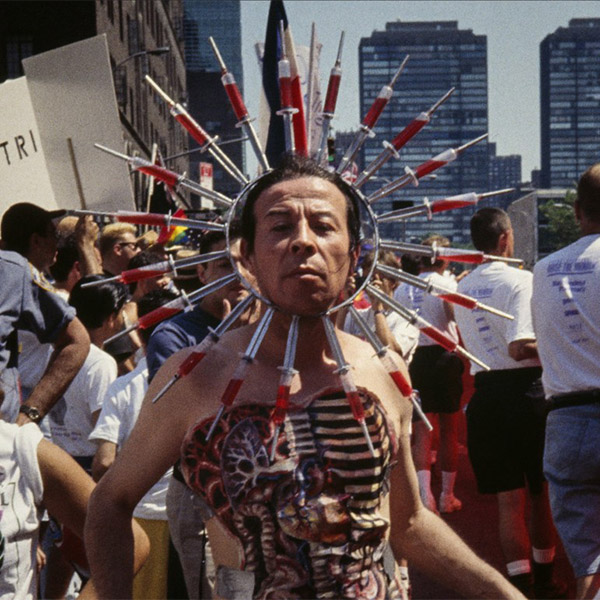
Lemebel was a rare master of propaganda, image, and language. (Rare, I say, because while it is hardly common for anyone to be a master of one of those three, to master all three is the mark of some sort of genius.) The performance art he conceived — particularly as part of the Yeguas del Apocalipsis (Mares of the Apocalypse) with his friend Francisco (Pancho) Casas — used sharp and shocking imagery to make political statements, while his writings mold words and rend sentences into forms that surprise, jolt, offend, and awaken readers (often for political purposes; often with vivid imagery).
One of the qualities that most draws me to Lemebel’s work is his commitment to memory and history. Example: His crónica “Night of Furs”, while hardly more than 10 pages, ranges across decades of Chilean history, offers a sense of all that has been shattered and extinguished by AIDS, makes fun of the obliviousness of the upper classes and their fetishized commodities, and presents fond, funny, touching portraits of prostitutes, transvestites, drag queens — the lost, lonely, lustful — and then ends, wistfully, with magic and mystery. (Lemebel was a master of endings.)
In “A Tree Full of Legs”, Lemebel wrote: “When one casts out the line of memory, episodes begin cropping up, episodes that for a long time no one wanted to remember, since forgetting was safer.”
5.
“Maybe there’s a way to rescue Ronald Wood from being yet another young person whom the eighties riddled with bullets.” So begins one of Lemebel’s most powerful crónicas, simply titled “Ronald Wood” with an added subtitle/dedication: “For that rumpled blossom of a boy.” Perhaps, going in, we think this is going to be a story of a lost love. That would be an understandable assumption. But it is mistaken.
Wood was a student of Lemebel’s when Lemebel was an art teacher at a school in Maipú “during the iodine rodeo known as the seventies.” Ronald was not a good student; distracted, disruptive, a clown. And then one day when Lemebel is teaching about Roman art and dictators, Ronald shows some interest. Lemebel’s lessons become dangerous — any whiff (never mind outright statement) of anti-government politics is grounds for dismissal or worse. But Lemebel lets history lead him toward teaching his students some ways of thinking beyond what they get on television and radio. It doesn’t last long. “At some point something got out, someone heard, and without being told why, I was forced to quit teaching in that district. I never saw Ronald Wood again, had no idea what happened to him in the strained years after that.”
Then: “Only on May 20, 1986 did the news reach me that he’d been killed in a student protest on Loreto Bridge.”
The first sentence gave away this part of the story, so I’m not ruining anything for you. It’s the final paragraph that is the kicker for this five-paragraph essay, a final paragraph overflowing with sadness, rage, beauty, regret. This crónica is more compressed and overwhelming in its mix of joy, sorrow, and memory even than “Night of Furs”. Pure essence of Lemebel. Seek it out.
6.
In My Tender Matador, the Queen discovers a sense of solidarity with the surviving family members and friends of los desaparecidos, the disappeared. This seems to surprise her. She has not paid a lot of attention to them before, but it is the people fighting to keep alive the memory of the disappeared who most inspire her toward action, toward bravery. What she does for Carlos is clearly and admittedly done for love of him, not any great commitment to a cause. But the brave demonstrators for the disappeared wake something in her.
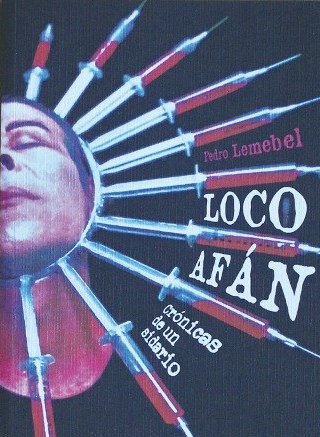
The word “AIDS” never appears in My Tender Matador, though Lemebel wrote frequently about the epidemic in his crónicas. The first recorded cases of HIV/AIDS in Chile appeared in 1984, and by 1986 the disease would like have appeared in the Queen’s community. Certainly, it would have been a topic of conversation, given the prevalence by then of international news stories about AIDS. But Lemebel keeps it out of the book explicitly, while anyone who knows anything about the era must think of it when reading the Queen’s response to the protests on behalf of the disappeared. Instead of bringing the empathy of the larger society toward the locas in their suffering — in the way that so many stories of AIDS made queer people for once mournable by the larger society — Lemebel always seeks to broaden empathy, to expand it outward, and in a story about a loca that means having her expand her feelings toward the tens of thousands of people the government vanished. It’s quite a move for a queer writer to suggest that while an AIDS epidemic is an atrocity, it ought to open our hearts wider, letting us find common cause with sufferers in other atrocities. (The world does not lack for atrocities.) It is the lost individual lives of the disappeared that inspire a new passion and resolve in the Queen. Certainly, she and her friends could have been among the erased and murdered, given how much contempt the government felt for queer people, but they could also wither away in a disease that turned healthy young people into dessicated corpses. Regardless of the cause or reason, the fact of life in 1986 for locas in Chile was that at any moment, anyone could be gone. And who will remember them? Who ever remembers lives before now, ways of living before these ways of living, ways of dreaming before the nightmare?
In “Night of Furs”, Lemebel writes, thinking back to a party in the days before Pinochet’s coup:
Maybe that photo from la Palma’s party is all that’s left from an era of social utopias when the locas caught a glimpse of their future emancipation. They took part in that euphoria, interwoven among the masses. Whether to the right or the left of Allende, they banged on pots and pans and spoke out, slowly refining the stories they told in shy glimpses and stammering speeches, recounting these minority histories in pursuit of legality.
The locas know that, like love, utopian hope can die fast. A glimpse of future emancipation was followed by an era of murderous defeat, of constant fear, of unfathomable loss. Many people died, and dreams died along with them. The locas know this as well as anyone, but, the Queen sees, not better than anyone. The solidarity that brings her to join with the families and friends of the disappeared is the solidarity of similar experience, the solidarity of basic human decency, and a kind of yearning and determination that, regardless of its inspiration, stands strong against a deadly dictatorship.
Lemebel’s 1986 manifesto ends with words we need here and now, in all our own localities, as we seek new solidarities, and so here, to end, a few of Lemebel’s words followed by Gwendolyn Harper’s translation of them into English:
A usted le doy este mensaje
Y no es por mí
Yo estoy viejo
Y su utopía es para las generaciones futuras
Hay tantos niños que van a nacer
Con una alíta rota
Y yo quiero que vuelen compañero
Que su revolución
Les dé un pedazo de cielo rojo
Para que puedan volar.
I leave you with a message
Not for my sake
I am old
And your utopia is for future generations
There are so many children who will be born
With a little broken wing
And I want them to fly, comrade
I want your revolution
To drop them a piece of red heaven
So that they fly.
-----
- 1The translation is by Gwendolyn Harper from the excellent recent Penguin Classics selection of some of Lemebel’s essays. An earlier translation is available online from Cordite Poetry Review. The original text is variously available, for instance at Altazor. ↩︎
- 2In her introduction to A Last Supper of Queer Apostles, Gwendolyn Harper says that in a conversation with Lemebel, Bolaño learned of the literary gatherings that Mariana Callejas held in her house in Lo Curro — a house where her American-born husband, Michael Townley, and other agents of the secret police (DINA), made poisons and bombs, and where at least one person was tortured to death — which would become the inspiration for Bolaño’s great novella By Night in Chile. I have not been able to verify the conversation elsewhere, but it is certainly plausible. Lemebel wrote about Callejas in his 1994 crónica “Black Orchids (or, The DINA’s Cultural Center)”, which Bolaño quotes at the end of one of the essays where he praises Lemebel, “The Corridor with No Apparent Way Out”, first published in 1999. See also Mariano Ben Plotkin’s useful article “Mariana Callejas: Literature and Horror in Pinochet’s Chile”. ↩︎
- 3Gonzalo Cáceres, who is, as far as I know, still alive and clearly not a Lemebel fan, having said in a 2023 television interview that Lemebel was in love with him and Cáceres spurned him, which is why Lemebel wrote nasty things about him. This seems unlikely. More likely: Gonzalo is the living embodiment of what Lemebel hated in mainstream gays. ↩︎
- 4The history of neoliberalism in Chile is one that more Americans ought to be aware of, since for over 50 years the country has served as a laboratory for the ideas of the University of Chicago and Milton Friedman. There has been a reciprocal relationship — the policies of the “Chicago Boys” in Chile and other Latin American countries were studied by various policy-makers who sought to implement similar programs in the global north. The ouster of Pinochet brought more freedom to Chile, but as Lemebel repeatedly pointed out, the freedom was unevenly distributed, strong currents of Pinochetismo remained, the country refused to prosecute former government leaders for crimes against humanity (until ultimately forced to do so in the 21st century by prosecutions elsewhere), and the change in leadership did not bring constitutional reforms — those would have to wait until the protests of 2019-2020 and the constitutional referendum in the fall of 2020. ↩︎
- 5I would love to read an analysis of the music in the novel by someone who knows Latin American and Spanish music well, as I don’t know how many are real and how many Lemebel created himself, if any. On the very limited research I’ve been able to do, the lyrics for “Tengo Miedo, Torero” seem closest to the version by Lola Flores, and that’s what’s used in the film, if I remember correctly, but the lyrics are not exact. ↩︎
- 6For instance, the title: Tengo Miedo Torero translates literally as “I’m scared, bullfighter”, which is clunky, but Silver found a phrase that has a lovely resonance and similar rhythm — both titles almost fit a tango rhythm. Nonetheless, it is well worth knowing the original title and its meaning when reading the novel because some of the ways the characters use the title gain power from “I’m scared” or “I’m afraid”. ↩︎
- 7Further complicating all this is the long history of cross-dressing as part of Latin American cultures and festivities. That history is far more than I can discuss here. See Translating the Queer: Body Politics and Transnational Conversations by Héctor Domínguez Ruvalcaba for a good exploration of these issues. Also worth looking at is “Pedro Lemebel and the Translatxrsation: On a Genderqueer Translation Praxis” by Arielle A. Concilio in TSQ: Transgender Studies Quarterly. ↩︎
Discover more from Matthew Cheney
Subscribe to get the latest posts sent to your email.
