One book can change your life.
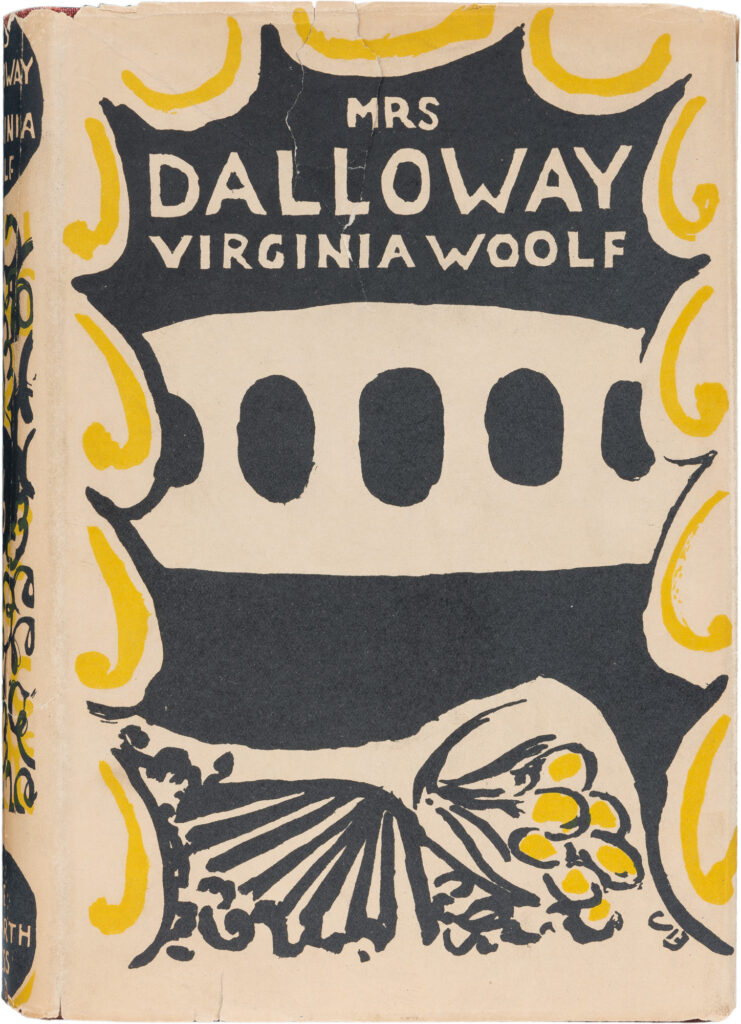
Virginia Woolf’s novel Mrs. Dalloway was officially published on 14 May 1925 in Britain and the United States, making it 100 years old today, although it had a long gestation — Woolf wrote about a character named Clarissa Dalloway in her first novel, The Voyage Out (1915), and her 1922 short story “Mrs. Dalloway in Bond Street” more or less corresponds to the first chapter of the finished novel. The innovations of her 1922 novel Jacob’s Room allowed her the confidence and vision to create the form of Mrs. Dalloway, but in many ways it was a novel that drew from her entire experience of living, reading, writing.
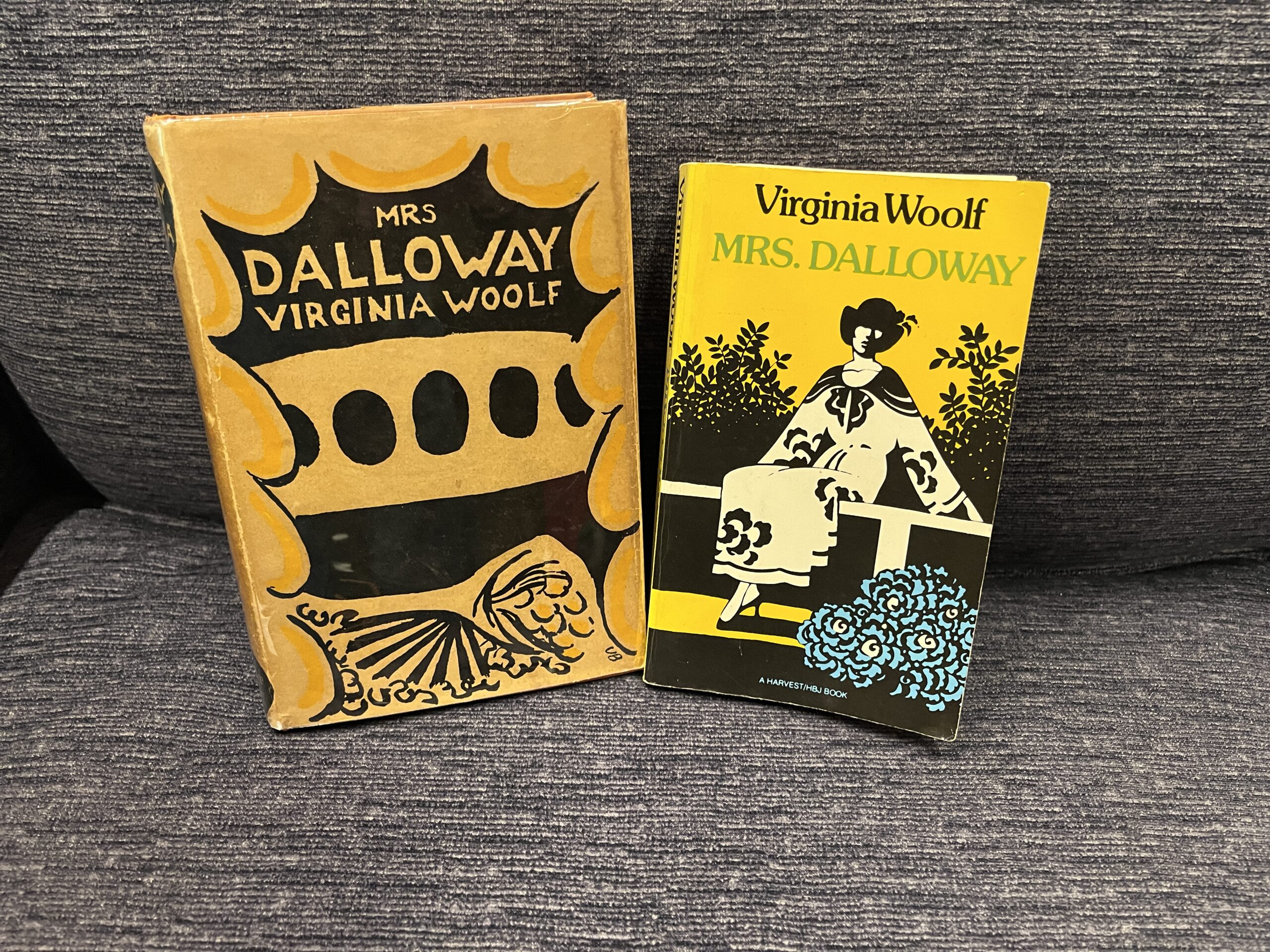
When I first encountered Mrs. Dalloway, I was entirely too young for it, but nonetheless, strangely, intrigued. I think I was 12 or 13 years old. I saw it for sale in the local college bookstore, assigned for a course: the Harvest mass market paperback, the cover dominated by bright yellow. Was it the yellow that attracted me? I don’t know. I don’t think I knew anything about Virginia Woolf except that she was in the title of a play by Edward Albee, a play that I would become obsessed with in high school, though I’m not sure if I had read it when I first looked at Mrs. Dalloway. I was working at the bookstore that summer (pricing and stacking textbooks, mostly, on the 2nd floor of a cement building that had no air conditioning and was an oven), but nothing I remember explains why I was drawn to that particular book out of the thousands I spent my days with. Perhaps I knew the name of the English professor who assigned it. I was trying to read more Serious Literature and not just science fiction. But I truly don’t know.
For whatever reason, I picked up the book and read a couple of pages.
I did not understand most of the sentences, and yet I remember quite vividly how they fascinated me — in large part because I could not understand them. Yes, they were written in English, but I had no frames of reference. Characters get referred to in glimpses and the various place names were unfamiliar to me.
And yet … the sentences and the punctuation drew me in. I remember standing in the sweltering heat of the bookstore’s second floor and reading this sentence:
How fresh, how calm, stiller than this of course, the air was in the early morning; like the flap of a wave; the kiss of a wave; chill and sharp and yet (for a girl of eighteen as she then was) solemn, feeling as she did, standing there at the open window, that something awful was about to happen; looking at the flowers, at the trees with the smoke winding off them and the rooks rising, falling; standing and looking until Peter Walsh said, “Musing among the vegetables?”—was that it?—“I prefer men to cauliflowers”—was that it?
All those semi-colons! The repetition of the flap of a wave; the kiss of a wave! Parentheses! Dialogue embedded in narrative! Dashes!
I thought: You can do that? All of that?! And then: You can do that!
Once the book was mine and I had it at home, I pored over those opening pages again and again, imbibing their rhythms and strangeness, learning, for the first time, without knowing the terms for them, about free indirect discourse and interior monologue. I studied with the eyes of a writer, wanting to know how this magic worked.
I didn’t stick with Woolf’s novel all that long, did not even manage to get through the first chapter, but I kept the book around and dipped into it now and then.
Seven or eight years later, the summer of 1997, I was home from college at New York University and once again working at the local college’s bookstore (now in a new, air-conditioned location; now promoted to being a clerk) when a new professor, Jeanne Dubino, brought the annual International Virginia Woolf Conference to our little town. We went all out for it at the bookstore, filling the place with books by and about Woolf. Now, I thought, maybe I can learn something about Mrs. Dalloway.
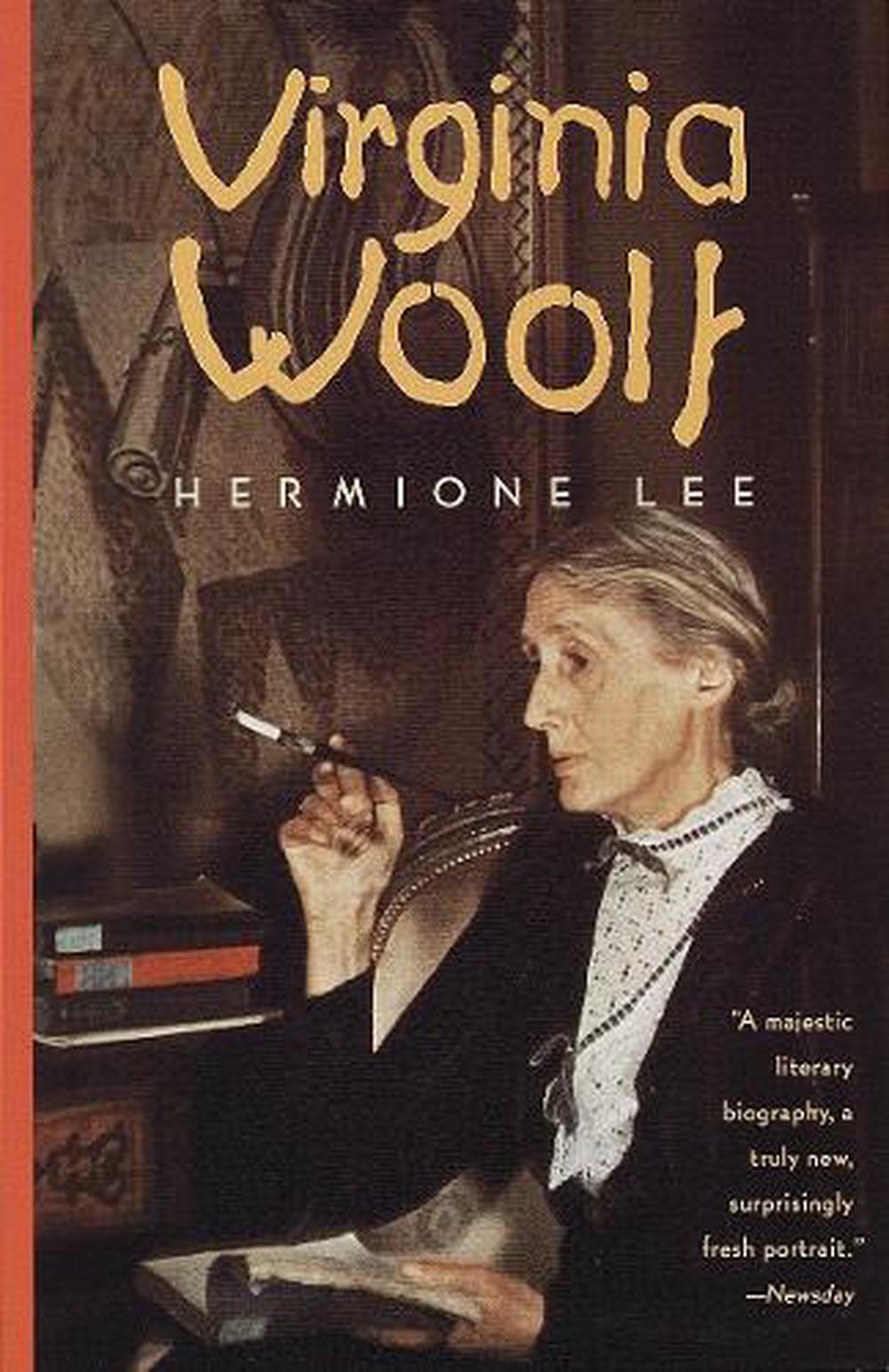
Little did I know what a bounty of riches had been brought to my door. Hermione Lee was the keynote speaker. Her astonishing biography of Woolf had just been published. Like most of the other bookstore workers, I had volunteered to help staff the conference, and I was working the registration table when Hermione Lee arrived one night, a bit frazzled after various delays. In one of the bolder things I’ve ever done in my life (I am not a bold person), I said to her, “I’ll sign you in if you’ll sign my book.” The poor woman was exhausted, but her eyes lit up and she laughed and signed the copy of the biography I’d bought to prep for the conference. Later, our little downtown movie theatre got to offer a premiere of the film of Mrs. Dalloway, starring Vanessa Redgrave, before it even hit the festival circuit. After watching it and discussing it with my friend Katherine Min, who told me how much the novel meant to her, I went back to the book and finally read it straight through for the first time.
Aside from the conference, that was a difficult summer for me. My parents had divorced, leaving me feeling unmoored and homeless, and putting new pressures on the family finances. I really couldn’t afford to keep going to school in New York, but I had also come to realize I was unhappy at NYU and my dream of becoming a famous playwright was farther away than ever. I still had a year left of school, so I decided to transfer to the University of New Hampshire to finish up. Through the summer, I was working at a local tourist attraction in addition to working at the bookstore. My waking hours were full each day, but I had no idea what to do with my life and felt like a complete failure. Mrs. Dalloway provided a strange sort of comfort. I read it slowly, carefully, immersively.
In the spring semester of 1998 at UNH, I took a seminar on Virginia Woolf taught by Jean Kennard. It was cross-listed between English and Women’s Studies, and I was the only male in the room. I was also an outsider in not having been a member of the English department for very long, so hardly anybody knew me. Professor Kennard was amused (pleased, even) that I had been at the Woolf Conference the past summer. She put us through our paces — we read all of the novels except Night and Day (which may be the reason why I’ve never much warmed to that book), plus A Room of One’s Own and Three Guineas and a number of essays. It was more reading than I ever did for almost any other course in my life. It strained every neuron in my brain, but I wouldn’t have traded the experience for anything — an experience I continue to draw from to this day. (Twenty years later, back at UNH to do a Ph.D., I wrote an obituary for Jean Kennard for Virginia Woolf Miscellany, one of a handful of pieces of writing I am proudest of for the work it did in the world, bringing attention to someone who deserved it.)
And of course, with Prof. Kennard, we spent a good amount of time on Mrs. Dalloway, and now I was ready. Though the yellow on its cover had faded a little bit through the years, I still had my trusty copy, and now I began to annotate it a little bit. (I have always been reluctant to write in books. But there was no way to survive Prof. Kennard’s course without doing so!) Now, thirty-something years after I bought it, my little paperback has fallen apart, but I just opened it and one page especially caught my attention for the underlined sentences:
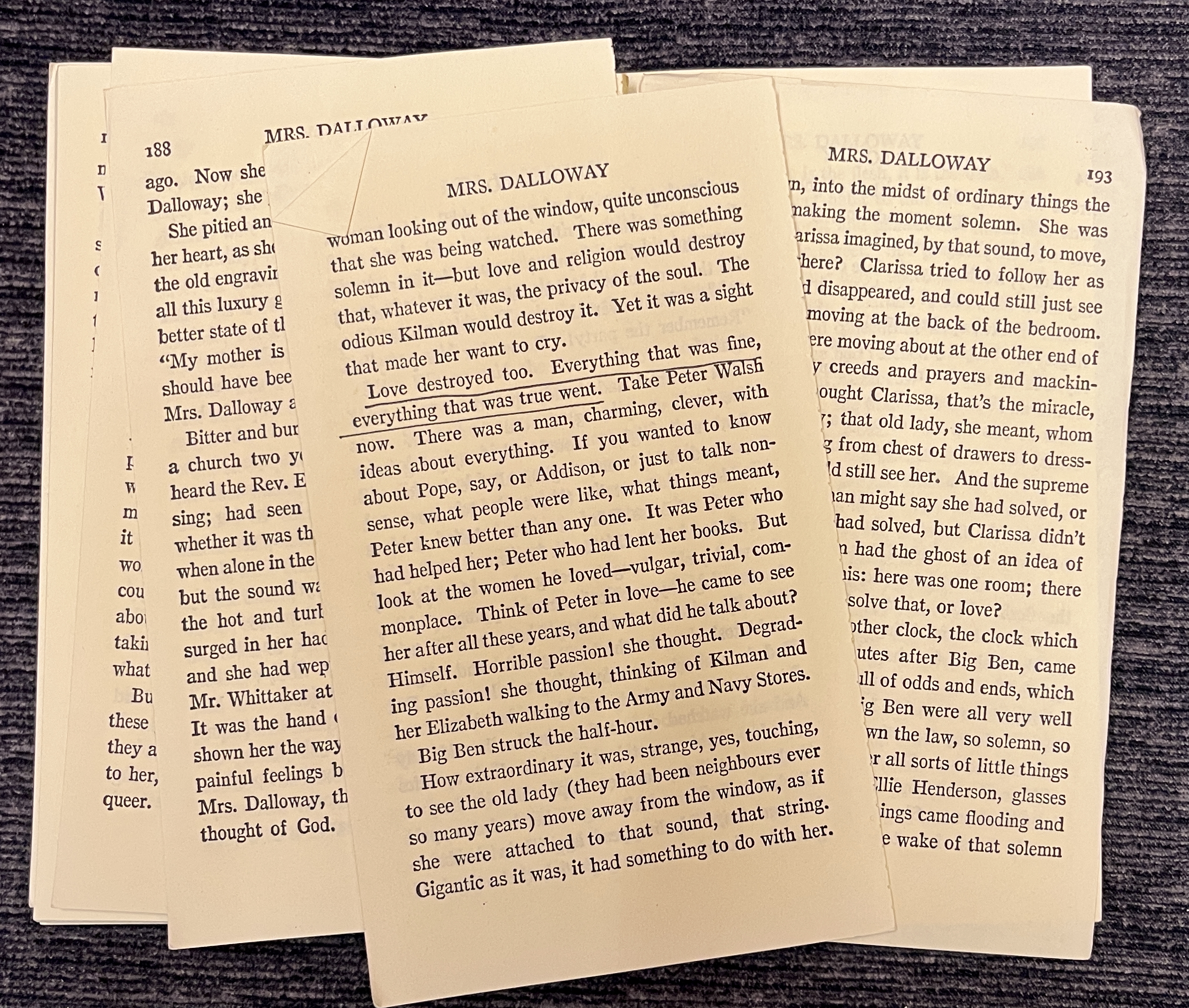
Love destroyed too. Everything that was fine, everything that was true went.
I’d forgotten those sentences until today. They might as well be the motto of nearly all the fiction I’ve written. And of so much of my life, especially in those college years — but, really, also ever after.
(Now, I suppose, I should do a Buddhist reading of Mrs. Dalloway, something about its perfect vision of impermanence. But that’s true of all of Woolf. She was as Buddhist a writer as any non-Buddhist writer I’ve ever read. Which is also an attraction of her work for me, as I tend to describe myself as someone who is not a Buddhist, but not not a Buddhist.)
Soon after I finished my undergraduate degree and started teaching high school, Michael Cunningham published The Hours, its title one of the early ones Woolf considered for Mrs. Dalloway, and a novel in which Woolf and Mrs. Dalloway (character and novel) figure prominently. Cunningham’s earlier novel A Home at the End of the World had been very important to me in my early years of college — it’s the first book I remember buying at A Different Light Bookstore in Manhattan, the first queer-specific store of any sort I ever set foot in. (Like my copy of Mrs. Dalloway, A Home at the End of the World was a little mass market paperback, a format that gave it a special power for me, unlike the more stately and respectable trade paperbacks it’s lived most of its life as.)
I don’t know how to convey the power of The Hours for me at that time. I borrowed the novel from the town library, not knowing much about it. It hadn’t won the Pulitzer yet. I hadn’t seen any reviews. It was just a book on the New Books shelf and by a writer who’d written an earlier novel I liked. And it was inspired by and partly about Virginia Woolf, who was becoming the most important writer in my reading life. So I read it, without expectations or assumptions, perhaps the best situation in which to read any novel.
The way that Cunningham wove Woolf into other stories, including a story of man dying of AIDS, undid me. I do not often cry when reading books (I cry when watching movies all the time; even action movies — put music, characters, images together for me and shazaam, the tear ducts open. Not for books.) but The Hours reduced me to weeping. I think part of it was that I had not processed my brief experience trying to be an activist with ACT UP in the mid-1990s, nor had I really reflected on the way the AIDS crisis had affected my sense of identity and sexuality. The Hours tapped into all those feelings, and did so via Virginia Woolf. And beautiful, beautiful sentences. I’m rarely, if ever, envious of a book; rarely do I ever think, “I wish I’d written that.” But that was my immediate response to The Hours. It was, in some weird way, a book I felt I’d been, myself, destined to write, but hadn’t known it. There’s a gift in that, a gift Michael Cunningham unwittingly gave me, the gift of seeing my own aspirations, pleasures, fears, memories, and desires woven into words on a page.
Eventually, when teaching Advanced Placement Literature courses, I would include both Mrs. Dalloway and The Hours, doing my best to share my excitements and puzzlements with the students. I don’t know if I ever succeeded, but it was nice to be able to spend prolonged time thinking and talking about two of the books that have meant the most to me in my life. I haven’t taught English for a while now, and I miss that.
By the time I was working on a Ph.D., I knew Woolf had to be part of my dissertation, but also that Mrs. Dalloway could not be. There’s more written about Mrs. Dalloway than about most other novels in the English language. I have no special insight into it, only a profound love for every page of this book that has accompanied me through so much of my life. I even said to my dissertation advisor (Jean Kennard’s successor), “I’d like to write about Woolf, but nobody needs to write the five hundredth dissertation on Mrs. Dalloway.” She wisely responded that there’s a lot of Woolf nobody pays enough attention to (the essays, the writings of the 1930s, etc.), and that got me thinking back to how much I had enjoyed The Years and Three Guineas in that undergraduate course long ago, a reflection that led to an article I wrote for Woolf Studies Annual and then my dissertation and the book that resulted from it.
A few years ago, I got something I never thought I would have: an early edition of Mrs. Dalloway with the original Vanessa Bell cover art. It required some of the most money I’ve ever spent on a single book, but also was quite a good deal for what it is. (The bookseller knew me, knew what the book meant to me, and wanted me to have it.) I didn’t care about it being a first edition or not; in fact, I enjoy that it’s from 1929 or 1930, with To the Lighthouse advertised on the rear flap and A Room of One’s Own the most recent book listed inside among “Books by Virginia Woolf”. It’s the American edition, and since that’s mostly the one I’ve read (there are some difference between the UK and US texts), it feels most appropriate.
And so I cherish it, alongside that broken old paperback that was the book that brought Virginia Woolf and Clarissa Dalloway to me all those decades ago, setting me on a path that I continue to follow, with constant curiosity and joy. One hundred years later, she’s as beguiling and inspiring as she ever was.
What is this terror? what is this ecstasy? he thought to himself. What is it that fills me with extraordinary excitement?
It is Clarissa, he said.
For there she was.
Discover more from Matthew Cheney
Subscribe to get the latest posts sent to your email.
