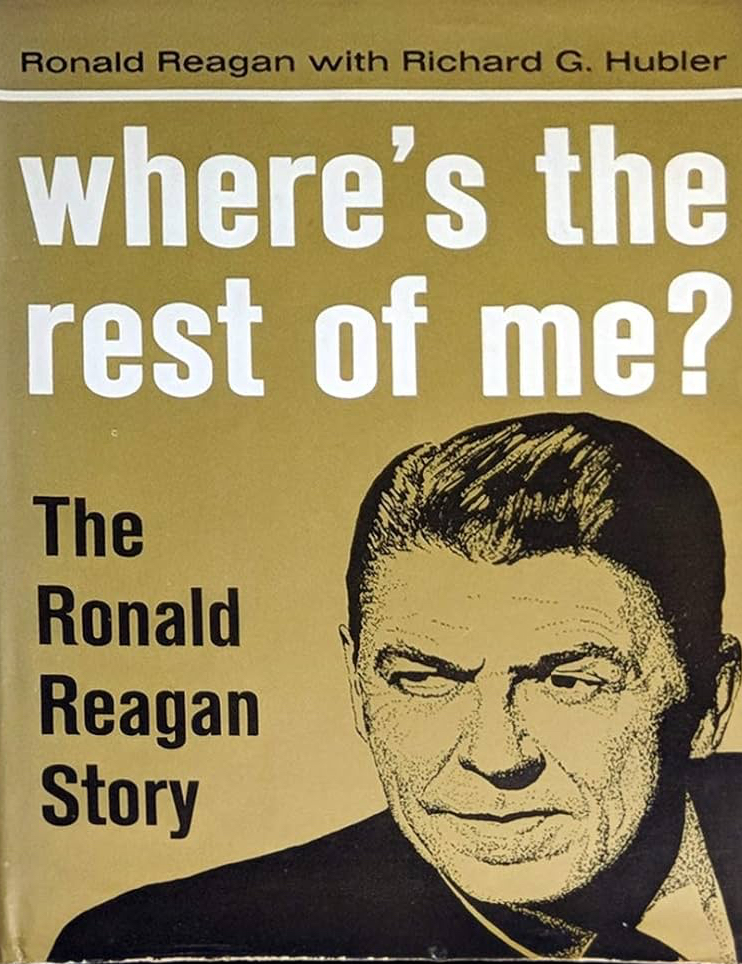
Where’s the Rest of Me?


Cowboy From Brooklyn
It was the end of May, 1937, and Ron Reagan was up against a deadline. He’d promised a yarn to the editor at Astounding Stories, and he was out of ideas. People knew him as the guy who wrote about alien invasions, but he didn’t feel much like writing about alien invasions right now, and anyway, he thought it would be a good idea to avoid getting too typecast. He should write a western. Enough with these space stories. Why did he keep writing space stories, anyway? He’d always liked reading the westerns, and just because he’d grown up in Brooklyn and never ridden a horse in his life didn’t mean he couldn’t come up with five or ten thousand words of something. But first he had to write this space story.
Love Is On The Air
“He was a good-looking guy, and nice, and a bit naïve, and so I fell for him,” Jane Wyman told their son later. “We all make mistakes. Hindsight being twenty-twenty and all that. But what could I do? I was a bit player in unpopular radio shows. He was a failed writer trying to get work as an entertainment reporter. We had lunch and talked about our dreams. We were just kids, really. I’d never even seen a man naked before. How was I to know…anything?”
Accidents Will Happen
Ron didn’t often go to the sorts of bars where he’d meet men like Alejandro, but at least a few nights a week he could get away from the apartment and Jane and the kids. He always told her he was going out to wander around and try to come up with ideas for something to write. That was true most of the time, but he never told her the sorts of places he wandered to. Friday night he’d found his way beneath Brooklyn Bridge; Sunday he strolled over to a parking lot on West Street; tonight it was this basement bar a few blocks off Washington Square. He told himself this was research, that he’d be able to write an article for one of the slicks and maybe then turn it into a book, something about the difficulties of doughboys home from the war, the trauma of returning to ordinary life, the temptations offered by months and years among men. He told himself he was attracted to this bar because it was quiet, because the men inside seemed respectable, because he needed a stiff drink after all of Jane’s complaints about him being aloof and there being bills to pay and why didn’t he get a real job and stop writing one-cent-a-word crap. He told himself it would just be for a few minutes, a quick drink, nothing serious.
The Fight For The Sky
He’d made the June 1 deadline for the story by working through the night, but he hadn’t heard anything from Tremaine for a few months, so Ron stopped by the Street & Smith offices on 7th Avenue (a few blocks from the women’s prison) one hot, humid afternoon. F. Orlin Tremaine, editor of Astounding Stories, sat in a dusty office amidst piles of paper of all sorts—manuscripts, newspapers, magazines, stray pages from books. The office smelled of tobacco and wood pulp, making the already-oppressive air nearly gelatinous. “Reagan, right?” Tremaine said. “You sent us a story?” Ron said he’d published three stories with Astounding over the previous eighteen months, and that Mr. Tremaine himself had requested a story of 5,000 words to fill a hole he had in an upcoming issue, and he wondered if the story that he’d brought down to the office on June 1 was acceptable or if there was something perhaps wrong with it. “Story?” Tremaine said. “I asked for a story? Really. Don’t remember that, sorry. Sure it was me? I don’t really do that, son. You’ve probably got me confused with somebody over at Amazing or Wonder Stories.” Ron said he was sure it was him; he would never forget a request from Astounding, as their pay was better than the others. The title of the story was “The Fight for the Sky”, and it came in at almost exactly 5,000 words. “Sent in June?” Tremaine said. “June, June, June…” He riffled through piles of papers and envelopes. “Ah! June! Yes. Okay. Right. Your story. Sorry, it fell into the Big Middle.” Ron was not familiar with the term. “I’m filling magazines here,” Tremaine said. “I’ve got Astounding, I’ve got Clues, I’ve got Top-Notch. So each month when I need to fill ’ ‘em, I sit down with a pile of stories and go through ’ ‘em until I’ve got all the puzzle pieces put together. But I need to be fair to my writers, don’t I? So I turn the stacks over and the next month I start from the bottom. It’s an excellent system, I must say, and eminently fair, except that it has one side-effect, as all excellent systems do, and that side-effect is that it creates a Big Middle, and I’m afraid sometimes, unfortunately, stories get stuck in the Big Middle. As yours did. I’m very sorry for that. I’ll move it to the top and get back to you soon. Have a good day, Mr. Reagan.”
Prisoner Of War
“At some point,” Jane said after yet another night broken not by the screams of the baby but of her husband, “don’t you think it would be a good idea to maybe try to talk about what happened over there?”
Storm Warning
Ron didn’t dare stay all night at Alejandro’s grimy apartment very often, but Jane was getting more and more work out in Los Angeles, and the children, now seven and five years old, were perfectly happy with her parents in Cleveland. Jane told her mother that she and Ron hoped to buy a house in Ohio soon because it was such a better place to bring up children than New York or California, a statement which Jane’s mother assumed meant that Ron’s drinking had become a problem again. Though he missed his children, Ron had no other complaints about the arrangement, because it meant he and Alejandro were able to spend real time together, and nobody bothered him about his smoking or his drinking or how he spent his days. Alejandro’s apartment was a single room at 45 Grove Street, relatively big for what he paid in rent, with huge windows, good light, and plenty of space for an easel and canvases.
An Angel From Texas
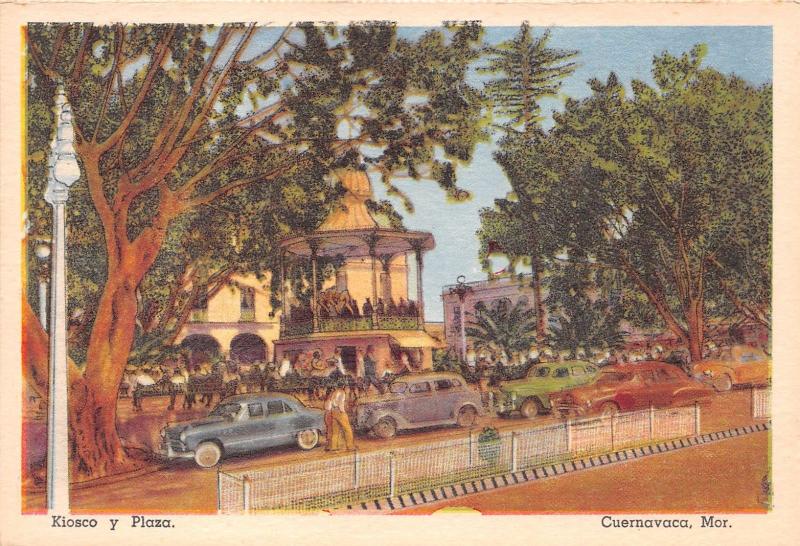
After Jane found his collection of Alejandro’s postcards from Cuernavaca, she insisted Ron see a shrink. He said it was all just for work, that he had a big article he was doing that had a good shot at the Saturday Evening Post or Collier’s, a real exposé, and he’d needed to get to know some of these freaks, these perverts, he needed them to trust him so that he could write about them and their world, that’s what writers do, as she ought to goddamn well understand by now. “You can see a psychoanalyst or a divorce lawyer,” Jane said. “One or the other. Make your choice.” He threatened divorce for days. She packed a suitcase for him. “Fine,” he said, “I’ll find a shrink. I ought to get a professional’s point of view on this stuff anyway. For my article.” He looked through the phone book and went to a few different appointments but every one made him feel like a criminal. Jane wouldn’t let him quit. She went to each appointment with him and waited outside. Dr. Mac McClure was the fourth. He was six feet tall, three hundred pounds, wore cowboy boots that he rested on his desk, and spoke with an accent he swore was west Texan. A steer’s skull hung above his massive desk. There was no couch in his office, only a couple of big leather chairs in front of the desk. “I know your name from somewhere, don’t I, Mr. Reagan?” he said. “You didn’t happen to write a story called ‘The Battle of San Francisco Bay’ a few years back, did you? That was a right good story, I must say, and I said to myself when I read it, I said, Mac, wouldn’t it be good to meet this man, this man who wrote this story, because this man is an interesting man, a complicated man, a man of many contradictions, and I do believe we could do some excellent work together, I do indeed. And Lord above, here you are. Trust in Providence, I always say, trust in Providence.”
The Big Truth
When in November 1937 he still hadn’t heard anything from Tremaine about “The Fight for the Sky”, Ron stopped by the Street & Smith offices again. He’d sold a few westerns and even a Doc Savage story recently, but it was nearing Christmastime and he could use some extra cash. Tremaine, he discovered, had gotten a promotion and wasn’t editing Astounding anymore. “I’m John Campbell,” said a crewcut man sitting in front of a rolltop desk and fitting a cigarette into a holder. Ron said, “I’ve read your stories, Mr. Campbell.” Campbell didn’t seem impressed. Ron asked about “The Fight for the Sky”. Campbell sighed. “Tremaine liked it, but I’m not going to buy it, and I’ll tell you why. Sit down, Mr. Reagan.” Ron moved a battered typewriter off of a chair and sat. “The problem with your stories, and I’ve read a few others—the problem,” Campbell said, “is that at their heart they’re fairy stories. I mean they’re stories a queer would write. And I’m looking at you right now, Mr. Reagan, and I know you’re not a queer, so I have to ask myself, as any reasonable man would: If you don’t look like a queer, why do you write like one? This is perplexing to me. Sure, I know a lot of queers don’t look the part, but they’re passing. They’re covering up. It’s sad, really. The point is, you can spot them by their mannerisms, by how they walk, their body posture, all that. And their words, the way they tell stories. There’s something ineluctably effeminate about it. And normal people have an inherent aversion. Take an extreme case, for example a full eunochoid—now, if you have some training in endocrinology, you know what a eunochoid is, you can understand the biological processes, and it may even present an interesting case, but to the average man, Bill Blow, I.Q. 95, ask him why he doesn’t like Cecil Jones and he won’t be able to tell you, but he’ll know he doesn’t like him. And your stories, they’re like eunochoids. You might as well submit them on perfumed paper in purple ink. What I’m saying, man, is put your balls into the story. Not somebody else’s, your own. Nice to meet you, Mr. Reagan.”
Heritage Of Splendor
Ron sold a few stories to John Campbell in the 1940s (“You found your balls!” Campbell wrote in his first acceptance letter), but by the end of the decade he was moving away from fiction, having met at a cocktail party the agent George Ward, who specialized in getting his authors jobs writing feature articles for the slicks and books of nonfiction for, as he called it, “the vast audience of intrepid laymen and the occasional bored housewife with a college degree.” One Friday in 1949, Ron happened upon Campbell at a Hoboken diner where both by chance had stopped for lunch, and Campbell asked him what he was working on, leading Ron to tell him about the new breed of what he was going to label “mystical psychologists” in an article George hoped would sell for big money and lead to a book project. Campbell liked the idea. “If a man were cynical enough,” he said, “he could make a fortune taking some of the basic ideas of psychoanalysis, adding a bit of science fiction, and then selling it as a religion, don’t you think?” Ron must have looked puzzled, because Campbell continued without waiting for a response: “I like your term, that mystical psychologists label, it’s catchy. But let’s remember that the non-mystic facts are that every human being has an innate something that is convinced of personal immortality. A conviction so general must have something on which it’s based, don’t you think? But what could it be? Well, here’s a proposition: Right now, you are two billion years old. An essential life-force in you has existed as an unbroken line of development for the full length of the existence of life on Earth. Now, if you could ever integrate the most powerful analytical tool in the known universe—the human mind—with the immense data-pool of our collective two-billion-year experience…well, then you’d be on your way to levitation, teleportation, telepathy, mental-powered transmutation of the elements, you name it.” Campbell smashed his cigarette into the brass ashtray on the table. “You know, if somebody was really cynical, what he’d do is take all that and then say it’s the true revelation of Jesus Christ. Spread that gospel around, and by the end of a decade he’d have more money than God.”
The Rear Gunner
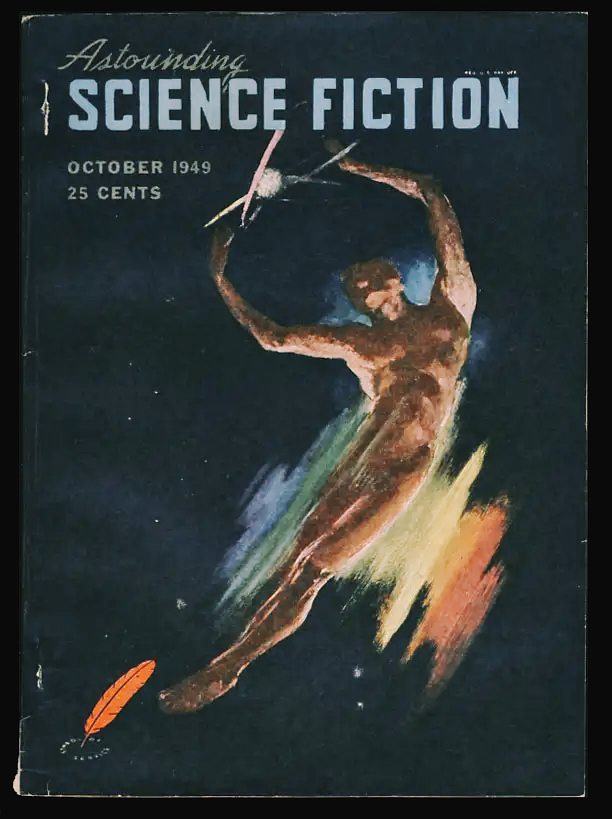
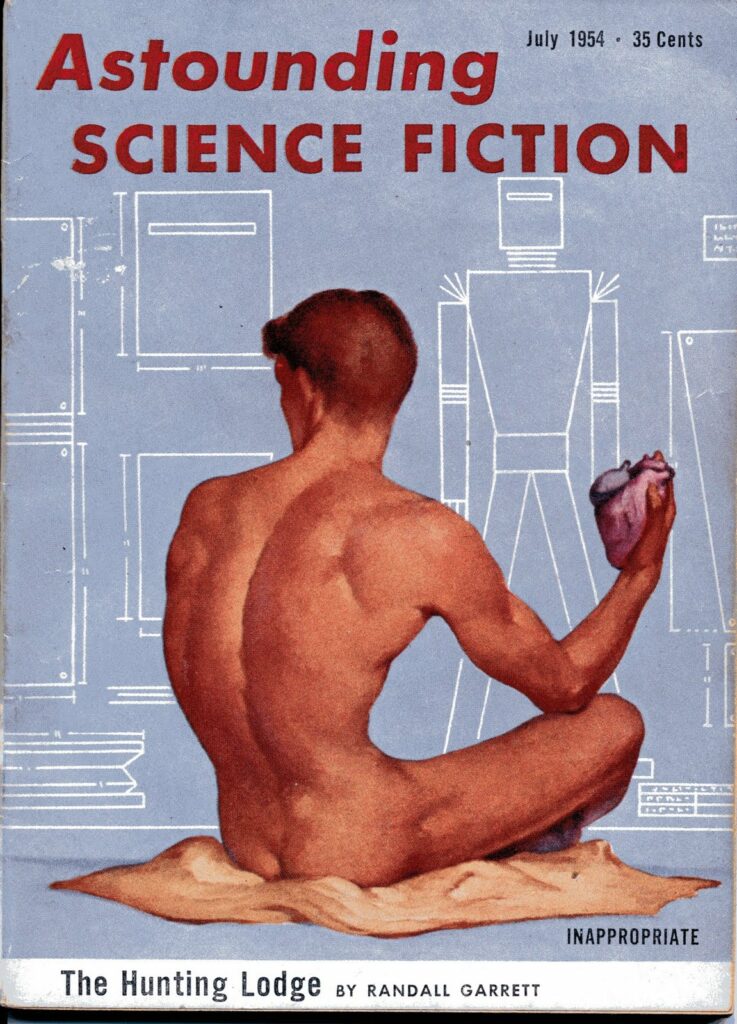
Ron asked Alejandro if he’d ever thought of doing illustrations for magazines. “I’m not sure I’d know how,” Alejandro said. Ron convinced him to let him show some drawings and paintings to editors he knew. Only John Campbell liked them. “There’s talent here, real style, but if I didn’t know you, Ron, I’d be sure you were a fairy. This is fairy art. Look at this. Okay, it’s called Prometheus, but jesus, man, look at it.” Ron reached out for the painting, but Campbell pulled it back. “And you know what? I’m putting it on the cover. Yes, I’m putting a naked man—and a naked man’s ass—on the cover of Astounding. Why, you ask? Because dammit, that’s a nice ass, and the boys over in the goddamn advertising office keep telling me our covers aren’t attracting a broad enough audience, so what the hell. I’m not about to put big-titty women and bug-eyed monsters on the cover of my magazine, but goddammit, even I’m enough of a fairy to know a beautiful, mythic male ass when I see one.” He was still laughing as Ron walked out of the office.
The Hasty Heart
The last morning they woke up together in Alejandro’s apartment was a cold Tuesday in December 1947. Ron woke first and stood up, naked and feeling naughty. He yawned exaggeratedly and Alejandro opened his eyes and enjoyed the view of Ron’s penis lifting, full of morning spunk, and he chuckled and saluted it and welcomed it to his mouth. Soon, they were back in bed, Ron’s fingers curled around Alejandro’s rigid haft, while Alejandro, gentle and teasing, stroked the back of Ron’s spongy scrotum, until eventually they needed to change the sheets and take a shower, and while soaping each other slowly, Alejandro said, “I’m going to have to go away for a bit,” and as they rinsed he said, “I need to go back to Mexico. My mother is sick,” and as they dried each other with threadbare towels that Ron was certain must date to the previous century, Alejandro said, “I don’t really know when I’ll be back, but I’ll write you all the time, mi amor.” It was then, for the first time since they’d known each other, that Ron collapsed into Alejandro’s arms in tears.
Bedtime For Bonzo
“The first time,” Ron said to Dr. Mac after nearly a year of sessions, “was when I was a kid, high school, just playing around, you know, as boys do, everybody does that, it’s perfectly normal, and then we got girlfriends and wives and we gave it up. But then there was the Army, which I don’t think really qualifies either, because what else were we supposed to do? I mean, we all thought we’d be dead at any moment, and some of us did die, a lot of us, we lost our friends, we lost everything, so why not mess around, right? I don’t see anything wrong with that, but I also know that somehow it was the war that made me into this. Don’t you think? Because after I got back, I just couldn’t really do anything with Jane anymore. Well no, that’s not true. I could do what we did, it was fine, it wasn’t torture or anything, but it was quick and mechanical. So I looked for other ways. That’s when I started going to the places where there were guys who were after the same thing. It was still pretty quick, but there was a pleasure to it, it was like it had been when we were all bunking with each other before we headed over to Berlin. There was a danger, definitely, because I didn’t know these men, and yet we were, well…there was a danger. Obviously. Of course. And that was part of the fun, the attraction. The first guy I went home with was named Franklin, and he had a nice place over on the East Side, not expensive but tasteful, and that was the first time in my entire life, I think, when I’d felt like I understood what the fuss was about, you know, the excitement, the passion of…of passion. Of sex. And beauty. That’s what it was. He was beautiful. Tall, blond, fit. He worked as a gardener for a very rich man, and so his skin was tanned and there wasn’t a bit of fat anywhere on him. Like Doc Savage, you know? The Man of Bronze. Piercing blue eyes. We met over in the meatpacking district, just one of those anonymous encounters at night, but there was something about him that made me want to stay with him, and something about me—” “Something?” Dr. Mac said. “Didn’t he tell you what it was? That something?” Ron nodded slowly. “Yes, he said…he said my penis—” “He didn’t say ‘penis’,” Dr. Mac said. Ron said that was true. “He said my cock was a thumper.” Ron chuckled at the memory. “I loved his arms and his lips and his hair, so short and blond, and we just couldn’t stop touching each other—” “Touching?” Dr. Mac said, and Ron said, “Yes, touching, and…and…” “Fucking?” Dr. Mac said. “Yes,” Ron said, “I suppose that’s the word. If you want to be crude about it.” Dr. Mac said nothing. “So anyway, we decided to go back to his place, because though Jane was away, I promised myself that I would never bring a man back to our apartment, and I never have. Franklin lived alone, so we went to his apartment, and we just went straight to his bed, and honestly we stayed in bed until at least noon the next day, just learning each other’s bodies, just…” “Just what?” Dr. Mac said. “Fucking,” Ron said. “But not only that, we would talk and then we’d play around some more and—” “Play?” Dr. Mac said. “Yes,” Ron said, “we played. It was play. It was as innocent as two little boys—” “Fucking,” Dr. Mac said. “No,” Ron said. “Playing. It was joyful. It wasn’t love, I don’t think, because we didn’t really have a lot to talk about or any real deep interest in each other as people, you know, out in the world, the real world, but we had this connection, this bodily connection, and it was glorious, we just lived in bed together, and it was in his bed that I felt—for the first time in so long—that I felt alive.”
The Winning Team
It took half a bottle of rye whiskey, but Alejandro convinced Ron to model for a nude portrait. Ron stood in a corner of the apartment, his left hand supporting him against the wall, his right arm reaching up to touch the top of one of the windows. “If the wind blows this curtain open,” Ron said, “the whole street will get a nice view of my cock.” Alejandro told him he’d heard half the Village had already had more than a nice view of his cock, so what was he worried about. “Touché,” Ron said. “And not true. Only maybe a quarter of the Village.” The curtain was blue silk, soft and light, almost translucent, and a breeze from the open window brushed it against Ron, tickling and exciting him. “It’s a good thing this portrait is from the back,” Alejandro said, “because otherwise your horn would get me arrested for being a pornographer.” Once Alejandro had the form sketched out, Ron rested on the bed, drank the rest of the bottle of rye, and fell asleep. A few days later, he returned to the apartment to see that Alejandro had been working on the painting almost continuously, and Ron had become a Titan reaching through a ring of fire toward the stars.
Code Of The Secret Service
Ron kept his postcards from Alejandro in a cigar box in the bottom left drawer of his desk. “Why not hide them better?” Dr. Mac asked. “Jane never went into my desk much,” Ron said. “But once you started having problems,” Dr. Mac said, “she suspected an affair, and you knew she did, she didn’t hide her suspicions, so why not put the evidence somewhere where she wouldn’t look?” Ron shrugged. “I don’t know,” he said.
Recognition Of The Japanese Zero Fighter
Jane found him at his desk, drunk and weeping over the postcards from Alejandro, scattered like a failed poker hand. He’d received a letter in response to his own, the one Dr. Mac and Jane had made him write, the one in which he said no, he couldn’t see Alejandro now that Alejandro was back from Cuernavaca, and he didn’t want to see him again, at least not for a long time, because their relationship had been unhealthy and he was now trying to get better, and he hoped that Alejandro would himself get help and become clean and pure and good again. Alejandro’s reply was written on a torn-off cover from Astounding, a naked man rising to the stars, just a few words: Goodbye. Love. A. Jane put her arm around Ron’s shoulders. He pushed her away. She tumbled backward, hitting her head on the wall. He screamed at her, terrible things, and she turned away and shielded her eyes from him, telling herself that it was the booze talking, he didn’t really hate her, no he couldn’t really hate her this much, no-one could hate someone this much, and she tried to pull away from him as he groped for her, but he tore her blouse and he spat on her, and he ripped her dress away and it was only then that she could get into a position to push him back as he struggled to unbutton his pants. She stood over him as he wept on the floor, the pathetic man, kissing a postcard and holding his limp and silly penis, and she forced herself to think about the sunlight in Los Angeles and the wonderful house she had bought without telling him, and the blue, blue pool the children swam in so freely, so happily.
The Angels Wash Their Faces
Dr. Mac asked him if he was a religious man. “No, not really,” Ron said. “I went to Sunday school, but I stopped when I was about fifteen. I suppose I believe in God. I’m just not very good at it.” Dr. Mac leaned forward, eyes ablaze. “How long have we been meeting, Ron? Eight, ten weeks now? Well, I’ve learned a lot about you in that time, and I believe I have a real good sense of you, and I believe you know I have a real good sense of you, isn’t that correct?” Ron said that was correct. “Now, it is against my professional practice to offer everyday advice, as you know, but the advice I am about to give you is much more than everyday—it is, indeed, advice for all of your existence and even, yes, for your immortal soul. You do believe in an immortal soul do you not?” Ron said he believed in an immortal soul. “Therefore, my boy, I must say that in my professional opinion the best thing you could do for yourself, for the health of your body and your mind and your immortal soul, I believe the best thing you could do is to get to know and to love and to worship our savior, Jesus Christ. Now, you do not need to say amen, and you do not need to go join an evangelical congregation or become a holy roller like some gesticulating negro, but you need to find some way to allow the truth of Jesus Christ our savior into your heart. Do you not agree?” Ron said that he agreed.
Law And Order
There are no depths, Alejandro once said, only surfaces. Surfaces upon surfaces.
Brother Rat
“No no no,” Dr. Mac said, “I don’t want shared credit. I don’t want any credit. I have a good thing going here, no need to muddle it up with a new approach. But I’ve had my lawyers draw up a good, solid, and I think eminently fair agreement by which I will receive 40% of the royalties due to the author, given that at least that much of the book itself is based on your interviews with me.” Ron looked over the papers Dr. Mac had handed him, then said, “That’s fine. But I’m having my lawyers add a clause releasing me from having to credit you or compensate you for future volumes that I am sole author of.” Dr. Mac put the papers into a black folder. “That’s fine,” he said. “Though I do hope we can continue to collaborate. It’s been such a fruitful relationship for us both.” Three months later, Dr. Mac fell asleep while watching his new television, and never woke up, his heart having stopped beating.
Million Dollar Baby
Ronald Reagan’s first book, The Revelations of Jesus: Good News for Mind and Soul, was released in December 1951. After a few weeks, it began to sell steadily, and entered the New York Times hardcover bestseller list on January 20, 1952 at number 14. Over the next month, sales continued to increase, and on March 9 it knocked Rachel Carson’s The Sea Around Us to second place and stayed in first until October 26, when Tallulah Bankhead’s autobiography sent it to second place, followed by the Revised Standard Version of the Bible in third. The Revelations of Jesus remained among the hardcover top ten until August 1955, by which time the sequel, Further Revelations of Jesus, released in April 1953, was holding steady in second place and Ronald Reagan’s third book, Sharing the Mind of the Christ, released in June 1955, was number one.
Going Places
Nancy Davis was the host of an interview show on DuMont Television Network, Morning Light, and at first she and Ron didn’t get along. Her opening question during his initial appearance on her show was, “Why don’t you consider your book sacrilegious?” Ron gave her his now nationally-famous chuckling smile and said, “Well, Nancy, don’t jump to conclusions. Some people might say, particularly if they couldn’t get out of the Old Testament, that the words and ideas of Jesus Christ are, in fact, sacrilegious. Now, I don’t happen to believe that, myself. But it might be said.” Ron thought then that if he were writing a science fiction story about Nancy Davis, he would say that death rays shot from her eyes. After the show was over, she came to his dressing room and said she was beginning to think he believed all the things he’d written in his book. “Of course I believe them,” he said. “The words in that book, which I do believe are the real lessons of Jesus Christ, updated with today’s mental science—those words have saved my life.” She said she hoped that they might talk again, and she gave him a slip of paper with her home telephone number written on it.
Swing Your Lady
Before she could agree to marry him, Nancy said she would need to know everything about his life before the book and the seminars made him famous. His life as a pulp writer, his time in the Army, his life with Jane, the divorce, and, most importantly, all the various struggles he referred to so vaguely in the book and in his speeches. She and Ron were sitting in the large and eminently tasteful living room of her apartment, a room with an expensive view of Central Park, a bookcase of leather-bound books she’d never read, and no furniture less than fifty years old. Ron was silent for longer than she’d ever seen him stay silent in a conversation, a moment that felt weighty, almost crushing, as if time itself was the only bulwark against a colossal threat. “Like my father before me,” Ron said finally, “I was an alcoholic. Not too bad before the war, but it got bad after, because the war was bad. I saw dear friends killed right in front of me, I saw towns and cities destroyed, I did some terrible things that I don’t need to dwell on, the terrible things a man does in war. I had trouble getting back to work afterward, and I blamed Jane, and I drank too much because it helped me stop feeling my fears and my failures. Jane convinced me to get help, and I got help, and eventually I got better. But I’d been a terrible husband to her, and a terrible father. A terrible, weak man.” Nancy said there were rumors of other things, of left-wing politics, maybe even a flirtation with Communism, and there were, too, whispers of sex perversion. “I was drinking an awful lot in those days,” Ron said. “I hardly knew who I was. There’s honestly not a lot I remember. It wasn’t really me. This is me. Here, now. This is me.” He kissed her delicately on the lips.
Hell’s Kitchen
Ron’s second appearance on Morning Light was less tense and awkward than the first. He and Nancy had kept their engagement secret, and would continue to do so for the next year, until she could get free of her contract and better position herself as an upstanding housewife and potential mother, but interest in Ron’s ideas had spread widely, and he had refused many other interview opportunities, instead encouraging reporters and publicists to spend $20 to attend one of his seminars. “Tell me about your view of sin,” Nancy said after the initial pleasantries at the beginning of the show. “Well, Nancy, I’m glad you’re interested in that, because it’s one of the central ideas not only in The Revelations of Jesus, but really in my entire approach to life. Sin is, in my view, and certainly the view of Jesus in the gospels, anything that is unhealthy to us as an individual or to a society. Usually both, because a healthy society needs healthy individuals. Take for instance something we don’t necessarily see as sinful, even if we do condemn it—Communism. I believe that Communism is sinful. It is sinful because it seeks to destroy the healthy passions of our free enterprise system, and it is a disease that spreads in a society. If our body is a temple, and God instructs us to treat it as such, we must resist disease. Not to resist disease is to commit sin. Whether we’re talking about our own body or our family body or our national body, we must do whatever we can to protect it, to nourish it, to keep it healthy and strong. When I was a young man, I made my living by writing stories about alien invaders, and as I grew older I realized that what I was writing about was, in fact, the threat of sin. This is what Nazism was, and it is why our triumph over Hitler was a great triumph for God. And it is what Communism is. An alien invasion. The ideas invade the individual first, and then the individual spreads them, not knowing he is being controlled by a kind of virus or demon, and what was a disease of an individual becomes a disease of a group and then a whole culture and nation, eventually of the whole species. I’ve given over my life to finding ways to combat this invasion. I’ve given my life to Jesus.”
For God and Country
On June 2, 1953, Ronald Reagan appeared before the House Committee on Un-American Activities and testified about the relationship between Communism and other types of personal and social failure that undermined the health of the national body. Frank S. Tavenner, Jr., Chief Counsel for the Committee, questioned him for nearly an hour about his techniques for diagnosing and treating such mental diseases or, as Mr. Reagan preferred to call them, sins. Mr. Tavenner asked Mr. Reagan how such sins were related to each other, and if one might, in his opinion, lead to another. “Certainly,” Mr. Reagan said. When asked to elaborate, he replied, “If we talk about sin, we talk about weakness and desire—about the desire produced by weakness, and the weakness that furthers that desire.” Mr. Tavenner asked Mr. Reagan if he was asserting that a person tempted to Communism might also suffer other perverse desires. “I think that is incontrovertible,” Mr. Reagan replied. “And I would urge all of our legislators to pay particular attention to the ways that individual weakness of desire can undermine the health and strength of our nation. Recent hearings have shown the pervasive power of sin in the industry that creates our entertainment, and only the most callous or disconnected man would suggest that our entertainments are not at least partly a reflection of ourselves, of something inside us, and so we should guard against sinfulness within them just as we guard against sinfulness in ourselves. It is the same with our government, which should be a reflection of our nation and its ideals. For instance, for our government to employ someone of weak moral character, someone with perverse desires—for our government to do that would be to weaken the national body itself.”
King’s Row
Nancy Reagan gave birth to her first child, Peter, nine months after she married Ron. A year later, she gave birth to Andrew, and the next year James. Her husband spent much of the time of her pregnancies on the road, often leading two or even three seminars a day. Reporters who attended the seminars wrote that Reagan would talk for much of the time, telling stories of his heroic experiences in the war, of the many celebrities he spent time with in New York (and, more recently, Hollywood), and of the important work he did for the government in combating Communism. The particular benefit of any individual story was hard to identify, but after about an hour and a half of storytelling, the audience would break up into small groups where members of the Revelation Society would then help them find the moral, intellectual, and, especially, psychological benefits in what they called “the teachings”. Each seminar ended with the audience reconvening in the auditorium for the climax of the seminar: a few individuals would be chosen to go onto the stage and participate in a preliminary analysis by Ronald Reagan. More than one researcher comparing reports of the seminars at this time has remarked on the frequency with which blond, blue-eyed men in their early twenties were chosen for the preliminary analysis, with at least one researcher suggesting that the same person was used at each event. Photographs prove, however, that despite superficial resemblances, numerous men participated.
Beyond the Line of Duty
“Some may call it unorthodox, even quackery,” Vance Britten, Vice President of the Revelation Society, told a reporter for the New York Herald Tribune in 1954. “But there’s one thing to remember. Really, the only thing that matters. Ronald Reagan has cured every sinner he worked with. He has cured ulcers, arthritis, asthma. He has brought happiness and optimism to millions. He has shown his followers a new, scientific—indeed revolutionary—path toward the enlightenment that Jesus Christ stood for so many centuries ago. He has shown how that enlightenment fits into a continuum of human history, our biological inheritance, the rock-solid reality of our two billion years of existence. He has shown us what immortality truly means.”
Smashing the Money Ring
“The sudden fame, the wealth, it all wore him down,” Nancy Davis told a reporter for a BBC radio documentary in 1983. “He was a good man at heart, a kind man. But it was too much for him. That’s all. It was too much for him. He went to pieces. There was nothing any of us could do for him.”
Night Unto Night
Despite the tax problems, despite continually hostile press coverage, despite the FBI inquiry, despite moving from New York to Hollywood to Montana to England to Switzerland and then, finally, to a giant yacht in the Pacific Ocean—despite it all, the family was happy and business was good for many years. “We’re a big organization now,” Ron said to anyone who asked about the obstacles, “so of course we’ve had growing pains. But look how much we’ve grown! I sincerely believe the good that we’ve done outweighs whatever challenges we have faced. The challenges only make us stronger.” The books continued to sell, the seminars continued to be popular, the individual analysis sessions continued to fill, despite their ever-rising price tag. Every day, Ron received letters from people who said he had changed their lives. He had given them hope, cured them of pessimism, made them proud to be who they were, helped them understand their individuality, helped them fight the invasion of sin, helped them embrace human immortality, brought them into an understanding of the truth of Jesus. He read these letters each night during his alone time. Nancy had been the one to insist on alone time for him, and she protected it zealously. “I don’t care if you drink,” Nancy said. “Maybe you have to. Maybe that’s who you are. But we’ve built something here, and if you ruin it, Ron, I swear to you I will make every day of the rest of your life a living hell. If I ever smell alcohol on your breath again in public, if I ever see you unsteady before an audience again—I swear.” She went to his study every midnight, let herself in with the only copy of the master key, and helped Ron to bed. Usually, he had passed out with his head on the desk, though sometimes he collapsed on the floor. Often, he reeked of urine and vomit. Sometimes he was awake, occasionally he was coherent, now and then he was sober and working and proud of himself. Every morning, she poured coffee and Dexedrine into him, and he said he loved her, and she sent him on his way.
Hellcats of the Navy
In October 1968, Ron was eating breakfast in the main cabin of the yacht that now served as his home and headquarters. Nancy was nearby, talking with the captain, when she heard her husband scream. Immediately, she assumed an assassin had found a way to get on board. That was one of the main reasons, aside from the endless tax troubles, they had moved to the yacht: Ron was convinced that people wanted to kill him. Nancy thought this was a bit paranoid, but not entirely unrealistic, and now she was certain it was more than realistic, it was a fact. She ran to the cabin and found Ron sobbing over a four-day-old Los Angeles Times that had come in with the mail at dawn. “What is it, Ron? What is it?” she said, again and again, but he pushed her away. He crumpled the first pages of the newspaper, then threw them across the room. Nancy went to retrieve them, but he screamed at her to get away, to leave him alone. She did. An hour later she found him with a nearly-empty bottle of tequila in hand, leaning over the starboard railing, trying to position his uncooperative body to jump into the ocean below. She pulled him back and helped him to their cabin, then went to retrieve the newspaper. There were reports on the progress of the war in Vietnam, reports on the election campaigns, and reports on a massacre outside Mexico City. Most of the pictures were of Mexico, including pictures of corpses—pictures that were, she thought, tasteless and shocking. (What purpose could there be to putting pictures of dead Mexicans in an American paper?) None of that should have so upset Ron, though. His behavior had been a bit more erratic recently, his generally excellent memory less and less reliable, and it was possible, indeed likely, that the alcohol and amphetamines had reached a toxic level in his brain, and she should begin to implement the detoxification plan she had had Dr. Winter draw up for just such a situation.
She’s Working Her Way Through College
Vance shared a recent article from a psychological journal with Nancy. He said that it was the funniest thing he’d read in ages. “‘Reagan’s success,’” he read aloud in the high-pitched voice of a cartoon egghead, “‘indicates society’s periodic need to re-conceptualize its leaders. Reagan thus appears as a series of posture concepts, basic equations which re-formulate the roles of aggression and anality.’ Can you believe people get published with this shit? Listen to this: ‘Motion picture studies of Ronald Reagan reveal characteristic patterns of facial tonus and musculature associated with homo-erotic behavior.’” Vance was laughing so hard he couldn’t keep reading. Nancy took the journal from him and looked at it. Ron stepped into the cabin then and genially asked what they were doing. Vance grabbed the journal from Nancy, who tried to protest, and he read, returning to egghead-voice: “‘Vaginal intercourse after watching films of Reagan proved uniformly unsuccessful, producing orgasm in 2% of subjects. Homosexual behaviors, however, increased, and Reagan films repeatedly produced proximal erections in at least 88% of subjects.’” Ron snatched the journal from Vance’s hands, opened a porthole, and tossed the Winter 1967/1968 Proceedings of the American Academy of Psychological Sciences into the ocean.
The Bad Man
By the spring of 1969, Ron’s drinking was mostly under control and he’d given up Dexedrine, but memberships in the Revelation Society were dropping and interest in individual analysis had nearly disappeared. Nancy and Vance had carefully diversified Ron’s assets, allowing him an impressive income despite the Society’s troubles, but the Society was within months of needing to declare bankruptcy. When a local CBS news affiliate in San Francisco asked for an interview, they all agreed it could be a useful way to remind the world of Reagan’s charismatic genius. What they did not know was that the interviewer, Johnny Barrett, had investigated some of the rumors around the young men Reagan frequently singled out in his seminars, and he had also heard that Reagan’s fondness for whiskey had never truly left him. Barrett carefully positioned two glasses and a bottle of Old Overholt on the little table between their chairs on the studio set, filling his own glass and offering Reagan a drink just as the show’s opening credits rolled. “Oh no,” Ron said, “I’ve been on the wagon for many years now.” Barrett smiled, took a sip himself, and then asked innocuous questions about the Society, Ron’s family, the huge yacht he lived on, his days as a pulp writer, and the many medals he said that he won in the war. A few minutes before the mid-show commercial break, Barrett said, “Now, you know, as with all celebrities, many rumors have sprung up around you. One that’s been especially persistent recently is that you have a particular interest in certain young men who attend your seminars. Only one has ever come forward with any accusations, and he says the others were well paid to keep their silence about your activities with them. What do you have to say about that?” Ron smile-chuckled and said, “Well, you know, whenever a man achieves a certain amount of fame or success, people will line up to lie about him, to try to bring failure to him and some sort of spotlight to themselves.” Barrett sipped his whiskey, then said, “So you’re denying the accusations?” and Ron said that of course he was denying them. “We were able to track down a few of the others,” Barrett said, “and they allowed us to tape record them as long as we wouldn’t use their names. Let’s play the recording—” The studio filled with the sound of a tentative voice, a man saying yes he’d been at the seminar and he had, at the end, gone up onto the stage and participated in preliminary analysis with Mr. Reagan, and that after the seminar he was invited to Mr. Reagan’s dressing room, where Mr. Reagan propositioned him in a very vulgar way. Another voice said he, too, was summoned to Mr. Reagan’s dressing room, and he thought what Mr. Reagan wanted him to do was funny, kind of a lark, so he went along with it, though now he had regrets. A third voice said that he went to numerous seminars, and at each one he was called onto the stage, and after each one he spent time with Mr. Reagan, performing perverse actions with him, and once he even stayed with him through the night. Barrett turned to the camera. “Response from Ronald Reagan when we return!” The show cut to commercial. Ron had already poured himself a drink, apparently without realizing it. By the time the commercial break ended, he had had three. He continued drinking throughout the program whenever the camera seemed to be on Barrett, but this was an illusion, as the two cameras were always running, and the show’s director quickly decided it was best to stay on Reagan. “These are all lies,” Ron said. “They are greedy, greedy people trying to take me down.” Barrett noted that Reagan seemed to be struggling still to overcome temptations. “It is an eternal struggle,” Ron said, “and that is the nature of the life that is, the billions of years we have in our souls, the life flows through us and so there is temptation that, of course, is what Jesus warned us against and which I help people to, their sins, overcoming sins, I help people—I help people. That is all you bastards should care about, but you don’t, you just want to tear me down like a sheet on a two-dollar whore.” He stood unsteadily, supporting himself with the chair. “How do I get out of this goddam viper pit?” he muttered. By this time, Nancy and Vance had pushed their way into the studio and, though five minutes remained of the show, they helped lead Ron off. Johnny Barrett watched them go. “Ronald Reagan, ladies and gentlemen, in his full glory.” Later that night, the Revelation Society issued a press release saying that on account of extreme exhaustion, Mr. Reagan would be taking a break from his duties and spending a well-earned vacation at sea. In truth, though they could hardly know it at the time, he would never be seen by the public again.
Nine Lives Are Not Enough
Reagan’s yacht, the Santa Fe Trail, became his Xanadu in the early 1970s after the Society went bankrupt and Nancy and the kids left. He hardly talked to the small crew, and most thought he didn’t know their names. Now and then he would ask the captain to travel in a particular direction, but it was rare. “We need to dock somewhere, Mr. Reagan,” the captain said one afternoon in April 1973. “We need supplies, we need repairs. We’re not in good shape.” The mail and supply boats hadn’t found them in weeks. Ron only knew this because he was down to his last case of whiskey. “Head to Mexico,” he said. “Get me to Mexico.” The captain said he would do his best.
The Last Outpost
Johnny Barrett spent a week in Ayutla de los Libres in October 1975, talking with people about the man they knew as Jack Browning, a gringo who spent most of his time in Vargas’s bar a few blocks from the centro. Jack Browning told people he was looking for Alejandro, but every time somebody named Alejandro went to him, he said no, no, not you, you’re the wrong one, you’re not my Alejandro. Señor Browning always had plenty of money, and he always paid well. He said he was going to Cuernavaca, but he never got very far down the road before somebody had to bring him back. “He would have died out there,” Vargas said. “He’d pass out on the side of the road. Sometimes, he’d just throw himself in front of cars or trucks. He didn’t know where he was or where he was going. So we always brought him back.” Johnny Barrett asked to see Señor Browning’s possessions. Doña Ana kept them at her house, where he had spent most nights. She was an old woman and had cared for him like she was his own abuela. Everything he owned had been in an Army-issue duffel bag. Some clothes, two bottles of tequila, a Swiss Army knife, a wedding ring, a big leather wallet stuffed with cash from various countries, and the tattered cover an old science fiction magazine. Some words had been written on it with a pen, but the paper was so faded and worn that Barrett couldn’t make out what they said. When Barrett got back to San Francisco, he told his producer, who hadn’t wanted him to go on this wild goose chase in the first place, that yes, this Jack Browning fellow could have been Reagan, but he just as easily could have not. “Who knows what became of the old guy,” Barrett said wistfully, and his producer shrugged and said, “Who cares?”
The Killers
It was a cool, perfect night in Manhattan. As they sat together on a bench in Washington Square Park, Alejandro asked, “How do you want to die?” Ron scowled. “What kind of question is that?” he said. Alejandro said, “It’s an important question. We have to envision our death, don’t you think? To appreciate our life. So for me, I want to die surrounded by flowers. All sorts of colors, all sorts of fragrances. To die in beauty. That’s what I want.” Alejandro entwined his fingers with Ron’s. “Now your turn.” Ron shook his head. “I dunno,” he said. “Of course you do,” Alejandro said. “Just use your imagination.” Ron pulled his hand away. “People could see us,” he whispered. Alejandro stared at him and raised his eyebrows expectantly. “Fine,” Ron said. “Okay. How do I want to die? Somewhere seedy. In a boarding house, maybe. The kind of place where they’re not surprised if you die. Or get shot. That’s what I want. I want to be lying on a bed in a boarding house, waiting for some hired guns to come in and shoot me, and then they do. That’s all. Just a kind of fate. You know they’re coming, you wait for them, and then they do what they always said they’d do, what they were always going to do from the beginning of time.” Alejandro ran his hand through Ron’s hair. “Sometimes,” Alejandro said, “I feel like I don’t know you.” Ron took Alejandro’s hand in his again. “I’m just joking with you,” Ron said, resting his head on Alejandro’s shoulder. “I don’t want to think about dying.” Quickly, surreptitiously, gently he kissed Alejandro’s cheek. “I think you’re the only one who really does know me,” Ron said. “As much of me as there is to know, anyway.” They sat on the bench for a while without talking, then went back to Alejandro’s apartment, which now seemed strange to Ron, as if he’d never seen it before, with all its mess of canvasses and brushes and paints, objects that now seemed to him to have been here for millennia—he and Alejandro were additions, new life, and as Alejandro took him in his arms, Ron was certain they would stay here, just the two of them, complete, forever.
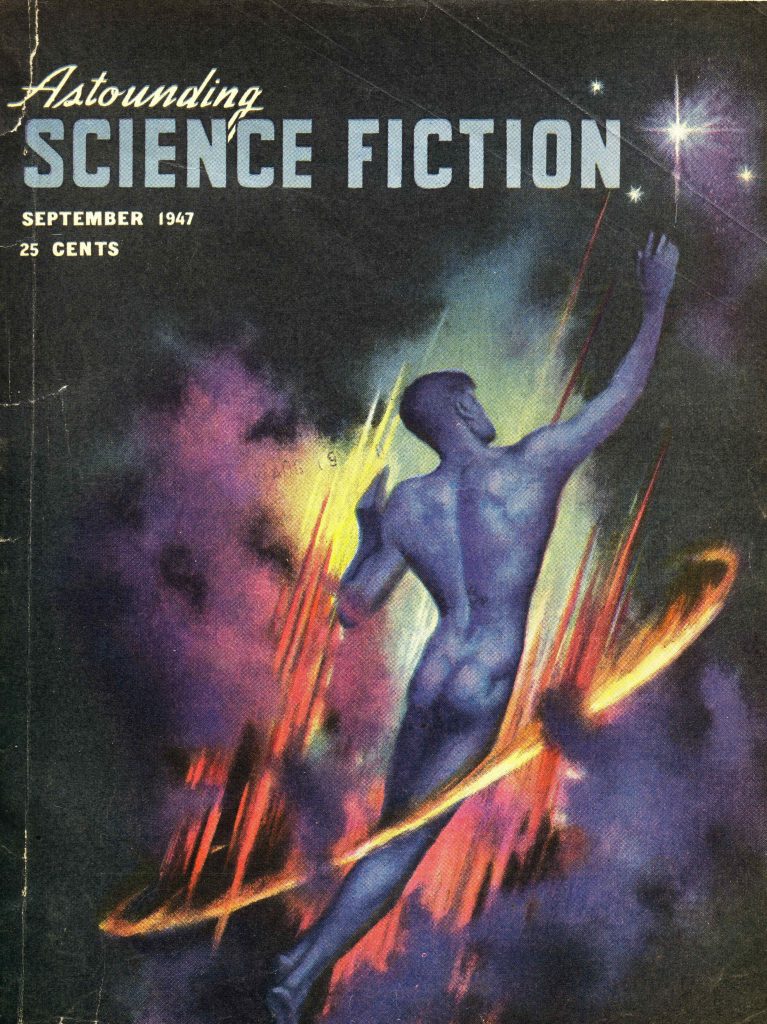
Astounding Science Fiction covers by Alejandro Cañeda
"Where's the Rest of Me" by Matthew Cheney was first published in Blood: Stories in 2016 and is now licensed under Creative Commons Attribution-NonCommercial-ShareAlike 4.0 International


