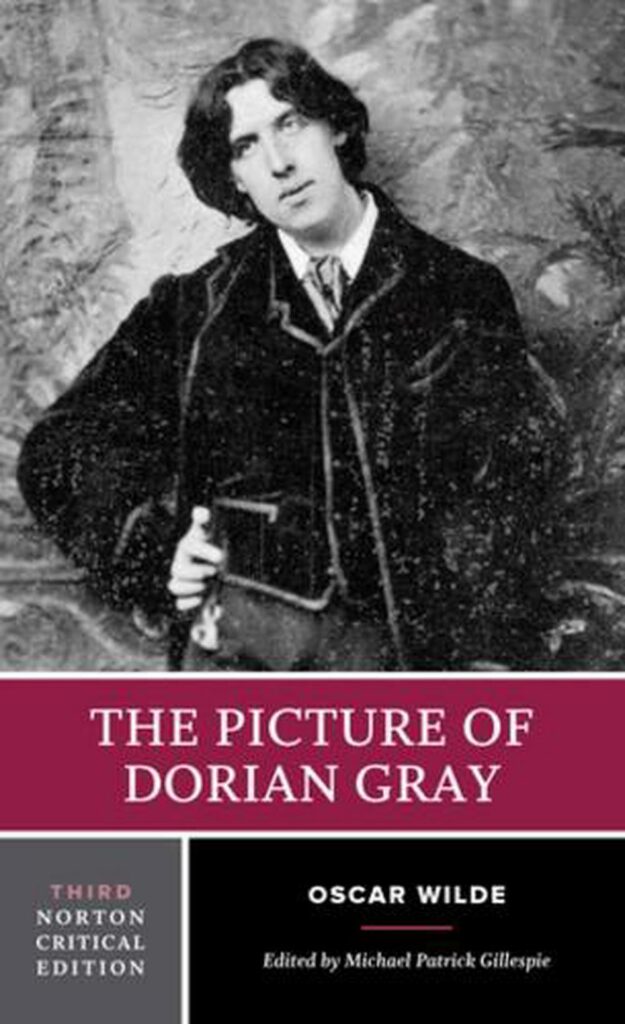
The following is of very niche interest. It began as an email, but then blossomed (metastasized!), because I was annoyed … and nothing propels me toward obsessive productivity quite as much as annoyance does.
In summary: The selection of critical essays and, especially, the bibliography in the last two editions (2007, 2020) of the Norton Critical Edition of Oscar Wilde’s The Picture of Dorian Gray is decades out of date. While the selection of critical essays is not entirely terrible, what’s truly gobsmacking is that Norton and the editor of both the second and third editions allowed the bibliography to be published. The book would be better with no bibliography at all rather than the one included. It’s a stunning failure of academic rigor that does real disservice to students and to the field of Wilde studies, a field that has seen many groundbreaking and informative publications since 1988, when the bibliography was put together for Norton’s first edition.
I created an addition to the book’s bibliography, available at this link. It is not comprehensive — I’m sure there’s plenty of good material I’ve missed, and in any case this bibliography is primarily aimed at students at my own institution, so I privileged work they have access to.
Now for a longer justification…
I am visiting a friend’s Queer Literature & Film course next week, right after the class has read Oscar Wilde’s The Picture of Dorian Gray, for which they are using the Norton Critical Edition in its most recent form, the third edition from 2020.1The class is reading my story “Wild Longing”, from The Last Vanishing Man, which includes some discussion of Wilde. This is the best paperback edition I know of for a class to use, and is the one I would assign were I teaching the novel … but nonetheless, the third edition is a terribly lazy and misleading update. Being a bit obsessive about this sort of thing, and infuriated by the laziness of the bibliography in the book, I prepared a more updated bibliography for the students.
I had not seen (did not know about) the third edition of the Norton Dorian Gray until I got the course syllabus. I bought a copy for myself, figuring that the updating would have at least a few things I might point out to the students. I have the second edition, which I used fruitfully when the novel was a central text for my PhD exams. The nice things about it — which remains true for the third edition — is that it contains both the full-length novel and the shorter, earlier version first published by Lippincott’s Monthly Magazine in 1890. Like other Norton Critical Editions (a series of which I am a longtime fan2Their edition of Chekhov’s stories still gives me almost giddy pleasure in the brilliance of its conception and editing.), all editions also include a helpful set of other texts: original reviews, memoirs, letters, etc. It’s a good package and, despite the severe reservations I’m about to express, in either edition it is the best affordable version for the classroom that I’m familiar with (I have not seen the first edition from 1988).
The problem is to some extent in the selection of critical writings about the novel and, primarily, in the bibliography. The only real difference between the second and third editions that I can see is that six of the seven essays in the criticism section are all different (though in both editions, editor Michael Patrick Gillespie includes one of his own essays, a different one in each edition; clearly, he thinks highly of his own work).
Critical Essays
The critical essays are individually unobjectionable, if on the whole a bit … uninspiring. Were I editing a collection of essays about Wilde and Dorian Gray for classroom use, I’d look more deeply and farther afield, and I would try to find at least one piece that connects to recent trends and concerns. (Gillespie’s own essay in the 3rd edition is titled “The Picture of Dorian Gray as a Post-Modern Work”. How 1990s!) The one essay to center queerness is Joseph Carroll’s 2005 “Aestheticism, Homoeroticism, and Christian Guilt”, which begins with grumbling about poststructuralism and goes on to present a “Darwinian” reading — I’d forgotten about those sad years when evolutionary psychology and literary studies briefly danced together. Carroll draws, seemingly uncritically, from Donald Symons’s 1979 Evolution of Human Sexuality, presenting its ideas of homosexuality and promiscuity as applicable to Wilde. In a 2021 article for the British Journal for the History of Science, Erika Lorrain Milam points out that Symons’s work was based on all the sexist assumptions of Sociobiology: “Symons argued that the frequency of sex among male homosexuals illustrated that males possessed a greater sex drive than females, derived from the far greater evolutionary importance of male sexual pleasure.” Thus, the one queer-focused essay in the book bases its premises in outdated, heterosexist research.
Wilde is important to queer studies, and to not include at least one reading from the field is to misrepresent the place of Wilde within the contemporary academy, like it or not (something makes me suspect Gillespie doesn’t like it). The bibliography includes nothing like Jeff Nunokawa’s 1996 essay “The Importance of Being Bored: The Dividends of Ennui in The Picture of Dorian Gray“, first published in Studies in the Novel and then in the pathbreaking 1997 queer studies anthology Novel Gazing: Queer Readings in Fiction (edited by Eve Kosofsky Sedgwick). Gillespie’s negligence in updating the new edition feels willfully ignorant and, indeed, seems to be willing students into ignorance.
The one essay that Gillespie holds over between the editions, Donald Lawler’s “Oscar Wilde’s First Manuscript of The Picture of Dorian Gray“, first published in 1972, remains worthwhile, though it is now superceded by the materials in Nicholas Frankel’s books of the typescript draft of the novel (see below). (Lawler was the editor of the first Norton Critical Edition of the novel, and wrote other useful essays on various versions of Wilde’s text, then ultimately the book An Inquiry into Oscar Wilde’s Revisions of The Picture of Dorian Gray [1988].) The most recent essays in the third Norton edition are two from 2014, which … okay. Given the time to select essays, get reprint rights, and produce the book, maybe 2014 was the latest practical date for anything recent and of quality to be included. A bibliography could point toward a few more recent items of value, helping students see what approaches scholars have taken during the time since those students were in high school rather than elementary school or preschool or earlier.
The real question, though, is do these essays justify the effort of a new edition? Or, as I suspect, are the six new essays just an excuse to create a new edition and make used books, for which the publisher receives no money, less likely to be assigned? Heterosexism and dustiness aside, the individual essays in each edition have merit, but the selection as a whole, in both the second and third editions, is pretty weak and unrepresentative of the truly exciting state of Wilde studies over the last 20-30 years.
All the signs point toward the third edition in particular being little more than a way to discourage students from buying secondhand books. Not only are the essays no significant improvement over the selection in the previous edition (they’re not worse, they’re just not notably better), the bibliography has only been updated to include the essays in the new edition … which seems pretty pointless.
Bibliography
As I said, the last few decades have been great for anyone interested in Wilde. Just with books, between 2007 and 2020 (the time between the 2nd and 3rd editions of the Norton Dorian Gray), we’ve gotten Thomas Wright’s Built of Books: How Reading Defined the Life of Oscar Wilde (2008), David M. Friedman’s Wilde in America: Oscar Wilde and the Invention of Modern Celebrity (2014), Matthew Sturgis’s Oscar Wilde: A Life (2018), Nicholas Frankel’s Oscar Wilde: The Unrepetent Years (2017) and The Annotated Prison Writings of Oscar Wilde (2018), Eleanor Fitzsimons’s Wilde’s Women: How Oscar Wilde Was Shaped by the Women He Knew (2019) — and that’s just the 2007-2020 Wilde books I happen to have sitting on my own shelves within arm’s reach!3There are also some excellent books published since the Norton Edition came out in 2020. See my supplementary bibliography.
And guess what! Not one of those books is included in the bibliography for the Norton Critical Edition. It’s academic malpractice.
If we take another look at the bibliography, we see that, in both editions, it is incredibly inadequate for works published from 2007 — and earlier as well. It doesn’t even include two of the most essential primary sources: Wilde’s grandson Merlin Holland’s The Complete Letters of Oscar Wilde (2000) and The Real Trial of Oscar Wilde (2003). The letters collections listed in the bibliography are the outdated ones from 1962 and 1985, and the only book on the trials in the bibliography is H. Montgomery’s Hyde’s from 1956, which Gillespie draws brief excerpts from in the section of contextual material. The bibliography has a section on “Collected Editions”, in which the most recent listed is The Annotated Oscar Wilde from 1982 — no mention of Oxford University Press’s Complete Works of Oscar Wilde series, ongoing since 2001. Clearly, Gillespie couldn’t be bothered to update Lawler’s bibliography from 1988 except to add the works he reprinted plus his own essays.4Since the book came out in 2020, Joseph Bristow’s astonishing Oscar Wilde on Trial: The Criminal Proceedings, from Arrest to Imprisonment has given us the fullest possible reconstruction of second and third trials, while Holland’s remains excellent for the first trial, which is the most famous. Between the two books, we likely have the fullest view of the trials possible unless lost transcripts suddenly appear or some documents held in private hands and kept from researchers find their way into public archives.
It’s especially unfortunate that Gillespie’s outdated bibliography makes it seem like Richard Ellmann’s Wilde biography is the most recent. Certainly, it’s an important, major-award-winning book — Ellmann was, of course, one of the great literary biographers of the 20th century — but Ellmann was elderly and terminally ill as he was finishing it, and the book is riddled with errors, including, most notoriously, a photo that is supposedly Wilde in drag as Salomé, but which is really a 1906 photograph of the Hungarian singer Alice Guszalewicz. Matthew Sturgis’s 2018 biography is far more accurate than Ellmann’s and benefits from recent scholarship. Neil McKenna’s The Secret Life of Oscar Wilde (2005) is controversial because it focuses so much on Wilde’s sex life, but, if McKenna is being truthful (and I’ve seen no evidence to suggest he’s not), he had access to materials held privately that nobody else has been able to use for research. It may seem prurient to focus so much on exactly just how and how often Wilde had sex with men, but his was perhaps the most famous sex life of the 19th century, and questions about his sex life have had real consequences for our society because of how he has been perceived, analyzed, represented (and misrepresented) ever since the trials (at the latest). From another biographical perspective, Franny Moyle’s 2012 Constance: The Tragic and Scandalous Life of Mrs. Oscar Wilde provides a useful, even powerful, view of Wilde’s really quite extraordinary (and deeply wronged) wife. And I am very fond of Frankel’s book, noted above, on Wilde’s last years — it’s a revelation.
Speaking of Frankel, and most crucially for this edition, Gillespie makes no notice of Frankel’s The Picture of Dorian Gray: An Annotated, Uncensored Edition (2011) or the more affordable paperback The Uncensored Picture of Dorian Gray (2012). I think it’s a little clickbaity on Frankel and Harvard’s part to call these editions the uncensored editions — it’s true in many ways, but the expectation it creates is that we’ve somehow been led wrong all these years and this is the True Version of the novel, which Frankel makes clear is not true. It’s a version based on the typescript before it was edited by publishers and Wilde himself. Nonetheless, the textual notes, introduction, and annotations in these editions give a fascinating view of the novel’s history from manuscript to magazine novella to full-length book, and Frankel’s bibliography is an order of magnitude better than Gillespie’s.
Finally, it’s remarkable that Gillespie pays no attention to films of Dorian Gray or Wilde’s life — this is something many Norton Critical Editions do, working on the assumption that teachers are likely to include at least a bit of audio-visual material alongside the written text.5This can sometimes go overboard — there was a Norton Critical Edition of Heart of Darkness a while back that had so much material on Apocalypse Now that it was almost comically unbalanced. The current edition is much improved. It’s arguable that Dorian Gray is at least as present as a concept and character now than as a novel people actually read — the idea of the portrait in the attic and the character of Dorian himself have moved into the pop culture mainstream. “Adaptations of The Picture of Dorian Gray“ is a Wikipedia page unto itself, and the history of representations of Wilde in film and on stage is rich and interesting.6The casting of the 1945 film of Dorian Gray is magnificent — could there be a better Dorian than Hurd Hatfield? The story of the two competing 1960 films about Wilde on trial is fascinating, and the Ken Hughes film with Peter Finch as Wilde remains compelling. Also, if you haven’t seen Rupert Everett’s portrayal of Wilde’s last days, The Happy Prince, seek it out — for my money, it’s the best film made about Wilde. To completely ignore this paratextual history in a critical edition of the book is … bizarre.
Enough — I think it’s clear that the current Norton Critical Edition of the novel is deeply inadequate on the critical and bibliographical side, useful as it is in presenting multiple versions of the text and some of the historical context.
-----
- 1The class is reading my story “Wild Longing”, from The Last Vanishing Man, which includes some discussion of Wilde. ↩︎
- 2Their edition of Chekhov’s stories still gives me almost giddy pleasure in the brilliance of its conception and editing. ↩︎
- 3There are also some excellent books published since the Norton Edition came out in 2020. See my supplementary bibliography. ↩︎
- 4Since the book came out in 2020, Joseph Bristow’s astonishing Oscar Wilde on Trial: The Criminal Proceedings, from Arrest to Imprisonment has given us the fullest possible reconstruction of second and third trials, while Holland’s remains excellent for the first trial, which is the most famous. Between the two books, we likely have the fullest view of the trials possible unless lost transcripts suddenly appear or some documents held in private hands and kept from researchers find their way into public archives. ↩︎
- 5This can sometimes go overboard — there was a Norton Critical Edition of Heart of Darkness a while back that had so much material on Apocalypse Now that it was almost comically unbalanced. The current edition is much improved. ↩︎
- 6The casting of the 1945 film of Dorian Gray is magnificent — could there be a better Dorian than Hurd Hatfield? The story of the two competing 1960 films about Wilde on trial is fascinating, and the Ken Hughes film with Peter Finch as Wilde remains compelling. Also, if you haven’t seen Rupert Everett’s portrayal of Wilde’s last days, The Happy Prince, seek it out — for my money, it’s the best film made about Wilde. ↩︎
Discover more from Matthew Cheney
Subscribe to get the latest posts sent to your email.
